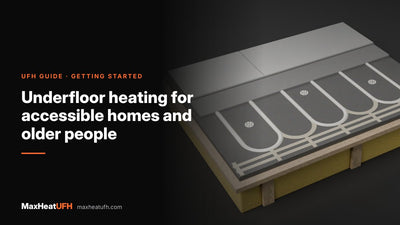
Underfloor heating with an oil or LPG boiler
How to run underfloor heating from an oil or LPG boiler: blending valve pump packs, minimum return and flow rules, condensing, who can do the work, planning for a heat pump and the grants for homes moving off oil or LPG.
Short answer: Yes, underfloor heating works well with an oil or LPG boiler. Run the boiler at its normal temperature and fit a blending valve pump pack at the UFH manifold to bring the water down to floor temperature, 55°C or less. Keep the boiler's own minimum return temperature and minimum flow rate, which oil boilers in particular can specify. Oil work must be done by an OFTEC-registered technician and LPG work by a Gas Safe engineer.
Around rural Britain, many homes have no mains gas and heat with oil or LPG instead. Adding underfloor heating (UFH) to one of these homes is no different in principle from a gas boiler: the floor needs cooler water than the boiler makes, so something has to mix it down. What changes is the detail in the boiler's manual, the people allowed to work on it, and the bigger question of whether you will switch to a heat pump in future.
This guide covers connecting UFH to an oil or LPG boiler, the boiler settings that matter, how to plan the floor so it suits a heat pump later, and the grants for homes moving off oil or LPG. For the gas boiler version, see our guide to underfloor heating with a boiler.
Can I run underfloor heating from an oil boiler?
Yes. A condensing oil boiler can supply UFH through a blending valve, in the same way as a gas boiler. One manufacturer's oil boiler manual, for example, gives typical design figures for both kinds of emitter:
| Emitter | Flow | Return | Difference |
|---|---|---|---|
| Radiators | 70°C | 50°C | 20°C |
| Underfloor heating | 50°C | 40°C | 10°C |
The same manual sets limits you need to respect. The boiler thermostat runs from 50 to 75°C, so the boiler cannot be turned down to a typical floor temperature on its own. It also says the return to the boiler must be kept at or above 40°C once the system is up to temperature, to prevent internal corrosion. That is why the floor should have its own pump and blending valve rather than taking boiler water straight through the loops.
Check your own boiler's manual. Figures differ between makes and models, and the manual is what the installer must follow.
How do I connect UFH to an oil or LPG boiler?
Treat the floor as its own heating zone with a pump and blending valve at the manifold. The usual layout is:
- Zone the UFH. On a system boiler with a cylinder, fit a 2-port zone valve on the UFH primary, as in an S-plan. Our Heatmiser UH4 and UH8 wiring guide covers the wiring centre.
- Run copper from the boiler. One manufacturer requires at least the first metre of flow and return at the boiler in copper, and allows plastic pipe for UFH only after the thermostatic mixing valve.
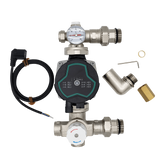
- Fit a blending valve pump pack at the manifold. Our blending valve pump pack holds the floor at a set 20 to 55°C.
- Respect the boiler's minimum flow. One manufacturer lists minimum flow rates for each model, from 1,100 litres per hour at a 20°C drop on its smallest boiler house model. If zones can shut down far enough to go below that, the system needs a bypass or a low loss header, as the boiler maker specifies.
- Wire a boiler interlock. The UFH wiring centre calls the boiler only when a room needs heat, and the boiler and pump switch off when nothing calls.
The same layout works with an LPG system or combi boiler. With an oil or LPG combi, the floor connects to the heating flow and return through the blending pack, like a gas combi. See our guide to connecting UFH to a combi boiler.
Will my oil or LPG boiler still condense with UFH?
It can, if the return water is cool enough. Condensing boilers recover extra heat from the flue gases only when the return water is below about 55°C. One manufacturer's manual gives the same 55°C figure for its condensing oil boilers.
A blending valve pack sends only a small flow of hot primary water into the floor and returns cooler water to the boiler. That helps keep the boiler return low. Two things push it back up:
- A bypass that is open too far, sending hot flow straight back to the boiler.
- A low loss header with more flow on the boiler side than on the heating side.
Balance the pumps and set any bypass to the boiler maker's figure. Then check flow and return temperatures at the boiler with the floor running. Part L also expects a full new or replacement heating system to be sized to run at a maximum flow temperature of 55°C, which UFH meets comfortably.
Who can install and connect an oil or LPG boiler?
For oil, use an OFTEC-registered technician. OFTEC says its registered installers in England and Wales can self-certify that their work meets Building Regulations, so there is no separate building control notice for the boiler. For LPG, the engineer must be on the Gas Safe Register, just as for mains gas.
You or your plumber can lay the floor, fit the manifold and pressure test the loops, then hand over to the boiler engineer for the final connection and commissioning. Electrical work on wiring centres and zone valves should be done by a qualified electrician. MaxHeatUFH does not install, but we can pass your project to a vetted approved installer through our installation enquiry.
Should I plan the floor for a heat pump later?
Yes, if you might replace the oil or LPG boiler with a heat pump while the floor is still in service. The floor is buried for decades, while boilers are replaced. Designing it for a lower flow temperature now costs little more and avoids lifting the floor later.
- Design for a low flow temperature. Use closer pipe centres in high heat loss rooms so the floor can heat the room at a low flow temperature.
- Insulate under the floor well. Better insulation sends more heat up and less into the ground.
- Use oxygen-barrier pipe, such as our PERT-EVOH pipe, so the heat pump's metal parts are protected.
- Size the manifold primaries for a heat pump. Heat pumps need much more flow than boilers, because they run a smaller temperature drop.
When the boiler goes, the blending valve pack is swapped for a non-mixing pump set, or removed if the heat pump's own pump can carry the floor. Our heat pump ready UFH checklist covers each point.
What grants are there for moving off oil or LPG?
The Boiler Upgrade Scheme in England and Wales pays £7500 towards an air source or ground source heat pump. Until March 2027 there is an extra £1500 if the property is heated by oil or LPG and has no mains gas connection. Hybrid systems, such as a boiler working with a heat pump, are not eligible. The grant is for the heat pump, installed by an MCS-certified installer, not for the underfloor heating itself.
On VAT: from 1 May 2023 to 31 March 2027, installing qualifying energy-saving materials, including heat pumps, is zero-rated, but only when the installer supplies and installs them. HMRC is clear that supply-only goods are standard-rated. MaxHeatUFH supplies kit only, so every product we sell, including UFH, carries 20% VAT. From 1 April 2027 the relief drops back to 5%.
Running costs are harder to compare. Heating oil is not covered by the Ofgem price cap, so its price moves with the market. For comparison, the October 2026 price cap for electricity is 26.32p per kWh (GB average, direct debit), which is what a heat pump on a standard tariff would pay.
Design your UFH system yourself in 3 minutes with MaxHeatUFH ProLoop and get an instant quick design and quote. Start your design
Frequently asked questions
Does underfloor heating work with an oil boiler?
Yes. Run the boiler at its normal temperature and fit a blending valve pump pack at the manifold to give the floor the lower temperature it needs.
Can I turn my oil boiler down to underfloor heating temperature instead?
Usually not. One manufacturer's oil boiler thermostat, for example, starts at 50°C, and the boiler has a minimum return temperature of 40°C. A blending valve at the manifold is the reliable way to control the floor.
Is LPG underfloor heating the same as gas?
The UFH side is the same. The boiler runs on LPG instead of mains gas, and it still needs a Gas Safe engineer for any work on it.
Do I need an OFTEC engineer to connect UFH to an oil boiler?
Any work on the oil boiler itself should be done by an OFTEC-registered technician. The floor, manifold and pump pack can be fitted by a plumber, with the boiler connection left to the OFTEC engineer.
Can I get a grant for underfloor heating with an oil boiler?
Not for the UFH itself. The Boiler Upgrade Scheme pays towards a heat pump, with an extra £1500 for oil or LPG homes with no mains gas until March 2027.
Will UFH make my oil boiler more efficient?
It can help a condensing boiler condense, because the floor returns cooler water. Keep bypasses and headers set correctly so hot water does not go straight back to the boiler.
Should I put in UFH now if I plan a heat pump later?
Yes, if you design it for a low flow temperature now. The floor stays, and only the pump pack at the manifold changes when the heat pump goes in.
Sources: OFTEC: why choose a registered competent person, BEAMA Part L heating controls guidance, GOV.UK Boiler Upgrade Scheme: what you can get, HMRC VAT Notice 708/6, Ofgem energy price cap
Products in this guide
Watch how each part works and how to fit it, and download its data sheet and install manual.


Every data sheet and manual: Product Library · All videos: MaxHeatUFH on YouTube

Design it in MaxHeatUFH ProLoop
Add your rooms, choose screed, overlay, joisted or electric, and get a free quick design and full kit list with prices.