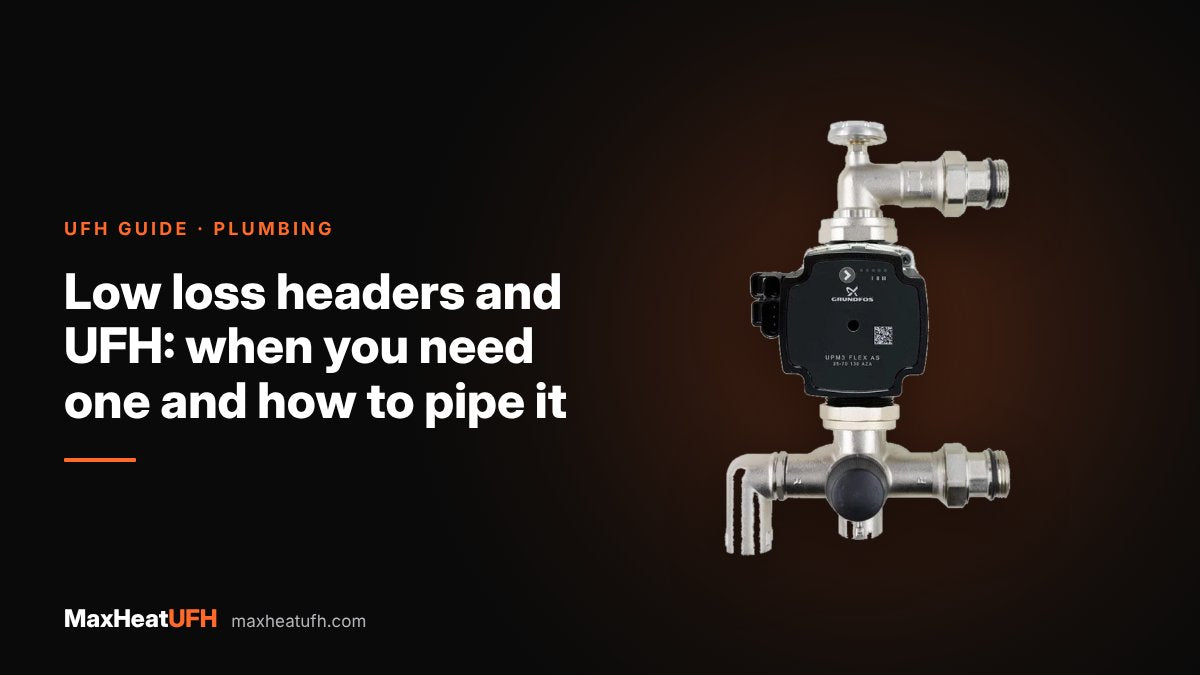
Low loss headers and UFH: when you need one and how to pipe it
When underfloor heating needs a low loss header or hydraulic separator, when closely spaced tees will do, how the flows on each side change your temperatures, and how to pipe one.
Short answer: You need a low loss header when two or more pumped circuits, such as a boiler's own pump and a UFH pump pack, would otherwise fight each other, or when the boiler needs a set minimum flow that the heating side cannot always give. It hydraulically separates the boiler side from the heating side. A single UFH manifold with its own injection or blending pump pack on a simple boiler often does not need one, and on a heat pump a header can cut efficiency because it mixes flow and return water.
A low loss header, also called a hydraulic separator or neutraliser, is a short, wide vertical pipe with two connections on the boiler side and two on the heating side. Because it has almost no resistance, the pumps on each side can run without pushing or pulling against each other. Most also vent air from the top and collect dirt at the bottom.
This guide explains when underfloor heating (UFH) needs a header, when closely spaced tees will do the same job, how the flows on each side change your temperatures, and how to pipe one. It is written for installers and confident self-builders. Boiler work must be done by a Gas Safe engineer, or an OFTEC-registered technician for oil.
What does a low loss header actually do?
It lets the boiler circuit and the heating circuit each run at their own flow rate without affecting each other. One boiler maker's technical bulletin on UFH notes that when two heating circuits are connected directly, each can change the other's flow, which can cause noise, wasted energy and heating where it is not wanted.
Because the header is open between the two sides, water can pass across it in either direction. What happens to your temperatures depends on which side is pumping more. One header maker's instructions set out the three cases:
| Flow condition | What happens in the header | Result |
|---|---|---|
| Boiler flow = heating flow | No mixing | Heating gets boiler temperature; boiler gets true return |
| Boiler flow > heating flow | Some hot flow drops straight to the return | Return to the boiler is warmer |
| Boiler flow < heating flow | Some cool return is drawn into the flow | Heating gets a lower flow temperature |
The second case is the one to avoid with a condensing boiler. A condensing boiler only recovers latent heat from its flue gases when the return water is cooler than about 55°C. A header that sends hot water straight back to the boiler keeps the return high and the boiler out of condensing mode. Hydraulic design guidance makes the same point: where the boiler side runs a constant flow and the heating side varies, the primary return ends up much hotter and efficiency falls.
When does underfloor heating need a low loss header?
Use a header when the hydraulics need separating, not by default. The usual reasons are:
- Several pumped circuits off one boiler. For example a radiator circuit with its own pump, one or more UFH manifolds with pump packs, and a cylinder.
- A boiler with a minimum flow rate. Some boilers must always see a set flow. One manufacturer's oil boiler manual, for example, lists minimum flows from 1,100 litres per hour at a 20°C drop for its smallest model. A header makes sure that flow is there even when most zones are shut.
- Long or undersized existing primaries where the boiler pump cannot also push water round the UFH loops.
- Larger or commercial systems, including boilers in cascade.
You are less likely to need one when a single UFH manifold is fed from a system boiler through a zone valve. One boiler maker notes that most modern UFH manifold pump packs use an injection control valve, which usually separates the floor from the primary circuit already. If your pack uses a thermostatic mixing valve, check its instructions; separation may still be needed.
Can I use closely spaced tees instead?
Yes, on many domestic jobs. Two tees close together on the primary pipe give the same separation as a header, using standard fittings. One boiler maker's bulletin sets out the method:
- Fit the two tees 150mm apart on the primary flow, with the UFH flow taken off the first and the UFH return joining at the second.
- Upsize the pipe between the tees by one size to keep the pressure loss low.
- Give straight runs either side. Fit straight pipe of at least 8 times the primary pipe diameter upstream and downstream of the tees.
- Keep a path for the boiler. The bulletin uses a spring-return motorised valve so primary water can still circulate when only the floor is calling.
Closely spaced tees are cheaper and take less room than a header, but they do not vent air or collect dirt. Fit a magnetic filter on the boiler return if the system has none. Use copper press tees or soldered fittings in the boiler area.
How does the flow on each side affect my UFH?
Match the flows as closely as you can, so very little water crosses the header. You can estimate each flow from the heat load and the temperature drop:
Flow (litres per second) = load (kW) ÷ (4.18 × temperature drop)
| Circuit | Load | Temperature drop | Flow |
|---|---|---|---|
| Boiler side | 12kW | 20°C | 8.6 litres/min |
| UFH manifold, no blending | 6kW | 7°C | 12.3 litres/min |
| UFH manifold, with blending pack | 6kW | 20°C on primary | 4.3 litres/min |
The middle row shows the trap. A manifold pumped straight off a header at a small temperature drop wants more flow than a boiler running a 20°C drop sends. The header makes up the difference with return water, so the floor gets an uncontrolled lower flow temperature. That is why boiler-fed UFH normally uses a blending valve pump pack, which takes a small, hot primary flow and mixes it down to a set 20 to 55°C at the manifold. Our guide to mixing and blending valves explains how they work.
Should I use a low loss header with a heat pump?
Usually not, unless the heat pump maker or the system design calls for one. A heat pump is most efficient at the lowest flow temperature that heats the house. Any point where flow and return mix forces it to make hotter water than the floor actually receives.
A header on a heat pump behaves just like a four-pipe buffer tank, without the extra volume. Where a heat pump needs separation, for instance with radiators and UFH on separate pumps, the designer may choose a buffer, a header or a different layout. Where the problem is only too little water, a volumiser is normally better. For most single-temperature UFH systems the heat pump's own pump runs straight through the manifold, or through a non-mixing pump set.
How do I pipe a low loss header?
Mount it upright, with the boiler on one side and the heating circuits on the other, flows at the top and returns at the bottom.
- Size it on the bigger flow. One manufacturer sizes its separators on the highest flow rate of either side. Check the maker's table; domestic headers are rarely too small.
- Mount it vertically. One header maker's instructions show the header fitted upright, directly on the system pipes.
- Connect the boiler side. Boiler flow into the upper connection, boiler return from the lower one, with the boiler or primary pump on this side.
- Connect the heating side. Each circuit, including the UFH pump pack, takes its flow from the top of the header and returns to the bottom, with its own pump.
- Fit an air vent at the top and a drain at the bottom. The top vent lets out air, and dirt collected at the bottom is flushed out through the drain.
- Insulate it. The header carries boiler flow temperature.
- Wire the pumps to run on demand. Each secondary pump runs only when its zone calls, and the boiler and its pump run when any zone calls.
Size the primary pipes between the boiler and header on the boiler flow, and between the header and manifold on the manifold flow. Our guide to UFH manifold primary pipe size gives the capacities of 22mm and 28mm pipe.
Design your UFH system yourself in 3 minutes with MaxHeatUFH ProLoop and get an instant quick design and quote. Start your design
Frequently asked questions
Is a low loss header the same as a hydraulic separator?
Yes. Low loss header, hydraulic separator and neutraliser are names for the same idea: a low-resistance section that lets the boiler and heating circuits run at their own flow rates.
Do I need a low loss header for one UFH manifold?
Often not. A single manifold with an injection-type pump pack on a zone valve usually works without one. You are more likely to need one with several pumped circuits or a boiler with a minimum flow rate.
Does a low loss header stop a boiler condensing?
It can if the boiler side pumps more than the heating side, because hot flow passes straight back into the return. Keep the flows matched and the return below about 55°C.
Can I use closely spaced tees instead of a low loss header?
On many domestic systems, yes. One boiler maker's method uses tees 150mm apart, one pipe size up between them, with straight pipe of 8 diameters either side.
Which way up does a low loss header go?
Vertically, with flows at the top, returns at the bottom, an air vent on top and a drain at the base.
Should a heat pump have a low loss header?
Only if the design needs separation. It mixes flow and return water, which makes the heat pump run hotter than the floor needs.
Do I still need a blending valve with a low loss header?
Yes, on a boiler. The header separates the flows but does not control temperature. The floor still needs a blending valve to keep its flow at 55°C or less.
Sources: Energy Saving Trust installer toolkit (flow formula)
Products in this guide
Watch how each part works and how to fit it, and download its data sheet and install manual.


Every data sheet and manual: Product Library · All videos: MaxHeatUFH on YouTube
Design it in MaxHeatUFH ProLoop
Add your rooms, choose screed, overlay, joisted or electric, and get a free quick design and full kit list with prices.