








Heatmiser wiring centre wiring guide: UH4 and UH8 explained
A terminal-by-terminal guide to wiring the Heatmiser UH4 and UH8 underfloor heating wiring centres, including the volt-free boiler interlock, pump output, radiator zone switch, hot water and load limits.
Short answer: A Heatmiser UH4 or UH8 takes a 230V supply fused at 5A, one 230V thermostat per zone, and the 230V thermal actuators for that zone. When any underfloor zone calls, it powers that zone's actuators, sends 230V to the manifold pump output and closes a volt-free heat enable contact (LS to LR) that tells the boiler or heat pump to run. The UH4 has 4 heating zones and the UH8 has 8, and both have one hot water zone. Each relay is rated 3A and the whole board 5A, and Heatmiser says to connect no more than 4 actuators to one zone.
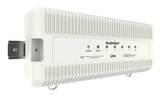
The UH4 and UH8 are the two 230V wiring centres most UK underfloor heating jobs use. They sit next to the manifold and act as a junction box with some logic. Thermostats tell them which rooms want heat, and they switch the actuators, the pump and the heat source in the right order. Get the wiring right and the system runs for years without a thought. Get it wrong and you get a pump running all night, a boiler that never fires or a blown fuse.
This guide goes terminal by terminal through both boards, using Heatmiser's own manuals and datasheets, and covers the limits that catch people out. For how a whole system is zoned, see UFH zoning and wiring centres. All mains wiring should be done by a qualified, registered electrician, as Heatmiser's manuals state.
What is the difference between the UH4 and the UH8?
The UH8 has 8 heating zones and the UH4 has 4. Otherwise the two boards share the same ratings, size and basic layout, so the choice comes down to how many thermostats you have.
| Specification | UH4 | UH8 |
|---|---|---|
| Heating zones | 4 | 8 |
| Hot water zones | 1 | 1 |
| Supply | 230V AC, 50Hz, fused at 5A | 230V AC, 50Hz, fused at 5A |
| Relay load | 3A resistive max | 3A resistive max |
| Total load | 5A resistive max | 5A resistive max |
| Radiator zone switch | Zone 4 (YES/NO) | Zone 8 (UFH/RAD) |
| Size | 384 x 148 x 60mm | 384 x 148 x 60mm |
| Mounting | Wall or DIN rail, IP20 | Wall or DIN rail, IP20 |
If you have 4 rooms now but might add a conservatory or split a room later, the UH8 costs a little more and leaves room to grow. The UH4 suits a single floor or extension. The UH8 suits most whole ground floors.
Both boards work with Heatmiser 230V mains thermostats. The UH8 manual names the neoStat, Edge and Slimline types. Battery thermostats need the UH8-RF and 12V network thermostats need the UH8-N, covered further down.
What does each terminal on a UH8 do?
Each terminal group does one job: mains in, thermostat in, actuators out, pump out, and a volt-free contact to the heat source. Here is the layout from the UH8 manual.
| Terminal group | Terminals | What it does |
|---|---|---|
| Mains | L, N, E | 230V supply, fused at 5A |
| Thermostat (per zone) | L, 1, 2, E, N, S/L | L and N power the thermostat. S/L is the switched live back from the thermostat, which turns the zone on. 1 and 2 carry timed signals from a time clock. |
| Zone output (per zone) | L, N | 230V to the actuators or valve for that zone. Duplicate L and N terminals are linked internally. |
| Heat enable | LS, E, LR | Volt-free switch. The supply on LS is passed to LR when there is a call for heat. |
| UFH pump | L, E, N | 230V to the manifold pump when an underfloor zone calls |
| UFH valve | L, E, N, Gr, Or | 230V to a manifold valve, with Gr and Or for the valve's auxiliary end switch |
| Time clock | L, E, N, 1, 2 | Switch live inputs that trigger time clock channel 1 or 2 on the thermostat terminals |
The UH8 wiring diagrams use 1.5mm² three core and earth cable and 1.5mm² four core and earth cable. Check the thermostat manual for which cores it needs. A programmable 230V thermostat such as the neoStat V3 has L and N terminals to power it, as well as its switching terminals.
The UH4 datasheet shows the same functions: mains, a terminal set for each thermostat, L and N zone outputs, the LS and LR heat enable, a manifold pump or valve output, and a hot water output with GR and OR terminals. Check the printed labels on the board you have in front of you, because the layout differs slightly between versions.
How do I wire a UH4 or UH8 to a boiler or heat pump?
Connect the heat source's call-for-heat circuit across LS and LR. That contact is volt-free, so it carries whatever the boiler or heat pump puts on it and nothing from the wiring centre itself.
- Find the heat source's demand terminals. Most boilers and heat pumps have a pair of terminals for an external room thermostat or a switched live input. The boiler or heat pump manual says which, and whether it expects 230V or a low-voltage volt-free contact.
- Run a cable from those terminals to LS and LR. The supply from the boiler goes to LS. The return to the boiler goes to LR. Earth goes to E.
- Remove any existing link only if the manual says so. Many boilers come with a link across the thermostat terminals. It usually comes out when an external control is connected.
- Test it. Turn one thermostat up. The zone output should go live, the pump output should go live and the boiler should start. Turn it down and all three should stop.
This wiring is what gives you boiler interlock. BEAMA's underfloor heating controls guide says that when there is no demand for heat, the heat source and the circulating pump should be switched off, and it does this by switching the boiler through the main wiring centre. Without it, the boiler or heat pump keeps firing to a manifold with every actuator shut.
On a system with radiators and underfloor heating on separate zone valves, the heat enable may instead feed a zone valve, whose end switch then fires the boiler. Our guide to underfloor heating with a boiler explains that circuit.
How should the UFH pump output be wired?
Wire the manifold pump from the UFH pump output, and put a high limit thermostat in the live feed. Heatmiser's manuals recommend wiring the pump through a high limit switch on the manifold to protect against a failure of the manifold's temperature control.
The pump output only goes live when an underfloor zone calls. A radiator zone on the switched zone does not start it (see the next section). This keeps the pump off when only radiators or hot water are calling.
The high limit matters most with a boiler. BEAMA says that if the heat source can produce water above 60°C, a high limit thermostat must stop water above 60°C entering the loops. If the blending valve sticks open, the high limit cuts the pump and the hot water stops circulating through the floor. Our guide to UFH mixing and blending valves covers where the high limit sits.
If you fit a motorised valve on the manifold instead of, or as well as, a pump, it goes on the UFH valve terminals. Its end switch wires go to Gr and Or. The manual says to link Gr and Or if the valve has no end switch.
What are the radiator zone switch and hot water output for?
It lets you use the last zone for a radiator circuit. On the UH8 it is a UFH/RAD switch on zone 8. On the UH4 it is a YES/NO switch on zone 4.
- UH8 set to RAD (UH4 set to NO): a call on that zone drives a radiator zone valve and the boiler, but not the UFH pump or valve output.
- UH8 set to UFH (UH4 set to YES): the zone works like every other zone and also starts the pump and valve outputs.
Leave it on UFH (or YES) unless that zone really is radiators. If you set it to RAD by mistake on an underfloor room, the actuators will open when the room calls but the manifold pump will not run, so that room never gets warm while it is the only one calling.
The hot water output works the same way for a cylinder zone valve, with its end switch on Gr and Or. The UH4 datasheet says the hot water valve live feed must go through the cylinder high limit thermostat.
Valves that need a closing signal, such as mid-position valves, need a separate changeover relay. The zone outputs only give a live when calling. They have no "off" live.
How many actuators can I put on one zone?
Heatmiser's FAQ says you can connect up to 4 actuators to one zone, and that the total load on the wiring centre must stay under 5A. The 3A relay rating per zone and the 5A board rating are both resistive loads.
Thermal actuators draw more current for a moment when they start than when they are holding open. One maker's 230V actuator quotes 1W in operation but up to 550mA for the first 100ms. When several zones call at once, those start-up surges add up, which is one more reason to stay well inside the limits.
What about the UH8-RF and UH8-N?
They are the same idea for different thermostats. The UH8-RF receives radio signals from battery thermostats. The UH8-N runs 12V network thermostats on data cable.
| Board | Thermostats | Key differences |
|---|---|---|
| UH8 | 230V mains | 1 fuse (5A anti-surge), volt-free LS/LR heat enable |
| UH8-RF | Wireless battery | Changeover boiler and hot water contacts (C, NO, NC), 3 fuses, 2-minute pump delay and daily pump exercise via DIP switches, channel set 01 to 99 |
| UH8-N | 12V network (neoStat 12V) | Thermostats on shielded 8-core data cable or shielded CAT-5E, shield earthed at the board, 230V actuators as normal |
On the UH8-RF, the manual says to mount it close to the equipment but never inside a metal enclosure. If that cannot be avoided, fit the EA1 extension antenna outside the box. The boiler output can also send a radio signal to an RF-Switch next to the boiler, so you need no cable between the manifold and the boiler. Our guide to UFH thermostats explained compares wired, wireless and smart options.
What are the most common UH4 and UH8 wiring mistakes?
- Wiring LS/LR without reading the boiler manual. The contact is volt-free, so it simply carries what the boiler puts on it. Some boilers use a 230V switched live, others a low-voltage contact, and the two are wired differently.
- No high limit on the pump. Heatmiser recommends one. With a boiler, a stuck blending valve can send very hot water into the floor.
- Last zone left on RAD. The room calls, actuators open, but the pump never runs.
- Valve with no end switch and no Gr-Or link. The output never completes.
If a zone or the whole board stops working, our actuator and wiring centre fault guide goes through the checks, starting with the 5A fuse.
Design your UFH system yourself in 3 minutes with MaxHeatUFH ProLoop and get an instant quick design and quote. Start your design
Frequently asked questions
Is the boiler connection on a Heatmiser UH8 live or volt-free?
Volt-free. The heat enable terminals LS and LR are a switch: the supply you bring to LS is passed to LR when any zone calls for heat. The UH8-RF uses changeover contacts marked C, NO and NC instead, and most systems use C and NO.
What fuse does a UH8 wiring centre need?
The supply should be fused at 5A. On the board, a 5A 20mm anti-surge fuse protects all the 230V outputs. The UH8-RF has three fuses: 800mA for the electronics, 5A for the outputs and 2A for the pump and valve outputs.
How many actuators can I connect to one zone on a UH8?
Heatmiser's FAQ says up to 4 actuators per zone, as long as the total load on the wiring centre stays under 5A.
Can I use a UH4 or UH8 with a heat pump?
Yes. Wire the heat pump's demand input across the volt-free LS and LR contacts, as you would a boiler. Check the heat pump manual for which terminals it uses and whether it needs a volt-free contact.
Why does my UFH pump not run when one room calls?
Check the radiator zone switch. If zone 8 on a UH8 is set to RAD, or zone 4 on a UH4 is set to NO, that zone opens its valve and fires the boiler but does not start the pump. Also check the high limit thermostat in the pump feed has not tripped.
Sources: Heatmiser UH8 manual, Heatmiser UH8-RF manual, Heatmiser UH8-N manual, Heatmiser FAQ: actuators per zone, BEAMA underfloor heating controls guide
Products in this guide
Watch how each part works and how to fit it, and download its data sheet and install manual.



Every data sheet and manual: Product Library · All videos: MaxHeatUFH on YouTube

Design it in MaxHeatUFH ProLoop
Add your rooms, choose screed, overlay, joisted or electric, and get a free quick design and full kit list with prices.


