








Electric underfloor heating under large format tiles and porcelain
How to lay large format porcelain and stone over an electric heating mat: levelling the base, solid-bed C1S1 adhesive and back-buttering, movement joints, decoupling membranes and the gradual first warm-up.
Short answer: Yes, you can lay large format porcelain and stone over electric underfloor heating, and heated floors are one of the main places they are used. Large format means a tile with an edge of 600mm or more, and the job turns on three things: a dead-flat base, a solid adhesive bed with no voids under the tile, and movement joints in the right places. Use a flexible cement-based adhesive, keep the floor below 15°C while tiling, and bring the finished floor up to temperature gradually. A qualified electrician must make the final connection of the heating under Part P of the Building Regulations and BS 7671.
Large format tiles and underfloor heating suit each other. A big porcelain tile conducts heat well, has few grout lines to interrupt the warm surface, and the slight extra thickness simply means the floor holds its warmth a little longer. MaxHeatUFH electric mats are made for tile and stone floors, so a 600mm, 900mm or 1200mm porcelain floor over a heating mat is a standard build-up, not a special case.
What changes with size is the margin for error. A 300mm tile will bridge a small hollow; a 1200mm tile will rock on it, and a void under a heated tile is both a weak point and a cold spot. This guide covers the base, the adhesive, the joints and the heating rules that make a large format heated floor behave. For the general method, start with tiling over underfloor heating.
What counts as a large format tile?
Tiling-industry guidance treats a floor tile with a minimum edge length of 600mm as large format. In practice the label covers everything from 600 x 600mm porcelain up to 1200mm and longer plank and slab formats.
Size changes the job in three ways. The tile is heavier and harder to bed without voids. The tile spans further, so flatness of the base matters much more. And each tile covers more of the heated floor, so a poorly bedded one shows up as a noticeably cooler patch. None of that argues against large format over heating; it argues for preparation.
How flat does the floor need to be before tiling?
Flatter than for any small tile, and flat before the adhesive bed, not corrected within it. The practical sequence over an electric mat is:
- Sound, rigid subfloor. Concrete, screed or a properly stiffened timber deck. Tiling guidance for heated floors says timber bases should carry a tile backer board or a suitable decoupling layer before tiling; a 6mm cementitious backer board does that job and stiffens the deck.
- Prime the base with a suitable primer such as Ultra Prime IT so the levelling layer bonds.
- Fix the mat and probe, and test. Record continuity and insulation readings before anything covers the cable.
- Level over the mat. A self-levelling compound over the cables gives large format tiles the flat, continuous base they need and protects the cable from the tiling that follows. Our guide to adhesive, levelling compound and decoupling for electric UFH covers compound choice and depths, and the adhesives and primers collection has the primer to use first.
Check the levelled floor with a long straight edge before tiling. Any hollow you can see under the straight edge now is a rocking slab later.
Which adhesive should you use over heating?
A flexible, polymer-modified, cement-based adhesive. Tiling-industry guidance for underfloor heating specifies a cement-based adhesive to BS EN 12004 with a minimum C1S1 classification, used to the manufacturer's instructions; the S1 deformability is what absorbs the small thermal movements of a heated floor. Ready-mixed paste adhesives are not for this job. Two refinements for large format:
- Solid bed, no voids. The guidance for heated floors is to trowel adhesive onto the substrate and back-butter the tile so there is full contact. For large format floor tiles it notes a pourable thick-bed adhesive can help achieve a solid bed. Every void is a weak point over a heated cable.
- Light natural stone. For light or translucent marble, use a white rapid-setting C2FT-S1 adhesive rather than a grey cement one, to avoid discolouration.
Grout matters too: the same guidance recommends a polymer-modified cement grout meeting BS EN 13888-1 Class 2 (CG2WA) over heated floors.
Where do movement joints go in a heated tiled floor?
A heated floor expands and contracts with every heating cycle, and large rigid tiles transmit that movement, so the joints are not optional. From tiling-industry guidance for floors over underfloor heating:
- Perimeter joint. Leave a gap of more than 6mm around the edge of the field, carried through tile and bed, so the floor can move against the walls. Skirting or trim hides it.
- Intermediate joints. Provide movement joints at up to 5m centres in each direction across larger floors.
- Existing floor joints. The heating cable itself must not cross an expansion joint in the structure, a requirement of BS 7671 Section 753, and the tile field should respect the same lines.
A decoupling membrane between the levelled, heated base and the tiles adds insurance on large format work: it absorbs lateral movement and temperature-driven stress between the base and the tile, and it is used with a flexible S1 adhesive. Our uncoupling membrane for electric UFH is made for exactly this build-up. On a floor with a history of movement, or stone over timber, it earns its place.
Can the heating be on while you tile?
No. Tiling-industry guidance says the floor temperature should not exceed 15°C before and during tiling, so switch the system off in good time. After tiling, two waiting rules protect the new floor:
- Full drying first. Do not switch on until the adhesive and grout have completely dried, to the adhesive manufacturer's stated times. Mat manufacturers say the same in their installation guides.
- Gradual first warm-up. Raise the temperature step by step over 10 to 14 days to the normal operating level, so the new tile bed is not thermally shocked. The floor probe's limit setting is your safety net throughout.
Thicker large format tiles also change the feel of the floor slightly: they take a little longer to warm through and stay warm longer after the heating switches off, a point worth knowing before you judge the system on its first evening.
Does large format change the heating system itself?
Barely, which is the good news. The mat choice follows the room, not the tile: a 150W/m² mat suits most rooms, with 200W/m² for high heat loss spaces such as conservatories. The tile's job is conduction, and porcelain and stone do it well whatever their size.
Three system points to get right on a large format job:
- Floor probe in conduit, between cable runs, with the end sealed against the levelling compound and adhesive, so it can be replaced without lifting a 1200mm tile.
- Test at every stage. Continuity and insulation readings before laying, after levelling, after adhesive and before grouting. A damaged cable found under a large tile is an expensive discovery.
- Electrician for the connection. A qualified electrician must make the final connection, provide 30mA RCD protection and certify the work under Part P of the Building Regulations and BS 7671.
Free design tool: laying large format over water underfloor heating in the rest of the build? Design your UFH system yourself in 3 minutes with MaxHeatUFH ProLoop and get an instant quick design and quote. Start your design
Frequently asked questions
Can you put large format tiles over electric underfloor heating?
Yes. Porcelain and stone conduct heat well at any size. The requirements are a flat, levelled base over the mat, a solid adhesive bed with no voids, a flexible C1S1 or better cement adhesive and correct movement joints.
What size is a large format tile?
Industry guidance treats floor tiles with an edge of 600mm or more as large format, which covers 600 x 600mm squares up to 1200mm planks and slabs.
Do I need to self-level over the heating mat before large tiles?
It is the reliable way to do it. Levelling over the mat gives a flat continuous base, protects the cable, and removes the temptation to build up adhesive thickness under a big tile to correct the floor.
What adhesive do I need for porcelain over underfloor heating?
A cement-based adhesive to BS EN 12004, minimum class C1S1, applied as a solid bed with back-buttering; a pourable thick-bed adhesive helps on large formats. Use white rapid-set C2FT-S1 under light marble.
Do large tiles need bigger movement joints?
The joints are about the floor, not the tile: a perimeter gap over 6mm and intermediate joints at up to 5m centres over heated floors. Large tiles just make it more important that the joints are actually there, because the field is stiffer.
Will big tiles make the floor slower to warm up?
Slightly. Thicker, denser tiles take longer to heat through and hold heat longer afterwards. On an insulated base the difference is minutes.
Can I lay 20mm porcelain slabs over an electric mat?
Thick porcelain can be laid over heating with the same rules: solid bed, flexible adhesive, joints, gradual first warm-up. Expect a slower response than standard 9 to 10mm porcelain, and confirm your adhesive manufacturer supports the tile over a heated base.
Sources: Tile & Stone Journal: tile adhesives with underfloor heating, IET Wiring Matters: floor and ceiling heating systems (BS 7671 Section 753)
Products in this guide
Watch how each part works and how to fit it, and download its data sheet and install manual.
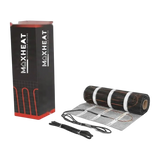


Every data sheet and manual: Product Library · All videos: MaxHeatUFH on YouTube

Design it in MaxHeatUFH ProLoop
Add your rooms, choose screed, overlay, joisted or electric, and get a free quick design and full kit list with prices.


