



Adhesive, levelling compound and decoupling membranes for electric underfloor heating
Which flexible adhesive to use over electric underfloor heating, how much adhesive and levelling compound to buy, when you need a decoupling membrane, how to prepare timber floors and when to switch on.
Short answer: Bed an electric heating mat or cable in a flexible cement-based tile adhesive, or cover it with a levelling compound rated for underfloor heating, so the cable is fully embedded. One supplier's rule of thumb is 1.8kg of adhesive per mm of depth per m². That gives about 15kg/m² for an 8.5mm build-up of board bed, cable layer and tile bed. A levelling compound uses about 1.7kg of powder per m² for each mm. Use a decoupling membrane over timber, fresh screed or mixed subfloors to stop movement cracking the tiles. It does not fix a bouncy floor, so stiffen the floor first.
An electric mat is only 3 to 4mm thick, but what goes around it decides whether the floor lasts. The adhesive or levelling compound protects the cable, spreads its heat and carries the tile. The membrane or board underneath deals with movement and heat loss. Get the layers wrong and you see cracked grout, hollow tiles or a damaged cable.
This guide covers which adhesive to use, how much to buy, when to use levelling compound instead, when you need a decoupling membrane, how to prepare timber floors, and how long to wait before switching on. For the mat install itself, see how to install an electric underfloor heating mat.
What adhesive should I use over electric underfloor heating?
Use a flexible cementitious tile adhesive that its maker says is suitable for underfloor heating. Adhesives are classed under BS EN 12004 by code, and the codes tell you what you are buying.
| Code | Meaning | Where it fits |
|---|---|---|
| C2 | Improved cementitious adhesive, higher bond strength | Porcelain and dense tiles |
| S1 | Deformable, takes small movements | Fixing heating to solid subfloors such as screed and timber |
| S2 | Highly deformable | Compressible surfaces such as insulation boards |
| F, T, E | Fast setting, reduced slip, extended open time | Choose for the job and conditions |
Flexibility matters because a heated floor expands and contracts every time it warms up and cools down. Typical products for this job are C2 S1 flexible adhesives, often sold as C2TE S1 or C2FT S1. An S rating is not a fix for a floor that bends: it measures how much the adhesive can deform, and a soft S2 adhesive can be unsuitable for heavy traffic.
The aim is for the heating cable, its joints and any loose cable to be fully embedded, with no cable showing. The heater makers we checked ask for a full bed of flexible adhesive over the mat, spread with a notched trowel.
How much adhesive do I need for underfloor heating?
Allow for every layer that is bedded in adhesive, not just the tiles. One underfloor heating supplier works on 1.8kg of adhesive per mm of depth per m² and builds up a tiled electric floor like this:
- at least 3mm to bond the insulation or tile backer board to the subfloor
- about 4mm to cover the heating cable
- at least 1.5mm to bed the tile
That is 8.5mm in total, or about 15.3kg/m². Leave out the first layer if you are not fitting boards.
| Area | With board (8.5mm) | No board (5.5mm) |
|---|---|---|
| 4m² | 61kg, 4 × 20kg bags | 40kg, 2 to 3 bags |
| 5m² | 77kg, 4 bags | 50kg, 3 bags |
| 10m² | 153kg, 8 bags | 99kg, 5 bags |
Treat this as an estimate and check the bag. Coverage varies by product and trowel. For example, one tile retailer says a 20kg bag covers roughly 4 to 5m² with a 6mm notch, and 2.5 to 3.5m² with a 10 to 12mm notch. One flexible adhesive maker quotes about 4kg/m² for floor tiles, and another about 4.5kg/m² for a 3mm bed. Add about 10% for waste.
Should I use levelling compound over a heating mat?
Use it when the floor finish is not tile, when the tiles are small, or when you want a flat, protected surface before tiling. It encapsulates the cable in one pour, so you are not trowelling adhesive over bare cable.
- Other floor finishes. Heater makers that allow wood, vinyl, carpet or laminate over a mat ask for a single layer of levelling compound rated for underfloor heating, usually at least 10mm deep. Do not build it up in several layers.
- Small tiles. One heater maker asks for levelling compound first where tiles are smaller than 90mm.
- Minimum cover over cable. One levelling compound maker sets at least 3mm over the cable for stone, ceramic and porcelain, and at least 5mm for timber, vinyl and textile finishes.
How much compound? One two-part compound's datasheet says a 20kg powder unit covers 1.2m² at 10mm, 2.4m² at 5mm or 6m² at 2mm. That is about 1.7kg of powder per m² per mm. For 10m² at 10mm, allow about 167kg, or 9 units. Check your product's figures, because coverage varies between compounds.
Prime first. Levelling compound needs a primed surface. Absorbent subfloors usually take a diluted coat, then a stronger one. Calcium sulphate screeds need their own priming routine. Follow the compound maker's instructions. Our Ultra Prime IT multi-surface primer is made for preparing subfloors before levelling compound or tile adhesive.
Fit a perimeter strip when you pour a self-levelling compound, and use levelling pegs so the depth is right across the floor.
Do I need a decoupling membrane with underfloor heating?
Use one wherever the subfloor can move in a different way to the tiles. A decoupling (uncoupling) membrane sits between the subfloor and the tile bed and stops sideways movement reaching the tiles and grout.
| Subfloor | Decoupling membrane? |
|---|---|
| Timber or plywood, including suspended floors | Yes |
| New screed tiled before it has fully cured | Yes |
| Mixed or uneven subfloors, existing tiles | Yes |
| Areas with vibration | Yes |
| Sound, dry, cured concrete or screed | Not essential, but one industry guide still recommends it |
Know what a membrane does not do. It protects against horizontal movement between subfloor and tile. It does not protect against vertical deflection. A floor that bounces must be stiffened first.
Our uncoupling membrane is fleece-backed. Bed it into flexible tile adhesive, roll it down firmly, then tile on top with flexible adhesive. Each metre of the 1m-wide roll covers 1m². It suits both mats and loose cable, which presses between the studs at the spacing you need. See our guide to loose cable vs mats.
How do I prepare a timber floor for tiles and underfloor heating?
Make it stiff first, then add a board or membrane. Newer British Standard guidance says timber floors should not be tiled directly.
- Check deflection. One industry guide sets a limit of span/360 for ceramic tiles and span/720 for natural stone. Add noggings between joists if needed.
- Overlay the boards. A summary of BS 5385-3 calls for at least 15mm WBP exterior plywood, screwed at 300mm centres or closer, with every board edge over a joist or nogging.
- Seal the plywood. Prime the back, face and edges to limit moisture movement.
- Add a backer board or membrane. A cement-faced board or decoupling membrane goes over the overlay.
- Lay the heater, encapsulate it, tile. Use flexible adhesive throughout and flexible grout.
On a suspended timber floor, insulation under the heater makes a big difference to warm-up and heat loss. Our cement-coated XPS backer board insulates and gives a tile-ready face. The 6mm cementitious backer board gives a solid tiling base where insulation is not needed. Bond boards in flexible adhesive and fix them as the maker says, staggering the joints. Our guide to insulation under underfloor heating covers the options.
What order do the layers go in?
For a typical tiled electric floor, from the bottom up:
- Prepared subfloor: clean, sound, dry and flat. Prime if the adhesive or compound maker asks for it.
- Insulation or backer board, bonded in flexible adhesive and fixed.
- Decoupling membrane, if the subfloor needs one.
- Heating mat or cable, tested before and after laying, with the floor probe between two runs.
- Adhesive bed or levelling compound fully covering the cable.
- Tiles in flexible adhesive, then flexible grout.
Test the heater's resistance and insulation before laying, after laying and after tiling, and record the readings. If something goes wrong later, those numbers help an electrician find the fault. See electric underfloor heating fault finding.
How long before I can switch the underfloor heating on?
Wait until the adhesive, grout and any compound have cured, then warm the floor up slowly. The wait depends on the product, so read the bag.
- One flexible adhesive maker says keep the heating off for 14 days after tiling, then raise the temperature by 5°C a day.
- Another says do not switch on for at least 28 days after tiling on solid floors, then bring it up gradually.
- Levelling compounds are much faster to tile over. One maker allows impervious coverings such as tiles after about 10 hours.
Our guide to commissioning underfloor heating covers first heat-up.
Design your UFH system yourself in 3 minutes with MaxHeatUFH ProLoop and get an instant quick design and quote. Start your design
Products for this job
- Uncoupling / Decoupling Membrane (1m wide roll)
- Ultra Prime IT Multi Surface Primer 5L
- Cement-Coated XPS Tile Backer Board
- 6mm Cementitious Tile Backer Board
- Overlay Panel Washers (pack of 100)
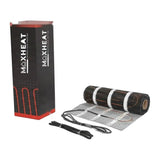
- Electric Underfloor Heating Mat 150W/m²
- All adhesives and primers
Frequently asked questions
Can I use any tile adhesive over a heating mat?
No. Use a flexible cementitious adhesive that its maker says is suitable for underfloor heating, typically classed S1 or S2 under BS EN 12004. Rigid adhesive can crack as the floor heats and cools.
How thick should the adhesive be over the cable?
Thick enough to fully embed the cable with nothing showing. One supplier allows about 4mm for the cable layer plus at least 1.5mm to bed the tile.
How much levelling compound goes over underfloor heating?
For tiles, one compound maker asks for at least 3mm above the cable. For timber, vinyl or carpet, at least 5mm, and heater makers often ask for a single 10mm layer.
Do I need a decoupling membrane on a concrete floor?
On a sound, cured slab it is not essential, though one industry guide recommends one on any subfloor as a precaution. Always use one on new screed that has not fully cured, on mixed subfloors, or over existing tiles.
Does a decoupling membrane stop tiles cracking on a bouncy floor?
No. It handles sideways movement between subfloor and tile. A floor that bends must be stiffened with noggings or an overlay first.
Can I tile directly onto floorboards with underfloor heating?
No. Overlay with at least 15mm plywood screwed at 300mm centres or closer, then add a backer board or decoupling membrane before laying the heater.
When can I turn the heating on after tiling?
Follow the adhesive maker. Typical waits are 14 to 28 days, then raise the temperature a few degrees a day.
Sources: Tile and Stone Journal: guarding against deflection, Stone Specialist: tiles on timber (BS 5385-3)
Products in this guide
Watch how each part works and how to fit it, and download its data sheet and install manual.



Every data sheet and manual: Product Library · All videos: MaxHeatUFH on YouTube

Design it in MaxHeatUFH ProLoop
Add your rooms, choose screed, overlay, joisted or electric, and get a free quick design and full kit list with prices.


