








Underfloor heating in park homes, lodges and annexes
How to add underfloor heating to a chassis-built park home or lodge: electric mats for bathrooms, lightweight low-profile water systems, BS 3632:2023 insulation standards and what changes for annexes on proper foundations.
Short answer: Yes, you can have underfloor heating in a park home, lodge or annexe, as long as the system matches the floor. These buildings sit on a chassis with a suspended timber floor, so heavy wet screed is out: the right choices are electric mats for bathrooms and kitchens, or a lightweight water system in low-profile panels or on spreader plates for whole-home heating. Newer homes built to BS 3632:2023 are insulated for year-round living and suit underfloor heating well; older homes and holiday-standard lodges lose more heat, so insulate first.
Park homes and lodges are factory-built on a steel chassis and craned onto a pitch, with a timber floor suspended over a ventilated void. That construction drives every heating decision: weight matters, floor build-up height matters, and the floor itself is a significant heat-loss surface with cold air moving underneath it.
This guide covers what makes park home floors different, whether electric or water underfloor heating fits better, which low-weight systems to use, and what applies to annexes and garden lodges. MaxHeatUFH supplies the kit UK-wide with next working day delivery on orders by 12pm Monday to Friday; installation is handled by vetted approved installers, and electric systems must have their final connection made by a qualified electrician (Part P / BS 7671). Send an installation enquiry here.
Can you fit underfloor heating in a park home?
Yes, both in new homes at the factory stage and as a retrofit. The constraint is never the heating technology, it is the floor: a suspended timber deck on joists over a chassis, with limited capacity for added weight and height.
That rules out the default approach used in houses, pipe buried in 50mm or more of screed, and points at three workable routes instead:
- Electric mats under tile or suitable floor coverings in bathrooms, en-suites and kitchens.
- Low-profile water systems in routed or castellated panels laid over the deck.
- Joisted water systems with aluminium spreader plates between the joists, where there is access during build or refurbishment.
What is different about a park home floor?
Three things: it is timber, it is suspended over outside air, and it belongs to a building designed to a weight budget. The floor deck sits on joists above the chassis, with a void beneath that is ventilated to the outside. Any heating in that floor should have insulation below it, otherwise part of the heat goes down into the void.
The build standard matters too. Residential park homes are built to BS 3632, the British Standard that sets minimum requirements for thermal insulation, ventilation, stability and room sizes. The current edition is BS 3632:2023, which replaced the 2015 edition (withdrawn in September 2024); manufacturers moved to it from early 2024. The 2023 edition improves floor and wall U-values and adds ventilation and condensation-control requirements, so a new BS 3632 home is genuinely built for year-round living, subject to the site licence. Holiday lodges built to EN 1647 instead are a holiday standard with lighter insulation requirements, so they need a more careful heat loss check before relying on underfloor heating alone.
Should a park home use electric or water underfloor heating?
Electric for rooms, water for whole homes, is the short version.
| Electric mat | Water (low profile) | |
|---|---|---|
| Best for | Bathroom, en-suite, kitchen | Whole home |
| Added height | Minimal | Low, panel plus deck |
| Added weight | Very little | Light, no screed |
| Heat source | Mains electricity | Existing boiler or heat pump |
| Running cost per kWh | 26.32p electricity | 7.97p mains gas, where available |
The running-cost figures are the October 2026 price cap rates. As a worked example at full power, a 150W/m² mat covering 4m² of bathroom floor draws 0.6kW, which costs about 16p per hour at the capped electricity rate, and the thermostat cycles it, so real use is lower. Many parks are on LPG or oil rather than mains gas, which changes the sums, so check your own fuel price. Our guide to electric UFH running costs per m² shows the method.
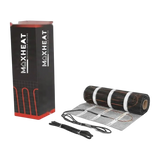
A MaxHeatUFH 150W/m² electric mat needs a thermostat with a floor probe, such as the Heatmiser neoStat-e. For choosing between mats and loose cable in awkward shapes, see loose cable vs mats.
Which systems keep the floor light and low?
For water underfloor heating in a park home or lodge, avoid anything wet or heavy and pick from:
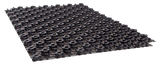
- Low-profile panels with 12mm pipe: MaxHeatFix low-profile panels take 12mm pipe over the existing deck with a small height build-up and no screed.
- Routed boards: rigid insulation boards with pipe grooves and a foil or cement face, laid over the deck, ready for the floor finish.
- Spreader plates between joists: aluminium heat diffuser plates carry the pipe below the deck where there is access from above during a refit, adding no height at all. See UFH in joisted timber floors.
Whichever you choose, insulation under the heated layer is the difference between heating the home and heating the void beneath it.
What about annexes and garden lodges?
A residential annexe on a proper foundation is a different case from a chassis-built lodge: with a concrete slab there is no weight constraint, so the full range of systems applies, including pipe in screed, and the annexe is treated like any small new build. A chassis-built garden lodge follows the park home rules above.
In every case, start from a heat loss calculation: small, well-insulated spaces often need surprisingly little output, while a thin-walled holiday unit may need more than a comfortable floor can give, in which case fix the insulation before the heating.
Who should install it, and are there grants?
Electric underfloor heating must have its final connection made by a qualified electrician (Part P / BS 7671), and any boiler work needs a Gas Safe engineer. MaxHeatUFH does not install: we supply the kit and pass installations to vetted approved installers.
On grants: the Boiler Upgrade Scheme offers up to £7500 towards an air or ground source heat pump in England and Wales, but the property must have a valid EPC and the work must be done by an MCS-certified installer, so check your home's position before counting on it. And on VAT: the 0% VAT rate on energy-saving materials applies only where a qualifying installer both supplies and installs qualifying measures in residential accommodation (until 31 March 2027); kit bought supply-only from any merchant, including MaxHeatUFH, carries 20% VAT.
Free design tool: sketch your park home or lodge in MaxHeatUFH ProLoop and get a quick UFH design, with the circuits laid out from the manifold you place and the kit priced in under 5 seconds from submission. Start your design
Frequently asked questions
Can you put underfloor heating in an existing park home?
Yes. The usual retrofit routes are electric mats in bathrooms and kitchens when floors are re-tiled, or low-profile water panels over the existing deck during a bigger refurbishment. Both avoid adding serious weight or height.
Can a park home floor take the weight of underfloor heating?
The systems suited to park homes are chosen precisely because they are light: electric mats, low-profile panels and spreader plates add little weight. What park home floors cannot take is a conventional thick sand and cement screed.
Is a park home warm enough for underfloor heating to work?
A home built to BS 3632:2023 is insulated for year-round living and suits underfloor heating well. Older homes and EN 1647 holiday lodges lose more heat, so have the heat loss checked, and improve insulation first if the numbers are marginal.
Is electric underfloor heating expensive to run in a park home?
In a small room, no. A 150W/m² mat over 4m² draws 0.6kW, about 16p per hour at the October 2026 price cap electricity rate of 26.32p/kWh, and the thermostat cycles it. Heating a whole home on electric mats costs considerably more than a water system on gas.
Can a lodge have water underfloor heating from its boiler?
Yes. A low-profile panel system or spreader plates can run from the lodge's existing boiler through a manifold with a blending valve, keeping the floor at a safe temperature for the timber deck.
Do I need an electrician for electric underfloor heating?
Yes. You can lay a mat yourself, but the final connection to the mains and the thermostat must be made by a qualified electrician under Part P / BS 7671, who will also test the installation.
Sources: BSI: BS 3632 residential park homes specification, Ofgem energy price cap, GOV.UK Boiler Upgrade Scheme
Products in this guide
Watch how each part works and how to fit it, and download its data sheet and install manual.




Every data sheet and manual: Product Library · All videos: MaxHeatUFH on YouTube

Design it in MaxHeatUFH ProLoop
Add your rooms, choose screed, overlay, joisted or electric, and get a free quick design and full kit list with prices.
Related guides
 Underfloor heating in a holiday home or second home: remote control and frost protectionElectric UFH · 9 min read
 How long does electric underfloor heating take to warm up?Electric UFH · 9 min read
 Underfloor heating for a home office: heating one room you work inElectric UFH · 8 min read