



Tiling over underfloor heating: adhesives, movement joints and large-format tiles
How to tile over water or electric underfloor heating: adhesive and grout classes, solid-bedding large-format tiles, where movement joints go, commissioning the screed, anhydrite preparation and when to switch on.
Short answer: Tile and stone are the best finishes for underfloor heating. Fix them with a polymer-modified cement adhesive of at least C1S1 to BS EN 12004 (C2 with S1 or S2 over timber), use CG2 grout, and solid-bed every tile with no voids. Put movement joints round the edge, between separately controlled heating zones, at doorways and between heated and unheated floor, and split large floors into bays of no more than 40m² for ceramic and stone. Commission the heating before tiling, tile with it off, then wait 7 days (rapid-set adhesive) or 14 days (normal-set) before turning it back on.
Tiles pass heat better than any other floor finish, which is why they suit underfloor heating (UFH) so well. They are also rigid and brittle. A heated floor expands and contracts every time the heating cycles, so the adhesive, the grout and the movement joints have to absorb that movement or the tiles crack, the grout breaks up, or tiles come loose.
This guide brings together the rules from The Tile Association (TTA), BS 5385, and adhesive and screed makers: which adhesive and grout, how to handle large-format tiles, where movement joints go, how to prepare and commission the screed, and when to switch on. It covers water and electric heating.
Why are tiles the best floor for underfloor heating?
Because they have almost no thermal resistance. In the CIBSE figures published by one UFH maker, 5mm ceramic tile is 0.0 tog and 25mm marble only 0.5 tog. Carpet and wood are 1.0 to 2.5 tog.
That shows up in output. In one UFH maker's table for a 65mm screed at 150mm pipe centres and 45/35°C water, tile gives 94W/m², 15mm wood 66W/m² and carpet 55W/m². Tile lets you run the coolest water for the same heat, which suits heat pumps.
Tile has no low temperature limit of its own, unlike wood, laminate and vinyl. The limits are the comfort limits in BS EN 1264: 29°C in occupied areas, 33°C in bathrooms and 35°C in edge zones. The TTA also gives a 45°C maximum water temperature for cement and calcium sulphate screeds.
Which tile adhesive should I use over underfloor heating?
A polymer-modified cement-based adhesive to BS EN 12004, at least C1S1, and more deformable over timber. The S rating is the important part: S1 or S2 means the adhesive is deformable, tested to BS EN 12002, so it can take some movement.
| Situation | Adhesive | Source |
|---|---|---|
| Heated screed or concrete | C1S1 minimum | TTA, Tile and Stone Journal |
| Suspended timber floor | C2 S1 or S2 deformable | TTA |
| Calcium sulphate screed with UFH | Polymer-modified, rapid-set helps | Adhesive maker guidance |
| Light or translucent marble | White rapid-set C2FT-S1 | Tile and Stone Journal |
| Large-format tiles (600mm and up) | Low-viscosity or pourable adhesive | TTA |
For grout, the TTA prefers a polymer-modified cementitious CG2 grout to BS EN 13888, or CG1 with a suitable admix. Tile and Stone Journal advises CG2WA. Leave grout joints of at least 3mm.
The Tile and Stone Journal also makes a point that is easy to miss: the tile and the heated base should expand at similar rates, or the stress between them can be too much. That is why a good adhesive bed and proper movement joints matter more over UFH than on a cold floor.
How do I fix large-format tiles over underfloor heating?
Solid bed them with no voids, on a flat base, with movement joints in the right places. The Tile and Stone Journal defines large-format floor tiles as having an edge of at least 600mm.
- Check flatness. The TTA calls for screed flatness to SR1, with no gap over 3mm under a 2m straightedge.
- Choose a thick-bed adhesive. A pourable or low-viscosity adhesive makes a solid bed easier.
- Back-butter. Spread adhesive on the floor and on the back of each tile, so there are no voids. A void over a heated floor is a weak point that can crack.
- Mind the bay size. Large tiles make movement joints more important, not less. See the next section.
- On timber, stiffen first. The TTA says a timber base must carry an extra dead load of up to 0.8kN/m² without excessive deflection. Stone Specialist suggests at least 15mm WBP plywood, screwed at 300mm centres maximum, or a tile backer board.
A tile-direct overlay board is another way to get a flat, rigid base. MaxHeatDeck has a fibre-reinforced cement face on both sides and suits heavier tiles. MaxHeatPanel is routed XPS made for tiling direct. Our guide to low-profile overlay UFH covers both.
Where do movement joints go in a tiled underfloor heating floor?
Round the edge, at every change of heating zone, at doorways, between heated and unheated floor, over structural joints, and at bay boundaries. Each joint should go right through the tile, the bed and the screed.
- Perimeter: a compressible strip from the base to the finished surface, allowing at least 6mm of screed movement. Our edge insulation roll does this job under screed.
- Bays: no more than 40m² for ceramic and natural stone, or 25m² for resin agglomerated tiles, in roughly square or rectangular panels.
- Intermediate joints: Tile and Stone Journal and Stone Specialist both give about 5m intervals in each direction.
- Heating zones: between areas on separate heating controls, and between heated and unheated floor.
- Doorways and shape changes: at thresholds, and where the floor changes width or direction, such as an L-shaped room.
- Structural joints: directly over any movement joint in the structure below.
The TTA asks for joints at least 6mm wide, sealed after grouting, with metal or rigid plastic edging for joints over 10mm. Pipes that cross a joint must be sleeved. One adhesive maker adds that you should never tile over the screed's expansion strips: carry them through to the finished floor with a flexible sealant.
An uncoupling membrane does not replace movement joints. The TTA says these membranes neutralise lateral stress only, and joints are still needed. They do help over new screed, timber and mixed bases. Ours is a fleece-backed uncoupling membrane.
How do I prepare and commission the screed before tiling?
Let the screed cure and dry, run the heating through a full heat-up and cool-down, and only then tile. The TTA gives these routines:
| Screed | Before heating | Heat-up cycle |
|---|---|---|
| Sand and cement | Cure at least 7 days, then dry 2 more weeks | Up to 5°C a day to a 45°C maximum, hold 3 days, cool to room temperature |
| Calcium sulphate | Heating may start 7 days after laying | Up 5°C a day for 4 to 5 days, hold 3 days, down 10°C a day until the surface is at least 15°C |
The same adhesive maker stresses that the UFH must be fully commissioned through its whole range before tiling, and that a simple air pressure test does not count. Our guide to commissioning underfloor heating covers the system side, and screed depths and drying times covers the screed.
Some stone needs a drier screed. For marble, agglomerated stone, limestone and travertine, the TTA asks for no more than 75% RH at 20°C.
How do I tile onto a calcium sulphate (anhydrite) screed?
Remove the laitance, check it is dry, prime it and use a polymer-modified adhesive. Calcium sulphate screeds are popular over UFH because they flow round the pipes, but they need careful preparation for tiles.
- Remove the laitance. That adhesive maker recommends mechanical preparation with a rotary disc to take off the weak top layer, then remove all dust.
- Check it is dry. The same maker uses a surface hygrometer under an insulated box, left for about 4 days on the unheated floor. Below 75% RH is dry enough.
- Allow drying time. Its rule of thumb is about 1mm a day for the first 40mm, and 0.5mm a day after that. A 50mm screed needs at least 60 days.
- Prime twice. It recommends two coats, the first more diluted, to consolidate and isolate the screed.
- Use a polymer-modified adhesive. With UFH, it advises polymer-modified adhesive, and a rapid-set one helps limit moisture moving into the screed.
When can I turn the heating on after tiling?
After 7 days for rapid-set adhesive or 14 days for normal-set, according to the TTA. Then raise the temperature gradually. Stone Specialist gives 5°C a day, and Tile and Stone Journal suggests bringing it up over 10 to 14 days.
On tiling day, the heating should be off. The TTA says to start only when the screed and room are above 15°C but not above 20°C. Tile and Stone Journal says the floor should not exceed 15°C during tiling. Aim for a cool, steady floor around 15°C.
Always follow the adhesive maker's own times if they differ.
How do I tile over electric underfloor heating?
Bed the mat or cable in levelling compound or adhesive, test it at every stage, and fit the floor sensor before any tile goes down. The TTA sets out these rules:
- Cover the cables with self-levelling compound or a C1S1 adhesive, taking care not to damage them.
- Test continuity, resistance and insulation resistance before laying, after laying, and after the levelling compound or adhesive goes on.
- Fit the floor sensor and thermostat before tiling.
- Give the client a diagram or photo of the cable layout.
- Use an RCD, and have a qualified electrician make the final connection under Part P and BS 7671.
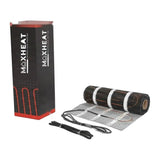
Our electric mats come in 100, 150 and 200W/m², about 3 to 4mm thick, and sit in the tile adhesive bed. See how to install an electric underfloor heating mat for the full method. To cut heat loss into a cold slab, lay them over a cement-coated XPS backer board.
Design your UFH system yourself in 3 minutes with MaxHeatUFH ProLoop and get an instant quick design and quote. Start your design
Frequently asked questions
Do I need flexible tile adhesive for underfloor heating?
Yes. Use a polymer-modified cement adhesive of at least C1S1 to BS EN 12004. The S1 rating means it is deformable. Over timber, use C2 with S1 or S2.
Can I tile straight onto underfloor heating boards?
Yes, on boards made for it. MaxHeatPanel, MaxHeatDeck and MaxHeatFix are made to be tiled directly. Use a flexible adhesive and follow the adhesive maker's guidance for the board.
How big can a tiled area be without a movement joint?
No more than 40m² for ceramic and natural stone, or 25m² for resin agglomerated tiles, per the TTA. Intermediate joints at about 5m centres are also common guidance.
Do I need a movement joint at the doorway?
Yes. The TTA lists doorways and thresholds, and the junction between heated and unheated floor, as places that need movement joints.
Can I tile onto a new screed with underfloor heating?
Only after it has cured, dried and been through a full heating cycle. For sand and cement, that is at least 3 weeks before the heating cycle even starts.
Why do tiles crack on underfloor heating?
Common causes are voids under the tiles, missing movement joints, a rigid adhesive, tiling before commissioning, and switching the heating on too soon or too fast after tiling.
Is an uncoupling membrane needed over underfloor heating?
Not always, but it helps over new screed, timber and mixed bases. It does not replace movement joints.
Sources: The Tile Association: tiling to heated floors, Tile and Stone Journal: tile adhesives with UFH, Stone Specialist: the fixer, underfloor heating, adhesive manufacturer guidance on tiling onto calcium sulphate screeds, BEAMA: choosing your floor covering for UFH
Products in this guide
Watch how each part works and how to fit it, and download its data sheet and install manual.




Every data sheet and manual: Product Library · All videos: MaxHeatUFH on YouTube

Design it in MaxHeatUFH ProLoop
Add your rooms, choose screed, overlay, joisted or electric, and get a free quick design and full kit list with prices.


