








Underfloor heating in nurseries and children's rooms
The sourced facts on heating a nursery: the Lullaby Trust's 16 to 20°C room temperature advice, the BS EN 1264 floor surface limit, and how to zone and control a child's room accurately with a floor probe and its own thermostat.
Short answer: Underfloor heating works well in nurseries and children's rooms because it holds a steady, controllable temperature with no hot radiator panels or sharp corners at child height. The Lullaby Trust advises keeping a baby's room at 16 to 20°C, with heating left on overnight kept low and no higher than 20°C, and BS EN 1264 caps a heated floor surface at 29°C in occupied rooms. Give the room its own thermostat, use a floor probe, and follow the official safer-sleep guidance for everything about how your baby sleeps.
Parents planning a nursery ask two heating questions: what temperature should the room be, and is a heated floor a sensible way to hold it. The temperature question has a clear, published answer from the safer-sleep charities. The heating question comes down to control, and that is where UFH is strong: a whole-floor emitter runs cool and steady where a radiator runs hot and cycles.
This guide sticks to the sourced facts: the recommended room temperature, the floor surface limits in the European UFH standard, and how to set up the controls so the room actually holds the temperature you chose. For anything about bedding, clothing or how your baby sleeps, follow the Lullaby Trust and NHS safer-sleep guidance rather than a heating guide, ours included.
What temperature should a nursery be?
16 to 20°C, according to the Lullaby Trust, the UK safer-sleep charity. Its guidance says this range helps stop babies getting too hot, and adds some practical points worth building into your heating plan:
- If the heating stays on overnight, keep it low, and no higher than 20°C.
- Keep the cot away from radiators, heaters and direct sunlight.
- Use a room thermometer rather than guessing.
- Check your baby by feeling the chest or the back of the neck, not hands and feet, and remove bedding layers if the skin feels hot or sweaty.
Those points are the charity's, not ours, and its advice is the place to start for anything beyond the plumbing. What a heating system contributes is the ability to hold 16 to 20°C reliably, which is exactly what a room thermostat on its own zone does.
Is underfloor heating suitable for a baby's room?
It is a well-matched emitter for the job, for reasons you can measure. BS EN 1264, the standard wet UFH systems are designed to, limits the floor surface to 29°C in occupied rooms. The whole emitting surface therefore stays below bath-water temperature, and in a room held at 18 to 20°C the floor normally runs well under the limit, because a nursery needs little output. Compare that with a radiator, which concentrates its heat in one hot panel at exactly the height a crawler or cruiser explores; the Lullaby Trust specifically advises keeping the cot away from radiators and heaters.
UFH also removes the radiator from the wall altogether, which frees wall space for the cot, keeps the floor warm where a baby will later crawl and play, and leaves nothing to trap small fingers. For the general safety picture across the whole house, see is underfloor heating safe.
How do you control the temperature accurately?
One thermostat in the nursery, on its own zone, with a floor probe as a second check.
- Zone the room separately. A nursery held at 16 to 20°C should not share a thermostat with a landing or a master bedroom on a different schedule. One room, one thermostat, one actuator or mat.
- Pick a thermostat you can read and trust. A programmable room thermostat such as the Heatmiser neoAir wireless thermostat shows the measured room temperature and can be repositioned if the first spot reads badly; app control means checking the nursery without opening the door.
- Add a floor probe. A 10K floor probe lets the thermostat limit the floor surface temperature as well as the air. On electric systems, use a floor-sensing thermostat such as the neoStat-e, and have the final connection made by a qualified electrician (Part P, BS 7671).
- Keep a separate thermometer in the room. The Lullaby Trust recommends a room thermometer; a wireless air sensor paired to the system, or a simple standalone thermometer by the cot, confirms what the zone is doing where it matters.
- Site the thermostat sensibly. Away from direct sun, lamps and draughts from the door, at a height where it reads the room the cot is in.
Water or electric UFH in a child's room?
Either controls well; the choice follows the building, not the occupant. Most nurseries are upstairs, so the practical question is usually how to put UFH in a timber first floor.
| Water UFH | Electric mat | |
|---|---|---|
| Best when | Whole floor or whole house is being done | One room is being refurbished |
| First-floor fit | Spreader plates or routed panels between or over joists | Thin mat under most finishes |
| Running cost | Lower per kWh via boiler or heat pump | Higher per kWh, but a nursery's load is small |
| Control | Room thermostat + actuator, floor probe optional | Floor-sensing thermostat with built-in floor limit |
For the build-up options upstairs, see UFH on the first floor, and for the wider case for heated bedrooms, underfloor heating in bedrooms.
What about rugs, cots and play mats on a heated floor?
Keep the heated floor as clear as you reasonably can, and know that anything thick on top of it runs warmer underneath. Flooring manufacturers warn that rugs and mats act as heat accumulators: heat that cannot escape upwards builds up below them. That matters mostly for the floor covering's own temperature limit rather than the room, but it is a reason to lay a thick play mat where you want it before setting the floor limit, and not to park heat-sensitive items flat on the floor.
Furniture follows the same logic as any UFH room: cots and beds on legs are fine, sealed-base wardrobes are better off an electric mat's heated area. Our guide to rugs and furniture on UFH covers the detail. And the scheduling point: a nursery is occupied at nap times as well as nights, so a flat, gentle schedule usually beats aggressive morning-and-evening peaks; see setback schedules for how to set it up.
Free design tool: add the nursery and the rest of the floor to MaxHeatUFH ProLoop and get a quick room-by-room design with each bedroom on its own zone, fully priced. Start your design
Frequently asked questions
What temperature does the Lullaby Trust recommend for a baby's room?
16 to 20°C, measured with a room thermometer. If heating runs overnight it should be kept low and no higher than 20°C, and the cot should be kept away from radiators, heaters and direct sunlight.
Is underfloor heating safe for babies and toddlers?
Wet systems designed to BS EN 1264 cap the floor surface at 29°C in occupied rooms, and a nursery normally runs well below that. For sleep safety itself, bedding, clothing and room setup, follow the Lullaby Trust and NHS safer-sleep guidance.
Does a nursery need its own heating zone?
It is the easiest way to hold 16 to 20°C while the rest of the house does something different. One thermostat in the room, controlling only that room, with its own schedule.
How warm does the floor itself get?
In a room with low heat loss held at 18 to 20°C, the surface typically sits only a few degrees above room temperature, and the system should be set so it can never exceed the 29°C limit in BS EN 1264. A floor probe enforces this.
Can I put a cot or play mat directly on the heated floor?
A cot on legs is fine. Thick rugs and play mats trap heat beneath them, so lay them before setting the floor limit and keep them off electric mats' heated area where the covering maker says so.
Should the heating be on all night in a baby's room?
The Lullaby Trust says that if heating is left on overnight it should be low, no higher than 20°C. A programmable thermostat holding a modest overnight setpoint does exactly this.
Products in this guide
Watch how each part works and how to fit it, and download its data sheet and install manual.


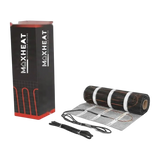

Every data sheet and manual: Product Library · All videos: MaxHeatUFH on YouTube

Design it in MaxHeatUFH ProLoop
Add your rooms, choose screed, overlay, joisted or electric, and get a free quick design and full kit list with prices.


