








Rugs, furniture and underfloor heating: what's safe
Which rugs and furniture are safe on underfloor heating, how tog ratings work, the stricter limits for electric systems, and how to plan heated floors around fitted furniture and wood finishes.
Short answer: Yes, you can put a rug on underfloor heating if it is thin, low-tog and made from natural fibres. Keep the total thermal resistance over an electric system at or below 1.5 tog, including the floor finish, as one heater maker requires. Never let any floor covering combination go above 2.5 tog. Over electric heating, avoid beanbags, mattresses, pet beds and flat-bottomed furniture. Use furniture on feet that leave at least a 50mm ventilated gap. Water systems are more forgiving, but a thick rug still blocks heat, and on wood floors it can push the boards past their temperature limit.
A rug on a heated floor acts like a duvet. Heat that should rise into the room is held in the floor beneath it, so the room warms more slowly and the floor under the rug runs hotter than the rest. With a water system the water temperature caps how hot that patch can get. With an electric system, the cable keeps putting out heat until the thermostat says stop, and the thermostat may not be able to see what is happening under the rug.
This guide explains tog ratings, which rugs and underlays to choose, what furniture is safe, the difference between water and electric systems, and how to plan a heated floor around fixed furniture. For floor finishes in general, see underfloor heating under tiles, LVT, laminate, wood and carpet.
Can you put a rug on underfloor heating?
Yes, with the right rug. The rules are the same as for carpet: keep the tog low, avoid insulating backings and underlays, and keep rugs smaller than the room.
- Low tog. One water underfloor heating maker suggests a rug of 2.5 tog or less. Over electric heating, one heater maker's limit is 1.5 tog for everything over the system, including the floor finish.
- Natural fibres. Wool and other natural materials cope with heat better. Some synthetic rugs can be damaged under sustained heat.
- Backing and underlay. Hessian backings are better than felt or polyurethane, which conduct heat poorly and can cause hot spots.
- Size. A smaller rug covers less of the heated area, so the room still warms properly.
If the rug came with a tog figure, use it. Many do not, in which case a thin flatweave in a natural fibre is the safest choice.
What is a tog rating and what is the limit?
Tog is a measure of thermal resistance: how strongly a material resists heat flowing through it. One tog equals 0.1m²K/W. The higher the tog, the more the layer blocks heat.
| Limit | Value | What it applies to |
|---|---|---|
| Carpet and underlay together | 2.5 tog maximum | Industry guidance for underfloor heating |
| Everything over an electric mat, including the floor finish | 1.5 tog (0.15m²K/W) | One heater maker's limit, covering rugs, furniture and other items |
| Any floor finish combination over an electric mat | Never above 2.5 tog (0.25m²K/W) | Same heater maker; not permitted |
| Underlays made for underfloor heating | Typically about 1 tog | Added to the carpet's tog |
Tog values add up. A rug laid over a carpet adds its tog to the carpet and underlay below. A rug on tiles adds almost all of its tog on its own, because tile adds very little.
The 2.5 tog figure for carpet has been around for a long time. Research for a water underfloor heating maker in 2005 found heavier carpets could work with its systems, because the water temperature can be raised to make up for them. Electric systems do not have that option, which is why electric heater makers set stricter limits.
Is a rug safe on electric underfloor heating?
A thin, low-tog rug is fine. A heavy rug, or anything that blankets the floor, is not. One heater maker tells installers not to place items over the system that push the thermal resistance above 1.5 tog. It names beanbags, heavy rugs, flat furniture, animal beds and mattresses.
The reason is how electric heating is controlled. The floor probe sits at one point in the floor, usually at least 300mm into the heated area, between two cable runs. It cannot sense the floor under a rug somewhere else in the room. So the thermostat keeps the heater on while the patch under the rug gets hotter than the rest of the floor.
Practical steps:
- Plan rugs before the heater goes down. Keep the floor probe away from where a rug will go, so it reads the open floor.
- Set a floor limit. Floor-sensing thermostats let you set a maximum floor temperature. The Heatmiser neoStat-e defaults to 28°C and can be set from 20 to 45°C. Set it to suit the floor finish.
- Choose thin, natural rugs, with a hessian backing or none.
- Never lay a rug over the thermostat's floor probe area if you can avoid it, or the heating will switch off early everywhere else.
Our guide to floor probes, air sensing and floor limits explains how to set the controls.
Can I put furniture on underfloor heating?
Yes, if it stands on legs. Furniture on feet lets air move under it and the heat escape. One heater maker asks for furniture over electric heating to have feet that keep at least a 50mm ventilated space above the floor.
| Item | Electric UFH | Water UFH |
|---|---|---|
| Sofa, bed or table on legs | Fine with a 50mm gap or more | Fine |
| Flat-bottomed furniture, plinth beds, storage boxes | Avoid over the heater | Reduces output in that area |
| Beanbags, mattresses, pet beds | Do not place over the heater | Reduces output; watch wood finishes |
| Thin rug, natural fibre | Fine within the tog limit | Fine |
| Thick rug with felt or foam underlay | Avoid | Reduces output; risk of hot spots on wood |
A floor under a wide, flat piece of furniture behaves much like a floor under a thick rug: heat builds up underneath and the room gets less of it.
Should underfloor heating go under fitted kitchen units, baths and wardrobes?
No. Leave fixed furniture and fittings out of the heated area. Heat trapped under a kitchen unit, bath or fitted wardrobe is wasted, and with electric heating it can build up.
- Measure the free floor area, leaving out units, baths, shower trays, the toilet and fitted furniture.
- Mark fixtures on the subfloor before laying the heater, so nobody runs cable under them.
- Never leave surplus mat rolled up under units or fixtures. Choose a mat close to the free area, or use loose cable to fill awkward shapes.
- Think about where furniture will go. If you know a large flat-based bed or a fitted wardrobe will sit in one spot, leave the heater out of that spot.
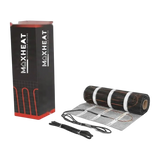
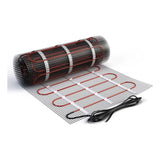
Our 150W/m² heating mat comes in sizes from 1m² to 12m², so you can match the free area without having surplus to hide.
Are rugs on underfloor heating bad for wood and vinyl floors?
They can be. Wood, laminate and vinyl have maximum surface temperatures, and a thick rug can push the floor under it past that limit even when the open floor is fine.
- Timber. Many timber flooring makers limit the surface to 27°C. Thick rugs over engineered wood can cause hot spots, warping and lifting boards.
- Solid wood is more prone to warping at higher temperatures. Use thinner, low-tog, natural-fibre rugs.
- Vinyl and linoleum are generally limited to 26 to 27°C to prevent discolouration and softening.
- Tile and stone handle heat well, so rugs and bath mats are much less of a worry.
Over wooden floors, a floor sensor and a floor temperature limit set to the flooring maker's figure give the best protection. Under BS EN 1264, any heated floor in an occupied area should stay at or below 29°C at the surface. Our guide to floor coverings for underfloor heating has more on each finish.
Do rugs make water underfloor heating less efficient?
They reduce the heat that reaches the room from that part of the floor, but they are not a safety issue with water systems in the same way. The water flow temperature limits how hot the floor can get.
If a room with water underfloor heating has a lot of rugs and feels slow to warm, the options are fewer or thinner rugs, a slightly higher flow temperature where the floor finish allows it, or a longer heating period. Before you change anything, check the loops are balanced and the room is getting its design flow. See underfloor heating not getting warm and balancing underfloor heating loops.
Design your UFH system yourself in 3 minutes with MaxHeatUFH ProLoop and get an instant quick design and quote. Start your design
Products for this job
- Heatmiser neoStat-e, with floor limit
- Heatmiser Slimline-E
- 10K Floor Probe (3m)
- Electric Underfloor Heating Mat 150W/m²
- Electric Underfloor Heating Loose Cable
- All thermostats and controls
Frequently asked questions
What tog rug can I use on underfloor heating?
One water underfloor heating maker suggests 2.5 tog or less. Over electric heating, one heater maker limits everything over the system, including the floor finish, to 1.5 tog. Thin natural-fibre rugs are the safest choice.
Can I put a rug on electric underfloor heating?
Yes, a thin, low-tog rug is fine. Avoid heavy rugs, rugs with felt or foam underlay, and anything that blankets the floor, because heat can build up underneath.
Can I put a bed on underfloor heating?
A bed on legs is fine. For electric heating, one heater maker asks for at least a 50mm ventilated gap under furniture. Do not put a mattress or a flat-based bed directly on an electric heated floor.
Should I put underfloor heating under a kitchen island or units?
No. Leave units, islands, baths and fitted furniture out of the heated area. Measure the free floor area and size the heater to that.
Do rugs damage wooden floors with underfloor heating?
Thick rugs can. They trap heat and can push the boards past the flooring maker's temperature limit, often 27°C, which can cause warping or lifting. Use thin rugs and a floor temperature limit.
What rug underlay is best for underfloor heating?
A thin one with low thermal resistance. Avoid felt and polyurethane underlays, which conduct heat poorly and can cause hot spots.
Will a rug stop my underfloor heating working?
No, but it reduces the heat from that part of the floor, so a room with large thick rugs warms more slowly.
Sources: BEAMA: choosing your floor covering for underfloor heating, Modern Building Services: research tests underfloor heating with carpet, Heatmiser neoStat-e V3 datasheet
Products in this guide
Watch how each part works and how to fit it, and download its data sheet and install manual.



Every data sheet and manual: Product Library · All videos: MaxHeatUFH on YouTube
Design it in MaxHeatUFH ProLoop
Add your rooms, choose screed, overlay, joisted or electric, and get a free quick design and full kit list with prices.


