








Underfloor heating setback and schedules: should you leave it on all the time?
How to schedule underfloor heating for screed, overlay and electric floors with a boiler or heat pump, what setback temperature to use, and how to set it on a Heatmiser thermostat.
Short answer: Don't leave underfloor heating at full comfort temperature all the time, and don't switch a screed floor fully off and on each day. Run a schedule with a setback: drop the room by about 3°C at night and when you are out, which is what BEAMA's controls guide calls for on screeds over 65mm. With a heat pump, keep any setback to 2°C or less, or leave it out, because the heat pump struggles to recover. Overlay and electric floors warm quickly, so you can time them more like radiators.
"Should I leave it on all the time?" is one of the most common questions about underfloor heating. The answer depends on the floor and the heat source. A thick screed floor holds a lot of heat and reacts slowly. A thin overlay board or an electric mat under tiles reacts much faster. A heat pump prefers steady running. A gas boiler can recover quickly.
This guide gives setback figures from BEAMA and manufacturers, schedules for each type of system, and how to set them on a Heatmiser thermostat. For how long each floor takes to warm up, see UFH warm-up times, and for target room and floor temperatures, see UFH temperature settings.
Should I leave underfloor heating on all the time?
Leave it under thermostat control all the time during the heating season, but with a schedule, not at one fixed comfort temperature. The thermostat holds a comfort temperature when you are in and a lower setback temperature when you are out or asleep.
For conventional heating, the Energy Saving Trust, quoted by Which?, says it is a complete myth that it is cheaper to leave the heating on low all day. A heavy screed floor is different in degree but not in principle. It cools slowly and warms slowly, so switching it fully off overnight saves little and leaves the room cold in the morning. A setback keeps most of the stored heat in the slab while still letting the room cool a little.
BEAMA's underfloor heating controls guide makes this a design requirement. It says floors with high thermal inertia, such as screed deeper than 65mm, need a night setback timing facility that lets the room cool by about 3°C overnight. Our guide to thermal mass and UFH explains why heavy floors behave this way.
What setback temperature should I use?
Use about 3°C on a screed floor with a boiler, and no more than 2°C with a heat pump. Here is what the published guidance says.
| Source | System | Setback |
|---|---|---|
| BEAMA UFH controls guide | Screed deeper than 65mm | Room cools by about 3°C overnight |
| Manufacturer FAQ | Manufacturer room thermostats, eco period | Usually about 4°C below the set point |
| Heat pump manufacturer FAQ | Heat pump with weather compensation | Maximum 2°C including hysteresis, short periods, or none in cold spells |
So if your living room is set to 21°C, a setback of 18°C overnight suits a screed floor with a boiler. With a heat pump, 19°C or a steady 20 to 21°C is the safer choice. Bigger setbacks save a little more in theory, but the floor then needs longer and hotter water to recover.
What schedule suits each type of floor?
Match the schedule to how fast the floor reacts. The slower the floor, the smaller and fewer the setbacks, and the earlier the heating needs to start.
| System | How to schedule it |
|---|---|
| Screed floor, boiler | Two comfort periods a day with a 3°C setback between and overnight. Use optimum start so the room reaches temperature on time. |
| Screed floor, heat pump | Steady comfort temperature, or a setback of 2°C or less overnight only. Let weather compensation set the flow temperature. |
| Overlay boards, boiler | Time it more like radiators, with shorter warm-up and deeper setbacks. Check the room recovers in time. |
| Electric mat or cable | Heat only the times you use the room. Bathrooms often need just a morning and evening period. |
| Spare rooms | Hold a low setback or frost temperature, and raise it only when the room is in use. |
For electric floors, BEAMA's heat pump and electric heating guide says direct electric zones need programmable room thermostats with an override feature. At the October 2026 price cap of 26.32p/kWh, a 10m² mat at 150W/m² (1.5kW) costs at most about 39p for every hour it runs flat out, so trimming unneeded hours matters more than it does on a heat pump. Our heat pump UFH guide covers the low-temperature side.
How do I set a schedule on a Heatmiser thermostat?
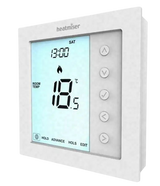
Pick a program mode, then set the times and temperatures for each heating level. Heatmiser's neoStat V3 offers non-programmable, weekday/weekend (the default), 7-day and 24-hour modes. Heatmiser's electric floor thermostat datasheets list 4 heating levels a day, each a start time and a temperature.
Here is an example weekday schedule for a screed living room with a boiler, using a 3°C setback.
| Level | Time | Temperature |
|---|---|---|
| 1. Wake | 06:30 | 21°C |
| 2. Leave | 08:30 | 18°C |
| 3. Return | 17:00 | 21°C |
| 4. Sleep | 22:30 | 18°C |
Then turn on optimum start. On the neoStat V3 it can start the heating up to 5 hours early, based on a rate-of-change setting in minutes per 1°C. It is off by default. With it on, the 06:30 time becomes "warm by 06:30", not "start at 06:30", which suits slow screed floors.
Other settings help with day-to-day changes:
- Temperature hold: keeps a temperature for a set time, then returns to the schedule.
- Override limit: limits how far someone can turn it up or down, from 0 to 10°C.
- Holiday mode: sets the dates you are away, so the thermostat drops out of its normal schedule and goes back to it when you return.
The neoAir wireless thermostat has the same program modes, optimum start and hold features. On an electric floor, the neoStat-e offers the same schedule options with a 16A output.
How should I schedule underfloor heating with a heat pump?
Keep it steady. A heat pump works best at a low, constant flow temperature, so large setbacks make it work harder to recover.
One heat pump maker says combining weather compensation and setback is counterproductive. Weather compensation gives the highest flow temperature overnight, when it is coldest, but a night setback switches the heat pump off for much of that time, so the room may not reach or hold its temperature. A midday setback has the same problem the other way: the flow is low in milder weather, and the heat pump is off for long stretches.
- Set weather compensation to the design conditions. This does most of the work.
- Hold a steady comfort temperature in the rooms you use most.
- If you want a setback, keep it to 2°C or less, including hysteresis, and keep it short.
- In long cold spells, reduce or remove the setback.
- Keep a minimum flow. BEAMA says wet systems should keep a minimum flow of water to avoid short cycling, so avoid schedules where every zone shuts at once.
What should I do when I go away or in summer?
Use holiday mode for short trips and frost protection for longer ones. Heatmiser's neoStat V3 has frost protection adjustable from 7 to 17°C, with 12°C as the default. That keeps the building and the floor from getting very cold, so recovery is quicker when you return.
In summer, set the thermostats to frost or standby rather than cutting power to the wiring centre. Some wiring centres exercise the pump and valves: the Heatmiser UH8-RF has a creepage setting that runs each pump and valve for 1 minute every 24 hours if they have not run. Our summer shutdown guide covers the rest.
Does a setback really save money?
Usually a little, if the setback is sensible for the floor. A lower room temperature for part of the day means less heat lost through the walls, windows and floor during those hours.
The evidence on exact savings is thin. A 2014 government review by the Department of Energy and Climate Change found no consistent and reliable body of evidence on how much heating controls save, and noted that people use controls more for comfort than for saving. So treat any fixed percentage you see quoted with care.
What is clear is the trade-off. On a screed floor, a deep setback or full switch-off means a long, hot recovery and a cold start to the day. With a heat pump, it can push the flow temperature up and the efficiency down. A modest setback is the safe middle ground.
Design your UFH system yourself in 3 minutes with MaxHeatUFH ProLoop and get an instant quick design and quote. Start your design
Frequently asked questions
Is it cheaper to leave underfloor heating on all the time?
Not at full comfort temperature. Leave it under thermostat control with a schedule and a setback of about 3°C on a screed floor. The Energy Saving Trust says leaving conventional heating on low all day to save money is a myth.
Should I turn underfloor heating off at night?
On a screed floor, turn it down rather than off. BEAMA's guide calls for a night setback of about 3°C on screeds over 65mm. Overlay and electric floors can be turned down further because they recover faster.
What is a good setback temperature for underfloor heating?
About 3°C below the comfort temperature on a screed floor with a boiler, such as 18°C at night for a 21°C room. With a heat pump, keep it to 2°C or less.
Should I use setback with a heat pump?
Only a small one. One manufacturer advises that combining weather compensation with setback is counterproductive, and that if you do, keep the setback to a maximum of 2°C and short.
What is optimum start?
A setting that starts the heating early so the room is warm by the time you set. On the Heatmiser neoStat V3 it can bring the heating on up to 5 hours early.
What should underfloor heating be set to when I am on holiday?
Use holiday mode or frost protection. Heatmiser neoStat and neoAir thermostats default to a frost temperature of 12°C, adjustable from 7 to 17°C.
Can I schedule each room differently?
Yes. Each zone has its own thermostat, so bedrooms, bathrooms and living rooms can each run their own times and temperatures.
Sources: BEAMA underfloor heating controls guide, BEAMA heat pump and electric heating controls guide, Which? (Energy Saving Trust comment), DECC: how heating controls affect domestic energy demand, Heatmiser neoStat V3 datasheet, Heatmiser UH8-RF manual, Ofgem energy price cap
Products in this guide
Watch how each part works and how to fit it, and download its data sheet and install manual.


Every data sheet and manual: Product Library · All videos: MaxHeatUFH on YouTube

Design it in MaxHeatUFH ProLoop
Add your rooms, choose screed, overlay, joisted or electric, and get a free quick design and full kit list with prices.


