








Underfloor heating in bedrooms: temperature, timing and floor finishes
What temperature to set a bedroom with underfloor heating, how to schedule it with setbacks, which carpet, underlay and wood floors work, what to do under beds and wardrobes, and how to zone bedrooms.
Short answer: Underfloor heating works well in bedrooms. Set the room to about 18°C at night, which is what The Sleep Charity suggests, and use a setback rather than switching off, because UFH is slow to warm up. Choose carpet and underlay with a low combined tog, kept within your system's limit, and keep wood floors at or below 27°C on the surface. In a baby's room, keep the room between 16°C and 20°C.
Bedrooms are one of the easiest rooms to heat with underfloor heating. They need less heat than living rooms, the heating can run gently through the evening, and there is no radiator under the window taking up space where a bed, desk or wardrobe could go. The main questions are what temperature to aim for, when to run it, and which floor finish to use, because most bedrooms are carpeted.
This guide covers all three, along with beds and fitted wardrobes, children's rooms, electric UFH in bedrooms and how to zone bedrooms on a manifold.
What temperature should a bedroom with underfloor heating be?
Aim for about 18°C at night. The Sleep Charity says around 18 degrees is ideal for a bedroom. The design tables used for heat loss calculations also use 18°C for bedrooms, against 21°C for living rooms and 22°C for bathrooms.
| Room | Typical design temperature |
|---|---|
| Bedroom | 18°C |
| Living room | 21°C |
| Bathroom | 22°C |
| Hall, stairs and landing | 16°C |
The thermostat setting is a matter of taste. Many people like the bedroom a little warmer in the morning and evening and cooler overnight. UFH heats the room evenly from the floor, so 18°C with a warm floor can feel more comfortable than the same air temperature from a radiator.
For babies, the Lullaby Trust recommends a room temperature of 16°C to 20°C. It says heating left on overnight should be set low and certainly no higher than 20°C, and advises using a room thermometer because it is hard to judge temperature by feel. It also advises keeping the cot away from heat sources such as radiators and heaters.
Is underfloor heating good in bedrooms?
Yes, for most homes. The benefits are practical:
- Free wall space. No radiator means more choice where the bed, wardrobes and desk go.
- Even heat. The whole floor gives out gentle heat, so there are no hot and cold spots.
- Low running temperatures. Bedrooms need little heat, so the floor can run cool, which suits a heat pump.
- Warm floor in the morning. Getting out of bed onto a warm floor is one of the things people notice most.
The main thing to plan around is response time. A screeded floor is slow to warm up and slow to cool down. That suits a room that is heated gently for long periods, but you cannot switch it on at bedtime and expect a warm room ten minutes later. Our guide to UFH warm-up times compares floor types.
When should bedroom underfloor heating come on?
Run it on a schedule with a setback, not on and off. A setback lowers the temperature by a few degrees at times you do not need full heat, then raises it again in time for when you do. This avoids the long recovery time of a floor that has gone fully cold.
- Set a comfort temperature for the morning and the evening before bed.
- Set a lower temperature for the day if the room is empty, and for the middle of the night if you like it cooler.
- Start each comfort period early enough for the floor to catch up. A screeded floor needs a much longer head start than an overlay board.
- Watch the room for a week and adjust the start times.
A programmable thermostat in each bedroom makes this easy. The Heatmiser neoStat V3 and the wireless Heatmiser neoAir both let you set separate times and temperatures. Our guide to setback schedules gives example settings.
Can you have carpet on underfloor heating in a bedroom?
Yes, as long as the carpet and underlay together have a low thermal resistance. Thermal resistance is often given as a tog value, and 1 tog equals 0.1m²K/W. The NBS notes that UFH makers quote maximums for carpet and underlay together of between 1.5 and 2.5 tog. One manufacturer's UFH handbook, working to EN 1264, uses 0.1m²K/W (1 tog) for living rooms as standard and says values up to 0.15m²K/W (1.5 tog) need to be agreed at design stage.
In practice:
- Add the carpet tog and the underlay tog together and check the total against your system's limit.
- Avoid thick carpets and felt underlays, which the NBS lists among finishes to avoid.
- Choose an underlay sold as suitable for underfloor heating.
- Tell your designer the floor finish before the layout is drawn. A carpeted room may need closer pipe centres or a higher water temperature for the same heat.
Our guide to carpet tog ratings and UFH has worked examples.
What about wood floors in bedrooms?
Wood and engineered boards work over UFH if you keep the surface temperature down. One leading manufacturer's installation guide says the floor surface must not exceed 27°C under timber finishes. The NBS gives the same 27°C figure for a typical water system with a 50°C average water temperature. It also advises acclimatising boards in the room with the heating on for at least seven days before laying.
A floor probe lets the thermostat limit the floor temperature directly. Our guides to wood flooring over UFH and floor probes cover this.
Should I put underfloor heating under the bed and wardrobes?
Under the bed, usually yes. Under fitted wardrobes, usually no. A bed sits on legs or a base and is often moved, so most designs heat that area. Fitted wardrobes are permanent, and heat trapped under them is wasted and can warm the contents. Leave the pipe or mat out where built-in furniture will go, and run the loop around it.
A bed with a solid base that sits flat on the floor does cover part of the heated area. In a small bedroom that matters more than in a large one. The same applies to large rugs and low furniture.
Can I use electric underfloor heating in a bedroom?
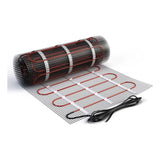
Yes, but it is usually better suited to small rooms or a single room in a refurbishment. Electric mats warm quickly, which suits a room that is only heated for short periods. One manufacturer recommends its 100W/m² mat for timber-based floors and its 150W/m² mat for concrete floors, with the mat covered in a flexible self-levelling compound before the floor finish goes down.
The cost is the electricity price. At the October 2026 price cap of 26.32p per kWh, a 10m² bedroom with a 100W/m² mat uses 1kWh in an hour at full power, about 26p. The thermostat cycles the mat on and off once the room is warm, so real use is lower. The final connection must be made by a qualified electrician. See our water vs electric UFH comparison.
How do I zone bedrooms on a water UFH system?
Give each bedroom its own thermostat and its own actuator on the manifold. Each bedroom then follows its own schedule, so a spare room can sit at a low setback while the main bedroom is at comfort temperature. On a manifold, every loop has an actuator, and a wiring centre links each thermostat to the actuators for its room.
Upstairs bedrooms are often on joisted floors, which need a different floor system from the ground floor. Our guide to UFH upstairs compares the options.
Design your UFH system yourself in 3 minutes with MaxHeatUFH ProLoop and get an instant quick design and quote. Start your design
Frequently asked questions
What is the best temperature for a bedroom with underfloor heating?
About 18°C at night. The Sleep Charity suggests around 18°C is ideal, and heat loss design tables use 18°C for bedrooms.
Is underfloor heating safe in a baby's room?
Follow the Lullaby Trust advice: keep the room between 16°C and 20°C, use a room thermometer, and if the heating stays on overnight, keep it low and no higher than 20°C.
Should I turn bedroom underfloor heating off at night?
Turn it down rather than off. A setback of a few degrees keeps the floor partly warm, so the room recovers quickly in the morning.
What tog carpet can I use on underfloor heating?
Keep carpet and underlay together within your system's limit. Makers quote between 1.5 and 2.5 tog in total. Avoid felt underlay.
Does underfloor heating work under a bed?
Yes. Most designs heat the floor under the bed. Leave out areas under fitted wardrobes and other built-in furniture.
Can I have different temperatures in each bedroom?
Yes. Give each bedroom its own thermostat and actuator so it follows its own schedule.
How warm should a wooden bedroom floor get?
No more than 27°C on the surface, unless the flooring maker says otherwise. Use a floor probe to limit it.
Sources: The Sleep Charity: creating an ideal bedroom environment, Lullaby Trust: baby room temperature, NBS: underfloor heating, the cover up, Ofgem energy price cap, and manufacturers' installation guidance to BS EN 1264
Products in this guide
Watch how each part works and how to fit it, and download its data sheet and install manual.



Every data sheet and manual: Product Library · All videos: MaxHeatUFH on YouTube

Design it in MaxHeatUFH ProLoop
Add your rooms, choose screed, overlay, joisted or electric, and get a free quick design and full kit list with prices.


