








Is underfloor heating safe? Burns, leaks, electrics and health
Why underfloor heating is one of the safest ways to heat a home: BS EN 1264 surface temperature limits, 30mA RCD protection under BS 7671, pressure testing before the floor goes down and sealed-system water treatment.
Short answer: Yes. A properly designed and installed underfloor heating system is one of the safest ways to heat a home. BS EN 1264 limits the floor surface to 29°C in occupied areas, well below the 43°C that HSE guidance treats as the safe ceiling for hot surfaces around vulnerable people, and far cooler than a radiator. Electric systems must be protected by a 30mA RCD and connected by a qualified electrician under BS 7671, and wet systems are pressure tested before the floor goes down.
People searching this question usually mean one of four things: can the floor burn anyone, can the pipes leak, is the electric version safe, and is there any health risk from the system. Each has a clear, well-regulated answer, and this guide takes them in turn with the figures from the standards rather than reassurance.
The short version is that the risks are designed out at the start: temperature limits in the design standard, RCD protection and qualified sign-off on the electrics, pressure testing before the screed, and water treatment in the sealed circuit. Where a judgement calls for a professional, we say which one: an electrician for anything electrical, a Gas Safe engineer for the boiler, and your GP for anything medical.
Can underfloor heating burn you?
No, not a system designed to the standard. BS EN 1264 caps the floor surface temperature at 29°C where people live and walk, 33°C in bathrooms (9°C above a 24°C room) and 35°C only in perimeter bands along outside walls where nobody stands for long.
| Surface | Temperature |
|---|---|
| UFH floor, occupied area (BS EN 1264) | 29°C max |
| UFH floor, bathroom (BS EN 1264) | 33°C max |
| UFH floor, perimeter zone (BS EN 1264) | 35°C max |
| HSE limit for touchable hot surfaces, vulnerable people | 43°C |
HSE guidance for health and care settings says a surface a vulnerable person could be burned by should not exceed 43°C at full output, and notes that serious injuries have been caused by hot pipes and radiators. A UFH floor sits 10 to 14°C below that limit by design, which is why it suits households with babies, older people and anyone with reduced sensation. Radiators and exposed heating pipework, by contrast, routinely run far hotter than 43°C.
The limits are kept by the controls: a blending valve caps the water temperature on wet systems, and thermostats with floor probes cap the floor itself. Our guide to UFH temperature settings covers what to set where.
Is electric underfloor heating safe?
Yes, when it is installed and connected as BS 7671 (the IET Wiring Regulations) requires. Section 753 covers floor heating systems specifically.
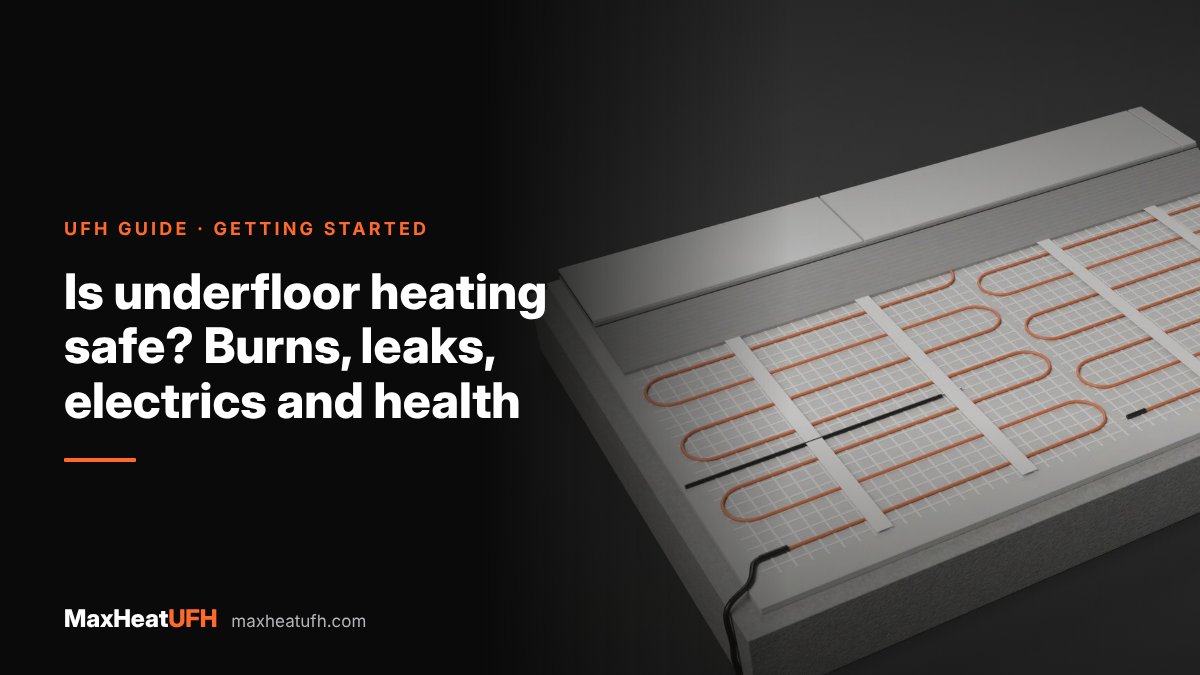
- 30mA RCD: electric floor heating circuits must have RCD protection rated at 30mA or less, which disconnects the supply in a fraction of a second if current leaks to earth.
- Earthed grid or screen: where heating units have no exposed conductive parts, the regulations require a metallic grid, with spacing of no more than 30mm, connected to the protective conductor above the elements. Your electrician confirms the arrangement for the electric mat you fit.
- Overheating protection: the regulations require measures against overheating of the floor, which is why mats must never run under fixed furniture and why a floor probe limits the floor temperature under sensitive finishes.
- Qualified connection: the final connection must be made by a qualified electrician, and the work falls under Part P of the Building Regulations in dwellings. Testing the mat's resistance before, during and after installation catches damage before it is tiled in.
Laying a mat yourself is allowed; energising it is the electrician's job. The detail is in our guide to RCD requirements for electric UFH.
Can underfloor heating pipes leak?
Rarely, and almost never from the pipe itself. A wet UFH loop is a single continuous length of plastic pipe from the manifold and back, with no joints buried in the floor, which removes the main cause of plumbing leaks. The pipe is rated far above anything the system does: our PERT-EVOH pipe takes 6 bar at 70°C, while a sealed heating system runs at 1 to 2 bar and UFH water at 35 to 55°C.
The leaks that do happen come from site damage, a nail or screw through a pipe, or a fitting at the manifold. The defences are simple:
- Pressure test before the floor goes down. One pipe maker's instructions test at 6 bar held for over an hour; our guide to pressure testing UFH gives the method and what to record.
- Keep the pipe under pressure while the screed is laid, so any damage shows at once.
- Photograph the pipe layout before it is covered, so nobody drills or screws into a loop later.
- Know that a damaged pipe is repairable. A pressure-rated coupling fixes a punctured loop; see repairing a damaged UFH pipe.
Is the water in the system a health risk?
The heating circuit is sealed and completely separate from your taps and drinking water, so you never come into contact with it. The water quality rules that apply to it are about protecting the system, not the occupants.
BS 7593:2019 is the code of practice: clean and flush the system, dose it with inhibitor, test the water annually, and re-dose or lab-test every five years. Because UFH runs below 60°C, the standard says to consider a biocide as well, which stops bacterial growth inside the sealed circuit that would otherwise foul the pipework. Our guide to inhibitor, biocide and antifreeze covers the dosing.
Questions about legionella relate to stored domestic hot water, not to a sealed heating circuit; HSE guidance on hot water safety deals with taps, baths and showers, where outlet temperatures above 44°C are the scalding risk. If anyone in the household is medically vulnerable, direct questions about their care to a GP or occupational therapist rather than a heating guide.
Is underfloor heating safe for children, older people and pets?
It removes the two hazards radiators bring into a room: a surface hot enough to burn and a hard object to fall against. A floor at or below 29°C is warm to bare feet but cannot scald, and there is nothing to pull off a wall, nothing to trap fingers and no sharp valve at toddler height.
- Older people: an even floor temperature and no radiators to navigate suits accessible design; our guide to UFH in accessible homes covers layouts.
- Pets: dogs and cats will find and lie on the warm floor; at EN 1264 surface temperatures that is comfort, not risk.
- Bathrooms: electric UFH in bathrooms must respect the zone and RCD rules in BS 7671, which is a job for the electrician, not a judgement call.
What are the warning signs that something needs checking?
A safe system is a maintained one. None of these means danger on its own, but each deserves attention rather than a shrug:
- Pressure falling on the gauge over days or weeks: find out where the water is going before topping up again.
- An RCD that trips when the electric UFH runs: have the circuit tested by a qualified electrician; do not reset and ignore it.
- A floor that feels hot rather than warm: check the blending valve setting and the thermostat's floor limit.
- Damp patches, lifted flooring or a musty smell near the heated area: investigate as a possible leak.
- Boiler or heat pump faults: gas appliance work is for a Gas Safe registered engineer only.
Annual checks of pressure, inhibitor level and controls keep the system in the state the standards assume.
Design your UFH system yourself in 3 minutes with MaxHeatUFH ProLoop and get an instant quick design and quote. Start your design
Frequently asked questions
Can underfloor heating catch fire?
A system installed to BS 7671 has overheating protection designed in: 30mA RCD protection, an earthed grid or screen over the elements, floor temperature limits and no heating under fixed furniture. The final connection must be made by a qualified electrician under Part P.
How hot does an underfloor heated floor get?
Design standards cap the surface at 29°C in occupied areas, 33°C in bathrooms and 35°C in perimeter bands. For comparison, HSE treats 43°C as the limit for hot surfaces around vulnerable people.
Is underfloor heating safe under wooden floors?
Yes, with a floor probe limiting the surface temperature to the flooring maker's stated maximum. See our guide to wood flooring over UFH for the details.
Is it safe to drill into a floor with underfloor heating?
Only once you know where the pipes or cables run. Use the installation photos or a thermal imaging survey first, and never fix into the floor on guesswork.
Is water or electric underfloor heating safer?
Both are safe when installed to the standards. Water systems carry low-pressure warm water with no joints in the floor; electric systems rely on 30mA RCD protection and an earthed grid or screen. The choice between them is about the project, not safety.
Does underfloor heating cause damp or mould?
No, a gently warmed floor dries surfaces rather than wetting them. Damp has a source, and heating choice is rarely it; our guide to UFH, damp and allergies separates the facts from the folklore.
Who should install underfloor heating?
A competent installer for the floor side, a qualified electrician for every electrical connection, and a Gas Safe engineer for any boiler work. MaxHeatUFH does not install, but works with vetted approved installers across the UK.
Sources: HSE guidance on scalding and burning, IET article on BS 7671 Section 753 floor heating requirements, Benchmark guidance on heating system water quality (BS 7593)
Products in this guide
Watch how each part works and how to fit it, and download its data sheet and install manual.


Every data sheet and manual: Product Library · All videos: MaxHeatUFH on YouTube
Design it in MaxHeatUFH ProLoop
Add your rooms, choose screed, overlay, joisted or electric, and get a free quick design and full kit list with prices.
Related guides
 Underfloor heating trade accounts: how installers buy UFH supplies at trade pricesGetting started · 5 min read
 Buying underfloor heating supplies online: what to check before you orderGetting started · 6 min read
 Underfloor heating glossary: every term explained (A to Z)Getting started · 14 min read