Underfloor heating glossary: every term explained (A to Z)
Plain-English definitions of underfloor heating terms, from actuators, manifolds and Eurocones to tog ratings, delta T, weather compensation and BS EN 1264.
Short answer: A wet underfloor heating system is made of pipe loops in the floor, a manifold that feeds them, a pump and mixing valve that set the water temperature, and thermostats and actuators that open each loop when a room needs heat. Most other UFH terms describe how the floor is built (screed, overlay, spreader plates, insulation), how much heat it gives (W/m², flow temperature, delta T) or how it is controlled (floor probe, setback, weather compensation). This glossary explains every common term in plain English, grouped by topic and listed A to Z within each group.
Quotes, product pages and installation manuals for underfloor heating are full of jargon. Some of it is borrowed from plumbing, some from electrics and some from building regulations. If you do not know what a Eurocone, a blending valve or a tog rating is, it is hard to compare quotes or follow a manual.
Each entry below gives a short definition and, where it helps, a figure from a maker's handbook or a standard. Where a topic has its own guide, we link to it. Terms are grouped so related words sit together: the parts of a wet system, pipe and fittings, the floor build-up, design and performance, controls, electric UFH, heat pumps, and standards and regulations.
What are the parts of a wet UFH system called?
- Actuator: a small head that sits on a manifold valve and opens or closes one loop when the room thermostat calls for heat. Most UFH actuators are thermal: a heated element moves a pin slowly, so they open and close gradually rather than instantly. A 2-wire thermal actuator suits most 230V wiring centres.
- Auto air vent: a valve, usually at the end of the manifold, that lets trapped air out of the system automatically while keeping water in.
- Ball valve: a quarter-turn shut-off valve. A pair on the manifold flow and return lets you isolate the manifold for maintenance without draining the whole system.
- Blanking cap or plug: a fitting that seals an unused port or the end of the manifold bar.
- Blending valve: a thermostatic valve that mixes hot water from the boiler with cooler return water to give a steady, lower flow temperature for the floor. Often used in the same sense as mixing valve.
- Drain and fill valve: a small valve with a hose tail on the manifold, used to fill, flush and drain the loops.
- Flow and return: flow is the water going out to the floor; return is the cooler water coming back. A manifold has a flow bar and a return bar.
- Flow meter: a clear gauge on the manifold that shows how much water is going through each loop, usually in litres per minute. It is used to balance the loops.
- Low loss header: a short, wide pipe that separates the boiler or heat pump circuit from the heating circuits, so each pump can run without upsetting the other. Also called a hydraulic separator.
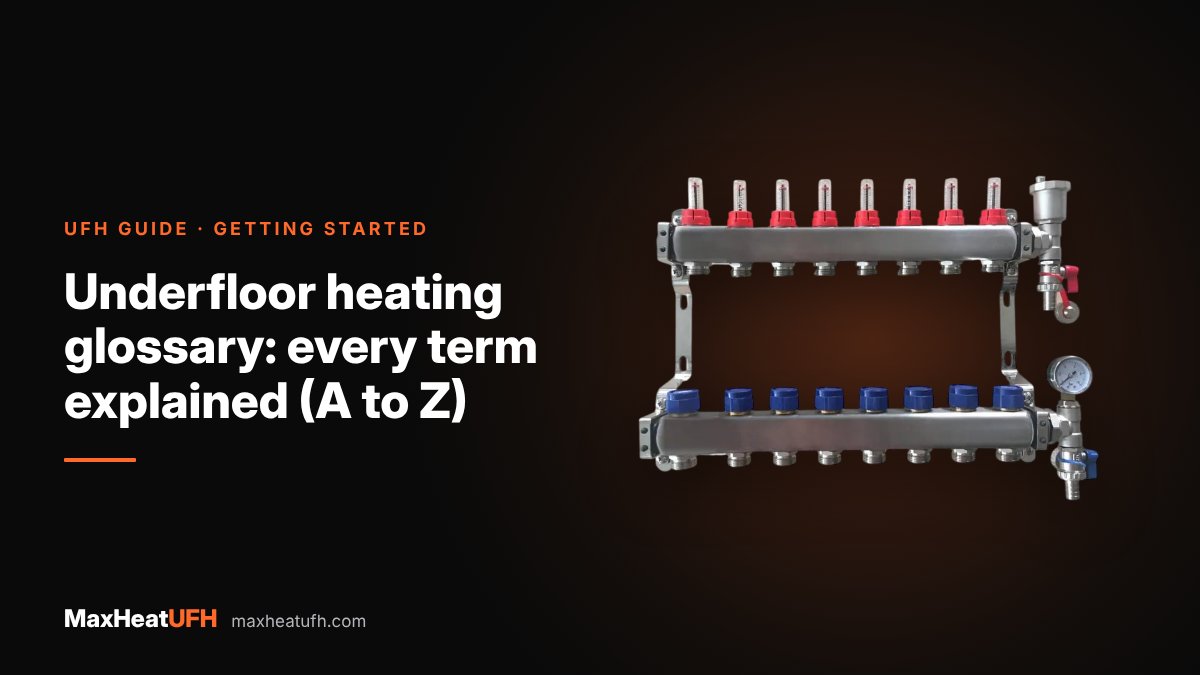
- Manifold: the central unit that splits the flow into individual loops and collects the return. It carries the flow meters, loop valves, actuators, air vent and gauges. See UFH manifolds and our manifold guide.
- Mixing valve or pump pack: the unit on the side of the manifold that brings the water temperature down to suit the floor and circulates it. Our guide to mixing and blending valves explains the types.
- Non-mixing pump set: a pump set with no mixing valve, used where the heat source already supplies water at floor temperature, typically a heat pump.
- Port: one connection point on the manifold. Each loop needs one flow port and one return port.
- Pressure gauge: shows the system water pressure. A falling reading over days usually means a leak or air loss.
- Primary pipework: the pipe between the boiler or heat pump and the manifold.
- Pump (circulating pump): moves water around the loops. One manufacturer's UFH handbook describes it as maintaining the pressure head needed to overcome losses in the circuits and the whole system.
- Three-port valve: a motorised valve that splits boiler flow between heating and hot water, as in a Y-plan system. A mid-position valve can feed both at once.
- Two-port zone valve: a motorised valve that opens and shuts one heating zone, as in an S-plan system.
- Wiring centre: a box near the manifold that connects the thermostats, actuators, pump and boiler or heat pump. When a thermostat calls for heat, it opens that zone's actuators and starts the pump.
What do the pipe and fitting terms mean?
- Bend support: a plastic former that holds pipe in a smooth 90° bend where it rises out of the floor to the manifold.
- Chamfering or reaming: bevelling the inside edge of a cut pipe so the fitting's O-rings are not damaged. One manufacturer's manifold connection guide calls for a 2mm bevel all round.
- Circuit or loop: one continuous length of pipe running from the manifold flow port, through the floor and back to the return port. One manufacturer's handbook says a heating circuit should not exceed 100m.
- Compression fitting: a fitting that seals by tightening a nut onto an olive or insert. Easy to remake but not always suited to being buried.
- Conduit: a corrugated sleeve slid over pipe where it passes through walls, expansion joints or crowded areas near the manifold.
- EVOH (oxygen barrier): a thin layer in plastic pipe that stops oxygen passing through the pipe wall into the water, which would otherwise corrode metal parts of the system.
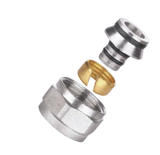
- Eurocone: a standard cone-shaped pipe connection used on most UFH manifolds. A Eurocone insert pushes into the pipe and a nut clamps it to the manifold port.
- Feed pipes or tails: the lengths of loop pipe between the manifold and the room the loop heats.
- MLCP (multilayer composite pipe): plastic pipe with an aluminium layer in the middle, such as PERT-AL-PERT or PEX-AL-PEX. It holds its shape when bent and has very low expansion. See UFH pipe.
- M-profile and U-profile: the jaw shapes used to press fittings. Copper press fittings usually use M-profile, multilayer fittings often U-profile. The jaw must match the fitting.
- PE-RT: polyethylene of raised temperature resistance, a flexible plastic used for UFH pipe, usually with an EVOH oxygen barrier.
- PEX: cross-linked polyethylene, another common UFH pipe plastic.
- Pipe centres: the distance between the middle of one pipe run and the next, also called pipe spacing or pitch. Closer centres give more heat at the same water temperature but use more pipe.
- Press fitting: a fitting sealed by crimping it onto the pipe with a press tool. Used where joints will be buried or must not be disturbed.
What do the floor and build-up terms mean?
- Castellated panel: an insulated or plastic sheet with raised bosses that hold the pipe in place before screed is poured.
- Clip rail and tacker clips: two ways of fixing pipe to insulation before screeding. Rails are strips with pipe clips at set spacing; tacker clips are stapled through the pipe into the insulation.
- Decoupling membrane: a layer between the floor and tiles that absorbs movement, often used with electric UFH under tiles.
- DPM (damp proof membrane): a sheet that stops ground moisture rising into the floor. On a ground floor it goes below the UFH insulation or as specified by the designer.
- Edge insulation strip: a foam strip fixed around the room perimeter before screeding. It stops heat escaping into the walls and lets the screed expand.
- Floor build-up: all the layers from the structural floor to the finished surface: insulation, pipe system, screed or boards, adhesive and finish.
- Floor covering resistance: how much the finish, such as carpet or wood, slows heat leaving the floor, measured in m²K/W. One manufacturer's handbook, following EN 1264, uses 0.10 m²K/W for living rooms and 0.0 for bathrooms, with up to 0.15 m²K/W by agreement.
- Insulation R-value: resistance to heat flow through insulation, in m²K/W. One manufacturer's handbook gives EN 1264 minimums of 0.75 above a heated room, 1.25 above an unheated space or the ground and 2.00 above outside air.
- Joisted floor: a timber floor on joists. UFH goes between or above the joists, usually with spreader plates or routed panels.
- Liquid screed: a flowing screed, often calcium sulphate (anhydrite) based, poured around the pipe. It self-levels and wraps the pipe closely.
- Overlay board: a thin routed board laid over an existing floor, used where floor height is limited.
- Routed board: an insulation or chipboard panel with grooves cut for the pipe at fixed centres, such as MaxHeatChip, MaxHeatPanel or MaxHeatDeck.
- Screed: a layer of sand and cement or liquid screed laid over the pipe. It protects the pipe, spreads the heat and stores it.
- Spreader plate: an aluminium plate that holds pipe under a timber floor deck and spreads its heat across the floor.
- Tile backer board: a rigid board, often cement-faced, that gives a stable base for tiles over insulation or heating.
- Tog: a unit of thermal insulation used for carpet and underlay. One carpet maker, citing the Underfloor Heating Manufacturers Association, says the carpet and underlay together should not exceed 2.5 tog over UFH, and recommends underlay under 1.3 tog. See our guide to carpet tog ratings.
What do the design and performance terms mean?
- Balancing: adjusting each loop's flow so every room gets the water it needs. Long loops need more flow setting than short ones.
- Commissioning: the checks and settings done when a system is first run: filling, bleeding, balancing, setting the flow temperature and testing the controls.
- Delta T (ΔT): the difference between flow and return water temperature. One manufacturer's handbook uses a design difference of 5K for UFH.
- Edge or perimeter zone: a band of tighter pipe along a cold outside wall or glazing. EN 1264, as set out in one manufacturer's handbook, allows it to be up to 1m wide with a surface up to 35°C.
- Floor surface temperature limits: EN 1264 limits, from one manufacturer's handbook: 29°C in occupied areas, 35°C in edge zones and room temperature plus 9K in bathrooms, which is 33°C at 24°C.
- Flow temperature: the temperature of water going into the floor. One manufacturer's handbook gives a 55°C maximum for cement and calcium sulphate screeds.
- Heat flux or heat output: the heat the floor gives the room, in watts per square metre (W/m²). One manufacturer gives about 100W/m² at the 29°C limit and about 175W/m² in edge zones. See our guide to heat loss and UFH output.
- Heat loss: the rate a room loses heat through walls, windows, floor, roof and draughts, in watts. The floor's output must match it.
- Loop design: the drawing that sets each loop's route, length, spacing and manifold port. MaxHeatUFH ProLoop gives a quick design; a full loop design can be ordered separately.
- Mean water temperature: the average of flow and return temperature. Output tables are often quoted at a stated mean water temperature.
- Pressure loss: the resistance a loop puts against the pump. One manufacturer's handbook says total pressure loss should not exceed 250 mbar.
- Pressure test: filling the pipe and holding it at a test pressure for a set time before the floor is covered, to prove there are no leaks.
- Thermal mass: how much heat the floor stores. A thick screed has high thermal mass, so it warms and cools slowly.
- Warm-up time: how long the floor takes to reach temperature from cold. Thin overlay systems warm faster than screed.
- Weather compensation: a control that lowers the flow temperature in mild weather and raises it in cold weather, using an outdoor sensor. It suits UFH and heat pumps well.
Design your UFH system yourself in 3 minutes with MaxHeatUFH ProLoop and get an instant quick design and quote. Start your design
What do the control and thermostat terms mean?
- Air sensor: a thermostat sensor that reads room air temperature. It can be built in or a separate remote sensor.
- Fail-safe: what a wireless system does if it loses the thermostat signal. Heatmiser's UH8-RF wiring centre runs the zone for 12 minutes every hour until the link returns.
- Floor limit: a maximum floor temperature set on the thermostat to protect the floor finish. On the Heatmiser neoStat V3 it can be set from 20°C to 45°C, default 28°C.
- Floor probe: a wired sensor laid in the floor so the thermostat can read or limit the floor temperature. Required for electric UFH and wood floors on many thermostats.
- Frost mode: a setting that keeps heating off unless the room falls to a low frost temperature. On a Heatmiser neoStat it defaults to 12°C, adjustable from 7°C to 17°C.
- Hold: a temporary override that keeps a set temperature for a chosen time, then returns to the programme.
- Hub: a unit that links wireless or smart thermostats to your router and app, such as the Heatmiser neoHub.
- Optimum start: the thermostat learns how long the room takes to warm and starts early so it is up to temperature on time. On a neoStat, a flashing flame shows it is active.
- Programmable thermostat: a thermostat with set times and temperatures through the day. See thermostats and controls.
- Setback: a lower temperature set for night or when the house is empty, instead of switching off.
- Switching differential: how far the temperature must drop below the set point before the thermostat calls for heat again.
- Zone: an area controlled by one thermostat. It can be one room or several loops.
What do the electric UFH terms mean?
- Cold tail: the unheated cable that connects a heating mat or cable to the thermostat.
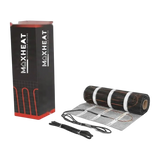
- Heating mat: a heating cable fixed to a mesh at set spacing, rolled out and tiled over. Rated in W/m².
- Loose cable: heating cable without a mesh, fixed on site at the spacing you choose. It suits awkward room shapes.
- W/m²: the power of an electric system per square metre. MaxHeatUFH mats come in 100, 150 and 200W/m² versions.
- 16A thermostat: a thermostat able to switch an electric heating load directly, up to 16 amps.
What do the heat pump, standards and regulation terms mean?
- Anti-freeze valve: a valve on outdoor heat pump pipework that drains a little water if it gets near freezing. One manufacturer's valve opens at 1°C.
- BS 7671: the UK wiring regulations. Electric UFH must be connected to them by a qualified electrician.
- BS EN 1264: the European standard for water-based underfloor heating, covering surface temperature limits, output and installation.
- COP and SCOP: coefficient of performance. COP is how many units of heat a heat pump gives per unit of electricity at one moment. SCOP is the average over a heating season. Lower flow temperatures improve both.
- Gas Safe: the register of engineers legally allowed to work on gas appliances in Great Britain. Any boiler connection work needs one.
- Glycol: antifreeze added to heating water. One inhibitor maker's glycol product protects to -11°C at its minimum 25% concentration.
- MCS: the Microgeneration Certification Scheme, which certifies heat pump installers and products. Our guide to UFH grants and VAT explains when it matters.
- Monobloc heat pump: a heat pump with all its refrigerant parts in the outdoor unit and water pipes running to it from the house.
- Ofgem price cap: the limit on unit rates for standard variable energy tariffs. For the October 2026 price cap, it is 26.32p/kWh for electricity and 7.97p/kWh for gas, GB average, direct debit.
- Part L: the part of the Building Regulations for England that covers energy efficiency, including insulation and heating controls.
- Part P: the part of the Building Regulations for England that covers electrical safety in homes, including new circuits such as electric UFH.
Frequently asked questions
What is the difference between flow and return?
Flow is the warm water going out to the floor loops; return is the cooler water coming back to the manifold and heat source.
What is the difference between a manifold and a wiring centre?
The manifold is plumbing: it splits water between the loops. The wiring centre is electrics: it connects thermostats to the actuators on the manifold, the pump and the boiler or heat pump.
What is a UFH actuator?
A small head on a manifold valve that opens or closes one loop when its thermostat calls for heat.
What does W/m² mean for underfloor heating?
Watts per square metre. For electric UFH it is the power of the mat. For wet UFH it is the heat the floor gives the room.
What is a blending valve?
A valve that mixes hot water from the boiler with cooler return water, so the floor gets water at a steady, lower temperature.
Sources: Heatmiser: neoStat frost mode, Heatmiser: neoStat icons, Heatmiser: UH8-RF fail-safe, Heatmiser neoStat V3 datasheet, Ofgem energy price cap
Products in this guide
Watch how each part works and how to fit it, and download its data sheet and install manual.


Every data sheet and manual: Product Library · All videos: MaxHeatUFH on YouTube
Design it in MaxHeatUFH ProLoop
Add your rooms, choose screed, overlay, joisted or electric, and get a free quick design and full kit list with prices.