Underfloor heating manifold guide: how a manifold works and how to choose one
How a UFH manifold works, what each part does, stainless vs composite vs brass, manual vs auto-balancing, and a step-by-step checklist for choosing the right 2 to 12 port manifold and pump pack.
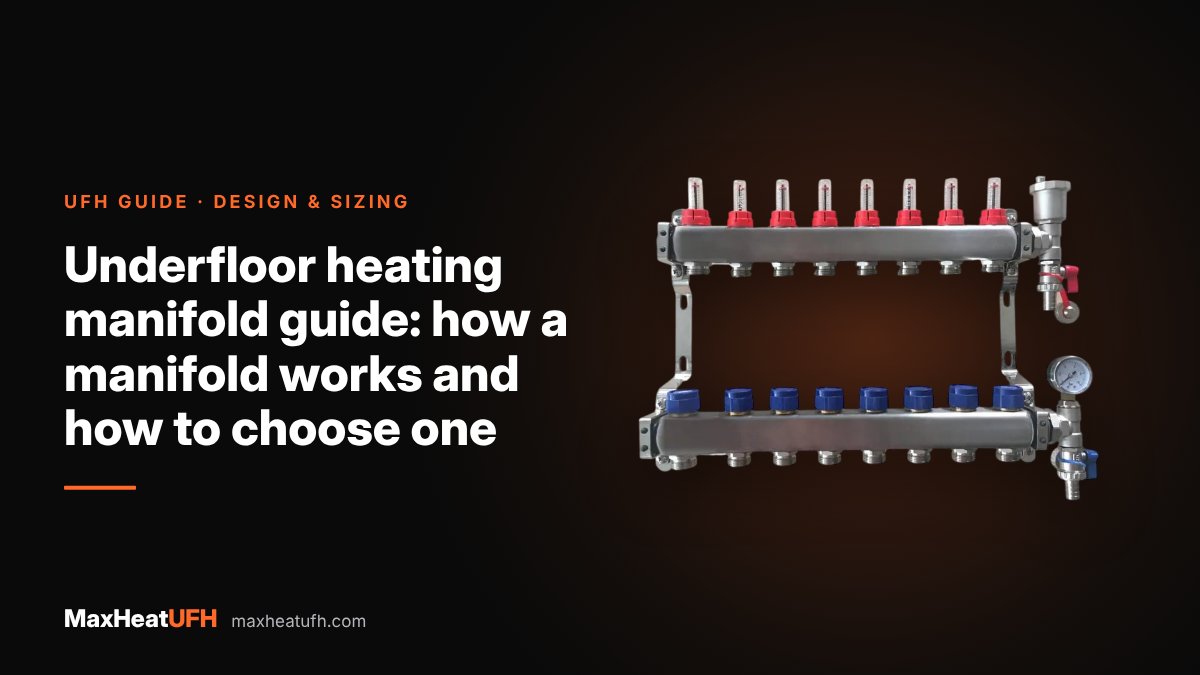
Short answer: A UFH manifold takes one flow and return from your boiler or heat pump and splits it into separate floor loops. Water enters the flow bar, passes a flow meter into each loop, comes back into the return bar and goes back to the heat source, while a valve and actuator on each loop open when that room's thermostat calls for heat. Choose one port per loop (most homes use 2 to 12), stainless steel or composite bars rated for your system, outlets that match your pipe, and a pump pack to suit the heat source: a blending valve pack for a boiler, usually a non-mixing set for a heat pump.
Every wet underfloor heating system has a manifold. It is where the loops are joined, filled, vented, balanced and switched on and off. It is also the only place in a screeded system where the loop pipe has joints, which is why it has to stay accessible.
This guide explains what each part of a manifold does, how the water moves through it, how stainless, composite and brass manifolds differ and how to choose one for your job. For port counts and loop lengths, see how many manifold ports do I need. For the pipework connections, see connecting a UFH manifold.
What does an underfloor heating manifold do?
It shares heat from one heat source between many floor loops and lets you control each one. Without it, you would have one long pipe with one temperature and no way to heat rooms separately.
A manifold does four jobs:
- Distributes: splits the flow into separate loops, each serving a room or part of a room.
- Balances: lets you set the flow rate in each loop so short and long loops heat evenly.
- Controls: opens and closes each loop, through actuators wired to room thermostats.
- Fills and vents: gives you somewhere to flush, fill, pressure test and bleed the loops.
With a pump pack fitted, it also sets the water temperature going into the floor and circulates it round the loops.
How does a UFH manifold work?
Water flows in one direction through the manifold, from the heat source, round each loop and back. On a typical system with a pump pack, the path is:
- Primary flow arrives from the boiler, cylinder or heat pump through an isolating ball valve, usually red.
- The pump pack blends it down to floor temperature if the source is hotter, then pumps it into the flow bar.
- The flow bar feeds each loop through its flow meter, which shows and sets the flow rate.
- Each loop runs through the floor, giving off heat, and returns to the manifold.
- The return bar collects the cooler water. Each loop's port has a valve, opened and closed by an actuator.
- Primary return goes back to the heat source through a blue ball valve.
When a room thermostat calls for heat, the wiring centre powers that zone's actuators. The actuator opens the valve on the return bar and water flows through that room's loops. When every zone is satisfied, the wiring centre turns off the pump and tells the boiler or heat pump it no longer needs heat. Our guide to UFH zoning and wiring centres explains the wiring.
Layouts vary between makers. Some fit the flow bar on top and some below, so always check the labels and the red and blue valve handles rather than assuming.
What are the parts of a manifold?
Most manifolds have the same parts. Some are fitted as standard and some are added to suit the job.
| Part | What it does |
|---|---|
| Flow bar | Feeds warm water to each loop |
| Return bar | Collects water back from each loop |
| Flow meters | Show and adjust each loop's flow, in litres per minute |
| Valve inserts and actuators | Open and close each loop for zone control |
| Automatic air vent | Lets out air from the bars |
| Fill and drain valves | Flush, fill, pressure test and drain the loops |
| Pressure gauge | Shows system pressure |
| Ball valves | Isolate the manifold from the primary pipework |
| Eurocone connectors | Join each loop pipe to a 3/4" outlet |
| Pump pack | Circulates water and, if a blending type, sets floor temperature |
Flow meter ranges differ by maker. One leading manufacturer's manifold reads 0 to 5 litres per minute. Our auto-balancing manifold reads 0 to 4 litres per minute on every circuit. The design gives you the target flow for each loop.
Most UK manifolds use 3/4" Eurocone outlets and 1" main connections. The outlets take a Eurocone connector core sized to your pipe, two per loop.
Stainless steel, composite or brass: which manifold is best?
All three work. The bigger differences are in weight, how they extend, and the pressure and temperature ratings, so match the ratings to your heat source and test pressure.
| Material | Examples | Points to know |
|---|---|---|
| Stainless steel | Most UFH brands, including MaxHeatUFH | Bars do not corrode. The most common choice for new UK systems. |
| Composite | Some larger UFH brands | Glass-fibre reinforced plastic. Light, and built from modules that clip together. |
| Brass | Older and budget systems | A long-standing option, now largely replaced by stainless steel. |
Ratings vary a lot from one product to the next, even within one material:
- One maker's stainless range: 8 bar, 100°C maximum.
- Another maker's stainless range: 5 bar continuous at 80°C, 10 bar test at 20°C.
- MaxHeatUFH auto-balancing stainless: 6 bar, 70°C maximum.
Check the rating against your pressure test and the hottest water the manifold could see. If a boiler feeds the manifold, the blending valve protects the floor, but the primary side still sees boiler temperature.
Manual balancing or auto-balancing?
A standard manifold is balanced by hand: you set each loop's flow meter or return valve to the design flow rate during commissioning. An auto-balancing manifold holds each loop at its set flow on its own, even as other zones open and close.
- Standard, such as the Dualmix stainless manifold: supplied with pressure gauge and air vent fitted. Balance it at commissioning.
- Auto-balancing: dynamic, pressure-independent valves on the return bar. You preset each circuit with a setting key and the valve keeps that flow.
Auto-balancing suits systems where zones switch on and off a lot, and heat pump systems where steady flow matters. Either way, see how to balance UFH loops for the target flows.
Do I need a mixing pump pack on the manifold?
You need a blending (mixing) valve when the heat source runs hotter than the floor should. You usually do not when the heat source already runs at floor temperature, as most heat pumps do.
| Heat source | Usual pump pack |
|---|---|
| Gas or oil boiler, also running radiators | Blending valve pump pack 20 to 55°C |
| Heat pump at floor temperature | Non-mixing pump set |
| Heat pump pumping straight through the loops | No pump pack, if the design allows |
Leaving out a mixing unit where the source can supply the right temperature can help the heat source run more efficiently. Our guides to blending valves and non-mixing pump sets for heat pumps go into detail.
How do I choose the right manifold?
Work through these in order and you will have the whole manifold specified:
- Count the loops. One port per loop. One leading manufacturer says that with loops of 80 to 100m, a manifold should ideally not go over 12 ports. If you need more, use two manifolds.
- Check the pipe size. Order Eurocone cores to match, such as 16mm or 12mm. Loop limits are about 100m for 16mm pipe and 60m for 12mm, according to manufacturer guidance.
- Pick the pump pack for your heat source, as above.
- Choose standard or auto-balancing.
- Add isolation. A 1" ball valve set, with gauges if you want to read flow and return temperatures.
- Add control. One 2-wire thermal actuator per loop and a wiring centre with the same voltage.
- Check the space. Most makers want at least 300mm from the finished floor to the lowest part of the manifold or pump set, and one leading manufacturer asks for 100mm clear above and to each side.
Leave yourself a spare port if you might add a room later. If you run out, the Dualmix takes a 1 port extension, and a spare port can be closed with a blanking cap.
Design your UFH system yourself in 3 minutes with MaxHeatUFH ProLoop and get an instant quick design and quote. Start your design
Products for this job
- Dualmix Stainless Steel Manifold Assembly (2 to 12 port)
- Auto-Balancing Stainless Steel UFH Manifold (2 to 12 port)
- Eurocone Connector Cores 3/4"
- Manifold Ball Valve Set 1"
- 2-Wire Thermal Actuator 230V
- Blending Valve Pump Pack with Grundfos UPM3 Flex
- Non-Mixing Pump Set with Grundfos UPM3 Flex
- All manifolds and components
Frequently asked questions
What is the difference between the flow bar and the return bar?
The flow bar sends warm water out to the loops and usually carries the flow meters. The return bar collects water coming back and usually carries the valves that the actuators open and close.
How many loops can one manifold take?
Most manifolds come in 2 to 12 ports. One leading manufacturer says 12 is the sensible maximum with loops of 80 to 100m, though some ranges extend further.
Can I add a port to an existing manifold?
Often, yes. Many manifolds take extension modules. The Dualmix takes a 1 port extension. Check your pump pack and the system design can cope with the extra loop.
Does every loop need an actuator?
Only if you want to switch it on and off. Every loop in a room that has its own thermostat needs one. Loops that are always open, such as on a single-zone system, can use the manual cap instead.
Can one manifold serve radiators as well?
It can if they run at the same flow temperature, but the system must be balanced carefully because radiators have lower resistance than floor loops. Usually radiators stay on their own circuit.
Is a stainless manifold better than plastic?
Stainless bars do not corrode and are the most common choice. Composite manifolds from major makers are light and modular. Pick on ratings, fittings and support rather than material alone.
Do I need a pump on the manifold with a heat pump?
Not always. Some heat pump systems pump straight through the loops. Many use a non-mixing pump set on the manifold so the floor has its own circulation. Follow the heat pump design.
Sources: Homebuilding: UFH manifolds, and manufacturers' installation guidance to BS EN 1264
Products in this guide
Watch how each part works and how to fit it, and download its data sheet and install manual.




Every data sheet and manual: Product Library · All videos: MaxHeatUFH on YouTube
Design it in MaxHeatUFH ProLoop
Add your rooms, choose screed, overlay, joisted or electric, and get a free quick design and full kit list with prices.