Engineered and solid wood floors on underfloor heating: temperature, moisture and fitting
How to lay engineered or solid wood over underfloor heating: the 27°C surface limit, board thickness and resistance, species to avoid, screed moisture and humidity, and the commissioning and warm-up routine.
Short answer: Engineered wood is the safer choice over underfloor heating, and some makers also approve solid hardwood when it is glued to a dry screed. Keep the wood surface at or below 27°C, which is the limit every wood flooring maker we checked sets. Choose boards about 14 to 22mm thick, which add roughly 0.08 to 0.13m²K/W, get the screed dry to the maker's limit (often 1.5 to 1.8% CM, or 75% RH in the UK), and keep room humidity between about 35% and 65%.
Wood is a natural material that swells when it takes up moisture and shrinks when it dries. Underfloor heating (UFH) dries the air and the boards, especially in winter, so a wood floor over heating moves more than the same floor over a cold slab. That movement is why wood makers set a lower surface temperature than other finishes, ask for a fully dried and heated screed before fitting, and want slow temperature changes afterwards.
This guide sets out the figures from six wood flooring makers, labelled Maker A to F: surface temperature, board thickness and resistance, species, screed moisture, humidity, the warm-up before and after fitting, and fixing methods. For all finishes compared, see underfloor heating under tiles, LVT, laminate, wood and carpet.
Can you put engineered or solid wood flooring on underfloor heating?
Yes for engineered wood, and yes for some solid wood. Makers disagree on solid boards, so follow the maker of the floor you are buying.
- Engineered wood: a hardwood top layer bonded to a cross-layered core. The core resists movement, so it is the usual choice. BEAMA's guide for heating makers calls engineered timber a stable choice over UFH.
- Solid wood: one UK wood flooring company says never to fit solid wood over UFH. One solid hardwood maker (Maker A below) publishes full systems for its solid boards over UFH, glued, clipped or on battens. BEAMA says solid hardwood should be kiln-dried, stored dry before fitting, and always used with a floor sensor.
- Softwood: BEAMA does not recommend softwoods for high-output systems because they can warp.
Whichever you choose, expect some movement. Maker A says wood shrinks when heated, so you will see larger gaps between boards in the heating season, and larger still where the floor runs warmer, such as under low bookcases or thick rugs.
What is the maximum floor temperature for wood on underfloor heating?
27°C at the surface. Several wood flooring makers give the same figure, and one of them aims lower still, at about 24 to 25°C with the room at about 21°C.
The heat source and the floor are not at the same temperature. The boards resist heat, so the screed under them runs warmer than the wood surface. Maker A gives this example: with 22mm boards giving 70W/m², the subfloor is about 9°C warmer than the wood surface. Its worked example with 0.15m²K/W of boards and underlay gives a concrete surface of about 37.5°C for a 27°C wood surface.
Maker A says flow temperatures normally lie between 35 and 45°C to keep the wood at 27°C, with an indicative maximum output of 100W/m². It adds that renovations often need extra heat from another source. Check the room's heat loss before you commit: our guide to heat loss and UFH output shows how.
The simplest way to hold the limit is a floor probe. Fit a 10K floor probe between the pipe runs, connect it to a thermostat with floor sensing and set the floor limit to 27°C or a little below. See floor probes and floor limits.
How thick can wood flooring be over underfloor heating?
Most makers' tables run from about 14 to 22mm. Thicker boards add more thermal resistance, so the floor gives less heat at the same water temperature.
| Board | Thermal resistance | Source |
|---|---|---|
| 14mm solid hardwood | 0.08m²K/W | Maker A |
| 15mm engineered | 0.08m²K/W (0.8 tog) | Maker B |
| 15mm solid hardwood | 0.09m²K/W | Maker A |
| 20mm engineered, 4 to 6mm top | 0.10m²K/W (1.0 tog) | Maker B |
| 20.5mm solid hardwood | 0.12m²K/W | Maker A |
| 22mm solid hardwood | 0.13m²K/W | Maker A |
Add any underlay to the board's figure. BS EN 1264 uses 0.10m²K/W as the standard floor covering for living rooms, and says values up to 0.15m²K/W must be agreed separately. A 20mm engineered board sits right at the standard. A 22mm solid board on a foam underlay goes past it.
The effect on output is real. In one UFH maker's table for a 65mm screed at 150mm pipe centres and 45/35°C water, tile gives 94W/m² and 15mm wood (0.10m²K/W) gives 66W/m², about 30% less. At 50/40°C, the wood floor gives 83W/m². Closer pipe centres or a slightly warmer flow can make up the difference, within the 27°C limit.
BEAMA adds a practical point: engineered boards under 20mm thick need extra decking for support unless they are laid over a screeded slab.
Which wood species should I avoid over underfloor heating?
Beech and maple are the species makers warn about most. They move more than most hardwoods as humidity changes.
- Maker D lists maple, beech and kempas as unsuitable over UFH.
- Maker E says hardwood is very susceptible to movement with humidity, "especially Beech and Maple".
- Maker F says its wood floors with an ash top layer are not suitable for floor heating.
- Maker A, by contrast, publishes UFH data for beech, oak, ash and maple boards without ranking them.
If the flooring maker approves a species for UFH in its written instructions, that approval is what counts. If the instructions are silent, choose another product.
How dry must the screed be before laying wood?
Very dry, and drier than for most other finishes. Test it, record the result and keep the record for the flooring warranty.
| Maker | Cement screed with UFH | Anhydrite screed with UFH |
|---|---|---|
| Maker C | below 1.5% CM or 70% RH | below 0.3% CM or 50% RH |
| Maker E | 1.5% CM or 75% RH max | not stated |
| Maker B | below 1.8% CM | not stated |
| Maker A (glued) | 75% RH in the UK | 75% RH in the UK |
| Maker D | below 75% RH floating, 65% RH glued | 0.5% residual moisture |
Most makers also want a moisture barrier. Maker C makes a 0.2mm polyethylene foil mandatory under its floating floors. Maker D asks for 0.2mm polythene or a liquid damp-proof membrane. Maker A applies its liquid moisture barrier before gluing. Our guide to screed drying times explains how long screeds take.
Room humidity matters as much as the screed. Maker A works to 35 to 65% RH for homes. Maker B asks for 40 to 65% during acclimatisation and 35 to 60% in use. Maker C allows 30 to 75% during fitting and 30 to 60% in use, and recommends continuous humidity monitoring with UFH.
How do I commission underfloor heating before laying a wood floor?
Run the heating through a full heat-up and cool-down cycle before any wood goes down, and get a written record of the temperatures. Maker D, referring to BS 8201, sets out this routine for a water system in screed:
- Wait. At least 21 days after a cement screed, or 7 days after an anhydrite screed.
- Start low. 23°C flow temperature, held for three days.
- Step up. Raise the flow by 5°C a day to the maximum design temperature.
- Hold. Keep it at maximum for three days, with no night set-back.
- Step down. Reduce by 10°C a day until the floor surface is 18°C.
- Record. Keep a certificate of the heat-up and cool-down for the flooring fitter.
Maker B uses a longer 21-day cycle: start at 20°C, rise by up to 5°C a day to 45°C, hold for about 8 days, then come down over about 8 days. Our guide to commissioning underfloor heating covers the system side.
How do I fit the wood and bring the heating back on?
Lay at a low, steady floor temperature, then raise the heat by 1 to 2°C a day. Maker D keeps the floor surface at 18°C during fitting and for three days after. Maker B waits at least 48 hours after gluing before turning the heating on, or about 14 days for floors with natural oil finishes, then raises it by 1 to 2°C a day.
- Glued down: the most common method on screed. Use the adhesive the flooring maker names for UFH. BEAMA says parquet should be glued continuously to the screed or deck.
- Floating: boards clicked or glued at the joints over an underlay. Maker C requires any added underlay to have a compressive strength of at least 400kPa.
- Nailed or screwed to joists: Maker B says there must be no air gaps, and the boards must never touch a hot water pipe.
- Expansion gap: at least 8mm round the edge and at fixed objects, often 13 to 15mm, per Maker B.
Can I put wood over joisted or electric underfloor heating?
Yes on joists, with the right layer between pipe and wood. Maker A requires heat-distribution plates for batten systems, and a pressure distribution board at least 15mm thick over grooved chipboard. Maker B asks for joists at 350mm centres or closer.
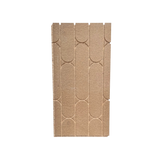
For joisted floors, use aluminium spreader plates between the joists, or MaxHeatChip routed chipboard on top. Our guide to UFH in joisted timber floors compares them.
Electric heating under wood is more restricted. Maker D allows it only if the heater maker can make sure the subfloor surface never exceeds 27°C, with a subfloor thermostat and evidence of that limit. Our electric mats and loose cable are made for tile and stone floors, so for wood we suggest water UFH.
Design your UFH system yourself in 3 minutes with MaxHeatUFH ProLoop and get an instant quick design and quote. Start your design
Frequently asked questions
Is engineered wood or solid wood better for underfloor heating?
Engineered wood, in most homes. Its layered core moves less with heat and humidity. Some solid hardwood floors are approved for UFH, but only within their maker's system.
What is the maximum temperature for engineered wood on underfloor heating?
27°C at the floor surface. Set the thermostat's floor limit to 27°C or a little below.
Will underfloor heating cause gaps in my wood floor?
Some seasonal gaps are normal, because wood shrinks as it dries in the heating season. Keeping humidity at about 35 to 65% and the surface under 27°C keeps the gaps small.
Can I use oak flooring over underfloor heating?
Yes. One maker, for example, publishes UFH guidelines for its engineered oak. Check that your product's instructions approve UFH and give a surface temperature limit.
How long should I wait to lay wood after the screed goes down?
At least 21 days for a cement screed before you even start the heating, then a full commissioning cycle, then a moisture test. In practice it is often several weeks more.
Can I lay wood on underfloor heating with a heat pump?
Yes. Heat pumps run cool, which suits wood. Check the floor still gives enough heat at your flow temperature with the board's thermal resistance included.
Do I need an underlay under engineered wood on underfloor heating?
Only for a floating floor. Glued floors need no underlay. If you float the floor, use a thin underlay sold for UFH and add its resistance to the board's.
Products in this guide
Watch how each part works and how to fit it, and download its data sheet and install manual.




Every data sheet and manual: Product Library · All videos: MaxHeatUFH on YouTube

Design it in MaxHeatUFH ProLoop
Add your rooms, choose screed, overlay, joisted or electric, and get a free quick design and full kit list with prices.