








How long does underfloor heating take to install?
Realistic timescales for underfloor heating: 1 to 2 days per room for electric mats, 2 to 4 days to pipe up a wet system, plus the screed waits that set the real calendar: 21 days before first heat for cement screed, 7 for anhydrite.
Short answer: An electric mat takes about 1 to 2 days per room including floor preparation. Piping up a wet system in a typical new build takes about 2 to 4 days, with retrofits adding a day or two of preparation first. The laying is not the slow part, the screed is: you can walk on it after 24 to 48 hours, but a cement screed must not be heated for 21 days (an anhydrite screed 7 days), and it dries at roughly 1mm of depth per day before the final floor can go down. Overlay board systems skip the screed and cut the whole job to days.
"How long does underfloor heating take?" really has two answers: how long the installer is on site, and how long before you can switch it on and lay the final floor. The first is measured in days. The second depends almost entirely on whether there is a wet screed in the build-up, and it is the number that catches people out when the flooring fitter is booked.
This guide breaks the job into stages with the times that are known, and shows where the timetable can be shortened. MaxHeatUFH supplies the kit with next working day UK delivery on orders placed by 12pm Monday to Friday; installation is handled by vetted approved installers, and you can send an installation enquiry here.
How long does electric underfloor heating take to install?
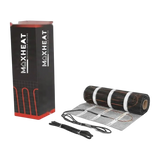
About 1 to 2 days per room, depending on the project. That covers preparing the subfloor, laying insulation boards, rolling out and taping the mat, fitting the floor probe, and resistance-testing the mat before and after it is covered. Tiling and grout curing then follow as they would on any tiling job.
The electrical connection is the one fixed dependency: the final connection to the mains and the thermostat must be made by a qualified electrician (Part P / BS 7671), so book one for the end of the job rather than discovering the requirement after the tiler has finished.
How long does a wet system take to pipe up?
Around 2 to 4 days for a typical new-build house, with larger or more complicated jobs taking longer. In an existing property, add roughly 1 to 2 days of preparation, lifting floors, clearing and levelling, before pipe can go down. The on-site work splits into:
- Subfloor preparation: insulation boards and edge insulation strip around the perimeter.
- Pipe laying: clipping or railing the loops to the design, running tails back to the manifold position.
- Manifold and connections: mounting the manifold, connecting loops, fitting the pump and blending valve.
- Pressure test: filling and testing the loops before anything covers them, see pressure testing UFH. A hydraulic test pump does the job, and the pipe stays under pressure while the screed is poured so any damage shows immediately.
- Screed: the pour itself is fast. Pumped flowing screeds go down at up to 2,000m² per day, so a house is a one-day pour; a hand-laid sand and cement screed takes longer.
How long does the screed hold everything up?
This is where the calendar time lives. Three separate waits apply, and they overlap rather than add neatly:
| Milestone | Sand and cement screed | Anhydrite (flowing) screed |
|---|---|---|
| Walk on it | 24 to 48 hours | 24 to 48 hours |
| First heating allowed | 21 days after laying | 7 days after laying |
| Drying rate for floor finishes | About 1mm per day up to 40mm, then slower | About 1mm per day in good conditions |
First heating then follows a commissioning ramp rather than a switch-on: start with a low flow temperature around 20 to 25°C, raise it by about 5°C per day to the design temperature, hold it, then step back down. Running the ramp actually helps the screed dry for flooring, and skipping it is a common cause of cracking. Our guides to screed depth and drying times and commissioning UFH cover both in detail.
So for a 50mm sand and cement screed, expect roughly three weeks before first heat and several more weeks before moisture readings allow a sensitive floor finish, unless the programme uses the heating ramp and good ventilation to speed drying.
How much faster are overlay and dry systems?
Dramatically faster, because the screed disappears from the critical path. Routed boards such as MaxHeatPanel are laid over the existing floor, the pipe is walked into the grooves, and tiling or flooring follows as soon as the loops have passed their pressure test. There is no 21-day wait and no drying time beyond normal adhesives.
The same goes for joisted systems on spreader plates and for castellated panels with a thin levelling layer, where the waiting time is the leveller's own drying, not a structural screed. See installing overlay UFH boards for the sequence.
What order do the trades go in?
On a new build or full renovation, underfloor heating slots into a fixed sequence, and most delays come from getting it wrong rather than from the UFH itself:
- First fix plumbing and electrics, including the manifold position and thermostat cabling.
- Insulation and edge strip.
- UFH pipe laid and pressure tested.
- Screed poured, with the pipe kept under pressure.
- Walk-on after 24 to 48 hours; other trades continue around the curing screed.
- First heating and commissioning ramp after the waiting period.
- Moisture test, then floor finishes.
Our guide to the new-build UFH sequence covers who does what at each stage.
How can you shorten the timetable?
- Choose anhydrite over sand and cement where the build-up allows: first heating at 7 days instead of 21.
- Choose an overlay or dry system in renovations: no screed wait at all.
- Commission with the ramp, early. The controlled warm-up is also the fastest legitimate way to dry the screed for flooring.
- Have the kit on site before the installer. MaxHeatUFH delivers next working day across the UK on orders placed by 12pm Monday to Friday, so missing fittings do not cost site days.
- Get the design done before anyone books dates. A clear loop plan means the pipe goes down once, with no re-laying.
Design your UFH system yourself in 3 minutes with MaxHeatUFH ProLoop and get an instant quick design and quote. Start your design
Frequently asked questions
How long does underfloor heating take to install in one room?
An electric mat room takes about 1 to 2 days including preparation, plus tiling. A single wet-system room on overlay boards is similar. A wet room in screed adds the screed's waiting time before heat and flooring.
How long before you can walk on the screed?
Typically 24 to 48 hours for both sand and cement and flowing anhydrite screeds. Walking on it is not the same as heating it, which comes much later.
When can underfloor heating be turned on after screeding?
No sooner than 21 days after a cement-based screed is laid, or 7 days for anhydrite, and then only on a ramp: start around 20 to 25°C flow and raise it by about 5°C per day. Heating a fresh screed hard from cold causes cracking and curling.
How long until the final floor can be laid?
When the screed is dry enough for the floor finish, as a rule of thumb screeds dry at about 1mm of depth per day in good conditions, so a 50mm screed can take several weeks. Moisture testing, not the calendar, gives the final answer.
Is retrofitting underfloor heating slower than a new build?
Usually, by a few days: existing floors must be lifted or prepared first, which adds roughly 1 to 2 days before pipe goes down, and overlay systems are often chosen precisely to claw that time back by skipping screed entirely.
Does the heating system itself slow down the rest of the build?
Only the screed wait does. Other trades can work in the building while the screed cures, as long as it is protected. Plan flooring and commissioning dates around the 7 or 21 day rule from the day of the pour.
Products in this guide
Watch how each part works and how to fit it, and download its data sheet and install manual.



Every data sheet and manual: Product Library · All videos: MaxHeatUFH on YouTube

Design it in MaxHeatUFH ProLoop
Add your rooms, choose screed, overlay, joisted or electric, and get a free quick design and full kit list with prices.
Related guides
 Underfloor heating trade accounts: how installers buy UFH supplies at trade pricesGetting started · 5 min read
 Buying underfloor heating supplies online: what to check before you orderGetting started · 6 min read
 Underfloor heating glossary: every term explained (A to Z)Getting started · 14 min read