Electric underfloor heating mat sizes: how to choose the right size
How to measure the free floor area and choose the right electric heating mat size, with a full size and wattage table, worked examples, and what to do if the mat is too big or the room falls between sizes.
Short answer: Measure the free floor area, leaving out baths, shower trays, toilets, kitchen units and anything fixed to the floor, then choose the mat size at or just below that figure. Never choose a mat bigger than the free area, because the heating cable cannot be cut or overlapped. If you fall between sizes, go down a size, or top up the gap with loose cable or a second mat taken back to the same thermostat.
Electric heating mats come in fixed sizes because each one is a single length of heating cable stuck to a mesh. You can cut the mesh and turn the mat to follow the room, but the length of cable, and so the area it covers, is fixed at the factory. Pick the wrong size and you either have cable left over with nowhere to put it, or a cold strip you did not plan for.
This guide shows how to measure the free area, lists the MaxHeatUFH mat sizes with their loads, works through three rooms, and explains what to do when the mat is too big, between sizes, or too small. If you have not yet measured the room, start with how to measure a room for underfloor heating.
How do I work out what size heating mat I need?
Take the room area and subtract everything the mat must not go under. The area left is your free floor area, and the mat should be that size or slightly less.
- Measure the room. Length × width in metres. Split L-shaped rooms into rectangles and add them up.
- Subtract fixed items. Baths, shower trays, toilet pans, pedestals, kitchen units, islands, built-in wardrobes and fixed appliances. One manufacturer says not to lay heating under fixed obstacles.
- Allow for clearances. One manufacturer keeps the heating at least half the cable spacing from obstacles. Another keeps cable runs at least 50mm apart and at least 30mm from conductive parts such as water pipes.
- Choose the nearest size below. One manufacturer's design manual picks the size with the "nearest less value". In its bathroom example, 9.33m² of free area gets a 9m² mat, not 10m².
Keep each mat to one room. One manufacturer's installation guide says not to lay a mat across two or more rooms, and you will want each room on its own thermostat anyway.
What sizes do electric underfloor heating mats come in?
MaxHeatUFH mats run from 1m² to 12m² at 100W/m² and 150W/m², and from 1m² to 10m² at 200W/m². All are 0.5m wide, so each m² of mat is 2m long.
| Mat size | Mat length (0.5m wide) | 100W/m² | 150W/m² | 200W/m² |
|---|---|---|---|---|
| 1.0m² | 2m | 100W | 150W | 200W |
| 1.5m² | 3m | 150W | 225W | 300W |
| 2.0m² | 4m | 200W | 300W | 400W |
| 2.5m² | 5m | 250W | 375W | n/a |
| 3.0m² | 6m | 300W | 450W | 600W |
| 4.0m² | 8m | 400W | 600W | 800W |
| 5.0m² | 10m | 500W | 750W | 1,000W |
| 6.0m² | 12m | 600W | 900W | 1,200W |
| 7.0m² | 14m | 700W | 1,050W | 1,400W |
| 8.0m² | 16m | 800W | 1,200W | 1,600W |
| 9.0m² | 18m | 900W | 1,350W | 1,800W |
| 10.0m² | 20m | 1,000W | 1,500W | 2,000W |
| 12.0m² | 24m | 1,200W | 1,800W | n/a |
The 100W/m², 150W/m² and 200W/m² mats each have a single 3m cold tail. The output, not the size, decides how warm the floor can get. See which wattage to choose.
What size mat do I need? Three worked examples
Here is the same method applied to three common rooms.
| Room | Room area | Less fixed items | Free area | Mat |
|---|---|---|---|---|
| Bathroom 2.4 × 2.0m | 4.80m² | Bath 1.7 × 0.7m (1.19m²), WC and basin zone about 0.4m² | About 3.2m² | 3.0m² |
| En-suite 1.8 × 1.5m | 2.70m² | Shower tray 0.9 × 0.9m (0.81m²), WC about 0.25m² | About 1.6m² | 1.5m² |
| Kitchen 4.0 × 3.5m | 14.00m² | Units 2.88m², tall housing 0.36m², island 1.62m² | 9.14m² | 8.0m² or 9.0m² |
In the kitchen, a 9.0m² mat fits the arithmetic, but you also need small gaps at the walls and around the island for the turns. If you sketch the layout and it is tight, use 8.0m². A sketch with the mat runs drawn at 0.5m wide is the quickest way to check.
Sketch where the mat starts, too. The 3m cold tail has to reach the thermostat or junction box, so start the mat on the wall where the thermostat will be.
What if the heating mat is bigger than the room?
You cannot use it as it is. The cable must not be cut, overlapped, bunched up or laid under a fixed item, so a mat that is too big has to be swapped for a smaller one.
One manufacturer's installation guide says the heating cable must not be cut or strained, and that runs must stay at least 50mm apart and must not touch or cross. One manufacturer says the heating element must never be cut or shortened, and that doing so voids the warranty. Folding surplus mat under a bath or kitchen unit is not allowed either: one manufacturer rules out laying heating under fixed obstacles, and trapped heat there can overheat the cable.
Your options are:
- Swap to the next size down. MaxHeatUFH offers 30-day returns, so check the size before you unroll the mat.
- Use loose cable instead. Loose cable can be spaced wider or tighter to fill an exact area. See loose cable vs mats.
The cold tail is different. One manufacturer says the cold lead may be shortened. Only the heating cable itself is off limits.
What if my room is between two mat sizes?
Choose the smaller mat. A slightly smaller heated area is barely noticeable, but surplus cable has nowhere safe to go.
If the gap is big enough to matter, you can fill it in two ways:
- Two smaller mats. For example, a 4.0m² and a 1.5m² mat for 5.5m² of free floor. Take each mat's cold tail back to the thermostat connection. One manufacturer's installation guide says to take every cold tail back to the controller, and another manufacturer says not to join mats to each other.
- Mat plus loose cable. Lay a mat over the main area and loose cable around the awkward edges, both back to the same thermostat.
Keep the output the same across the room. One manufacturer says all mats in one room must have the same W/m² unless each has its own floor sensor and thermostat. With 10W/m loose cable, 65mm spacing gives about 150W/m², which matches a 150W/m² mat.
How many mats can one thermostat run?
Add up the watts and keep the total within the thermostat's switching limit. Electric floor thermostats such as the Heatmiser neoStat-e and Slimline-E switch up to 16A, which is about 3,680W at 230V.
One manufacturer's UK guide gives these maximum areas on one 16A circuit: 35m² at 100W/m², 23m² at 150W/m² and 17m² at 200W/m². The same manufacturer's design manual also advises using only 70 to 80% of a thermostat's maximum load. Above that, use a contactor or split the floor into zones. Most single rooms are well inside the limit: a 12m² mat at 150W/m² is 1,800W, about 7.8A.
For more on this, see electric UFH thermostats and 16A loads.
Frequently asked questions
Can I cut an electric underfloor heating mat to fit?
You can cut the mesh and turn the mat to follow the room, but never the heating cable. One manufacturer says cutting or shortening the heating element voids the warranty.
Should I buy a heating mat bigger or smaller than my room?
Smaller. Choose the size at or just below the free floor area. One manufacturer's own example picks a 9m² mat for 9.33m² of free floor, because the cable cannot be cut.
What happens if my heating mat is too big?
Do not lay it. The surplus cannot be cut off, overlapped or hidden under a bath or unit. Exchange it for a smaller size, or use loose cable to fill the exact area.
Do I measure the whole room or just the free floor?
Just the free floor. Leave out baths, shower trays, toilets, kitchen units, islands and any fixed furniture or appliances.
Can I use two heating mats in one room?
Yes. Take each cold tail back to the thermostat connection rather than joining the mats, keep the same W/m² in the room, and keep the total within the thermostat's load.
How long is a 4m² heating mat?
MaxHeatUFH mats are 0.5m wide, so a 4m² mat is 8m long. Every m² of mat is 2m of run.
How much floor should the heating mat cover?
As much of the free floor as fits, without going over. Gaps of a few centimetres at walls and around fixed items are normal and needed for the turns.
Products in this guide
Watch how each part works and how to fit it, and download its data sheet and install manual.
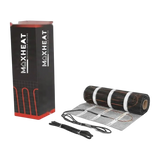
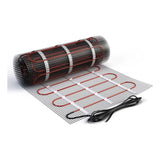


Every data sheet and manual: Product Library · All videos: MaxHeatUFH on YouTube

Design it in MaxHeatUFH ProLoop
Add your rooms, choose screed, overlay, joisted or electric, and get a free quick design and full kit list with prices.