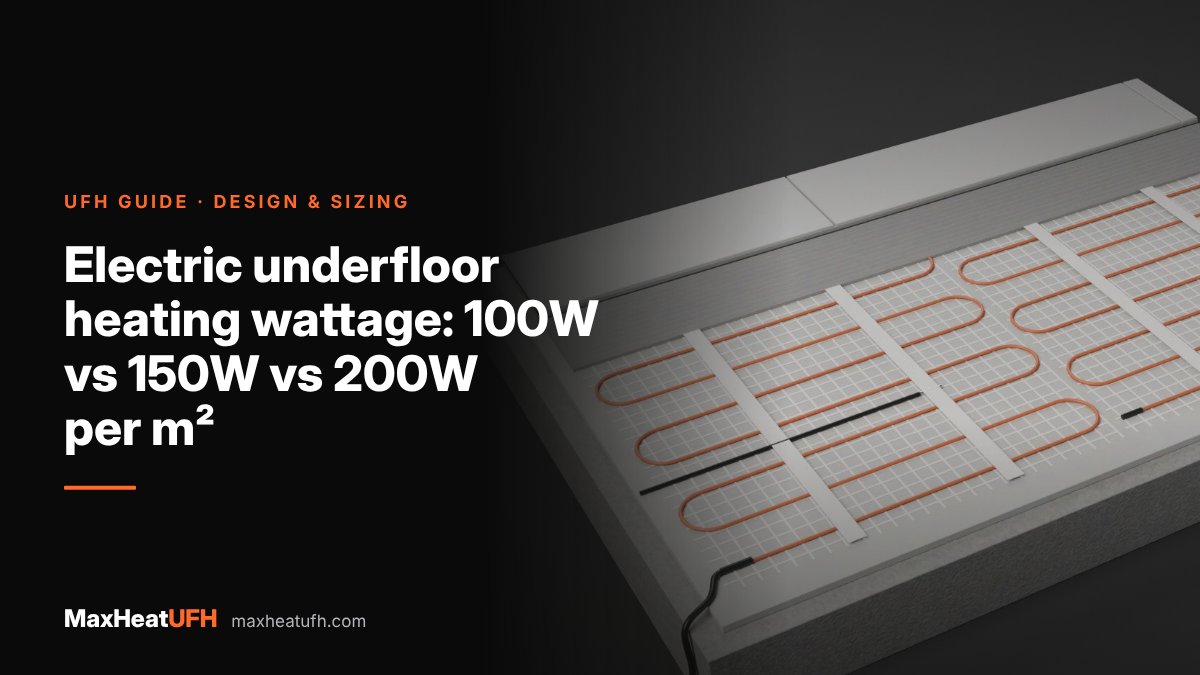
Electric underfloor heating wattage: 100W vs 150W vs 200W per m²
How to choose between 100W, 150W and 200W per m² electric underfloor heating, why the floor surface limit caps real output, and how wattage affects electrics and running costs.
Short answer: Choose 150W/m² for most tiled kitchens and bathrooms, 100W/m² for well-insulated rooms and en-suites, and 200W/m² only for rooms with high heat loss, such as conservatories, under tile or stone. A higher wattage does not double the heat your room gets: the floor surface temperature limits the output to about 100W/m² in a 20°C room. What the extra watts buy is faster warm-up and headroom on cold days. Under wood, vinyl or laminate the floor is often limited to 27°C, which caps useful output at about 75W/m², so a lower-output system is normally the right choice.
Electric underfloor heating mats and cables are sold by output per square metre: 100, 150 or 200 watts. The number tells you how much power the heater draws while it is switched on. It does not tell you how much heat the room receives, how much the system costs to run, or whether the floor finish will cope. Those depend on the floor surface temperature, the insulation underneath and the thermostat.
This guide explains what each wattage is for, why the floor finish matters more than the label, how wattage affects the electrics and running costs, and how to pick a size. For the install itself, see how to install an electric underfloor heating mat.
Which wattage electric underfloor heating should I choose?
Match the wattage to the room's heat loss and the floor finish. Start at 150W/m² for tiled rooms and move up or down only for a reason.
| Output | Best for | Floor finish |
|---|---|---|
| 100W/m² | New-build and well-insulated rooms, en-suites, cloakrooms, comfort warmth | Tile, stone; also the sensible choice where the finish is limited to 27°C |
| 150W/m² | Most kitchens, bathrooms and living areas | Tile and stone |
| 200W/m² | Conservatories, rooms with large glazing, older rooms with more heat loss | Tile and stone only |
Our 150W/m² mat is the all-round choice. The 100W/m² mat suits low heat loss rooms, and the 200W/m² mat is for rooms that lose more heat. All three are made for tile and stone floors and sit in the tile adhesive bed.
If you are not sure how much heat the room loses, work it out before you buy. Our guide to heat loss and underfloor heating output shows how to turn a room's heat loss into watts per m².
Does a 200W mat give twice as much heat as a 100W mat?
No. Once the floor is warm, the heat the room receives is set by how much warmer the floor surface is than the air, not by the wattage printed on the mat.
A floor gives out roughly 11W/m² for every degree it is warmer than the room. BS EN 1264 limits the floor surface to 29°C in occupied areas for comfort, which is 9°C above a 20°C room and about 100W/m² of output. In a perimeter strip up to 1m wide along outside walls, the limit is 35°C and output can reach about 175W/m², where the floor finish allows it.
So what does the extra wattage do?
- Faster warm-up. More power heats the adhesive, tile and subfloor up to temperature sooner.
- Headroom. On a very cold day, or in a room with large glazing, a 200W/m² mat can keep up where a lower output struggles.
- Shorter on-times. The thermostat switches the mat off once the floor or air reaches its set point, so a higher-output mat simply runs in shorter bursts.
The catch is that heat goes both ways. Without insulation under the heater, more of that power goes down into a cold slab instead of up into the room. That is why the choice of insulation board matters as much as the wattage. See insulation under underfloor heating.
What wattage should I use under wood, vinyl or laminate?
Use a low-output system and a floor sensor. Many timber flooring makers limit the floor surface to 27°C, which caps output at about 75W/m² in a 20°C room and about 50W/m² in a 22°C room.
Vinyl and linoleum are typically limited to 26 to 27°C to stop discolouration, and some luxury vinyl brands state 27°C. Some timber makers go further and limit the temperature on the underside of the board, which reduces usable output even more.
A 200W/m² heater under a floor limited to 27°C gains you nothing except a higher risk of overheating the finish if the controls are set wrongly. Our mats are made to sit in tile adhesive under tile and stone. Heater makers that allow other finishes require the mat to be covered in levelling compound first, usually a single layer of at least 10mm, and the floor maker's limit always applies. Check our guide to underfloor heating under tiles, LVT, laminate, wood and carpet before you choose.
Can I use electric underfloor heating as the main heat source?
Yes, if the floor can deliver the room's heat loss within the surface temperature limit. As a rough check, a tiled floor can give about 100W/m² of heated area in a 20°C room. If the room's heat loss divided by its heated floor area is below that, the floor can be the only heater.
Remember that only the heated area counts. Leave out kitchen units, baths, shower trays, the toilet and fitted furniture, because you must not lay heater under them. In a small bathroom, the heated area can be half the room or less, which is where a heated towel rail helps.
In rooms with large glazing, use 200W/m² along the cold edge or fit higher output across the whole floor, but keep the floor surface within the finish's limit. If the sums do not work, reduce the heat loss first. Insulation under the heater is cheaper than extra wattage.
How does wattage affect the electrics?
Total watts equals heated area times watts per m². That number sets the current the thermostat and circuit must carry.
| Heated area | 100W/m² | 150W/m² | 200W/m² |
|---|---|---|---|
| 4m² | 400W | 600W | 800W |
| 8m² | 800W | 1,200W | 1,600W |
| 12m² | 1,200W | 1,800W | 2,400W (two mats) |
Thermostats such as the Heatmiser neoStat-e switch up to 16A directly, which is about 3.6kW at 230V. Larger floors need more than one thermostat or a contactor. One heater maker also says no more than 7.5kW of heating should share one RCD or RCBO. Our guide to electric UFH thermostats and 16A loads covers the details.
Every electric floor heating circuit must be protected by a 30mA RCD, and the final connection must be made by a qualified electrician to BS 7671, under Part P in England and Wales.
Does a higher wattage cost more to run?
It costs more per hour while it is on, but not necessarily more overall. The thermostat switches the heater off once the set temperature is reached, so the energy you pay for depends mainly on how much heat the room loses and how long you heat it.
To estimate the cost per hour at full power, multiply kilowatts by your unit rate. Ofgem's price cap for 1 October to 31 December 2026 sets an average electricity unit rate of 26.32p/kWh on direct debit.
- A 4m² floor at 150W/m² draws 0.6kW, about 16p for each hour it is fully on.
- The same floor at 200W/m² draws 0.8kW, about 21p an hour, but reaches temperature sooner and then cycles off.
Where higher wattage can cost more is a poorly insulated floor, because the extra power drives more heat down into the slab. Our guide to underfloor heating running costs goes through real-world sums.
What about loose cable: how do I set the wattage?
With loose cable you set the output yourself by the spacing between runs. Closer runs give more watts per m².
| Floor output | 10W/m cable spacing | 20W/m cable spacing |
|---|---|---|
| 100W/m² | 100mm | 200mm |
| 130W/m² | 75mm | 150mm |
| 150W/m² | 65mm | 130mm |
These spacings are for our loose heating cable. Pick the length whose wattage is closest to area times W/m². For example, 4m² at 150W/m² needs about 600W, which is the 60m length of 10W/m cable at 65mm spacing. The heating cable must never be cut to length. See loose cable vs mats for when cable makes more sense.
How do I pick the right size and wattage?
- Measure the free floor area. Leave out units, baths, shower trays, the toilet and fixed furniture.
- Check the floor finish limit. Tile and stone suit any of the three outputs. For wood, vinyl and laminate, check the maker's maximum temperature.
- Check the heat loss. If it is above about 100W/m² of heated area, improve insulation or add another heat source.
- Pick the wattage. 150W/m² as standard, 100W/m² for low heat loss, 200W/m² for high heat loss under tile or stone.
- Choose the mat size closest to the free area without going over it.
- Plan insulation. Pre-insulate the subfloor unless it is an intermediate floor over a heated room.
- Add the thermostat and floor sensor, and check the total load against the thermostat's rating.
Design your UFH system yourself in 3 minutes with MaxHeatUFH ProLoop and get an instant quick design and quote. Start your design
Products for this job
- Electric Underfloor Heating Mat 100W/m²
- Electric Underfloor Heating Mat 150W/m²
- Electric Underfloor Heating Mat 200W/m²
- Electric Underfloor Heating Loose Cable, 10W/m or 20W/m
- Heatmiser Slimline-E thermostat
- Cement-Coated XPS Tile Backer Board
- All electric mats
Frequently asked questions
Is 150W or 200W better for a bathroom?
150W/m² suits most bathrooms. Choose 200W/m² only if the bathroom has high heat loss, for example an outside wall with a large window and no insulation under the floor, and the finish is tile or stone.
Can I use a 200W mat under laminate or wood?
It is not a good idea. Many wood and laminate floors are limited to 27°C, which caps useful output at about 75W/m² in a 20°C room. A low-output system with a floor sensor set to the maker's limit is the safer choice.
Will a 100W mat heat a room on its own?
It can in a well-insulated room with low heat loss, such as a new-build en-suite. In an older room with more heat loss, 150W/m² or a second heat source is usually needed.
Does higher wattage mean the floor gets hotter?
Only if the controls allow it. The thermostat and floor sensor stop the floor going above the set limit. Higher wattage reaches that limit faster.
Do I need insulation under an electric mat?
Heater makers recommend insulating the subfloor unless it is an intermediate floor over a heated room. Without it, much of the heat goes down into the slab and the floor warms slowly.
Can I mix wattages in one room?
Yes, with separate mats, for example 200W/m² along a glazed wall and 150W/m² elsewhere. Wire them to the thermostat in parallel and keep the total within its 16A rating.
What thermostat do I need?
A floor-sensing thermostat rated for the load, such as the Heatmiser neoStat-e or Slimline-E. Both switch up to 16A and use a floor probe to limit floor temperature.
Sources: BEAMA floor covering guide, Ofgem price cap unit rates, IET Wiring Matters: BS 7671 Section 753
Products in this guide
Watch how each part works and how to fit it, and download its data sheet and install manual.


Every data sheet and manual: Product Library · All videos: MaxHeatUFH on YouTube
Design it in MaxHeatUFH ProLoop
Add your rooms, choose screed, overlay, joisted or electric, and get a free quick design and full kit list with prices.