








Electric underfloor heating on Economy 7 and time-of-use tariffs
Whether Economy 7 or a time-of-use tariff cuts the cost of electric underfloor heating, why low-mass mats cannot store night heat, how to work out the break-even point with your own rates, and how to set the thermostat for cheap hours.
Short answer: Electric underfloor heating only saves money on Economy 7 if it actually runs in the seven cheap night hours. A thin mat under tiles warms and cools quickly, so it cannot store night heat for the day. Most of its use falls at the higher day rate. Economy 7 is generally only cheaper if you use about 40% or more of your electricity overnight, so do the sum with your own rates before you switch.
Economy 7 and other time-of-use tariffs charge less for electricity at certain times and more at others. Electric underfloor heating is a large, predictable load, so it is natural to ask whether running it on cheap hours cuts the bill. The answer depends on two things: when you need the heat, and whether your floor can hold heat from the cheap hours until then.
This guide explains how Economy 7 works, why most electric UFH does not suit it, the cases where it can work, and how to set your thermostat for a cheap-rate tariff. All costs use the October 2026 price cap single rate of 26.32p per kWh unless stated.
How does Economy 7 work?
Economy 7 gives you a cheaper rate for seven hours at night and a higher rate for the rest of the day. One large energy supplier says the daytime rate is higher than a standard single-rate tariff. The cheap hours depend on your meter and supplier, and for many meters they fall somewhere between 10pm and 9am. Some tariffs, called Economy 10, give ten cheaper hours.
- Check your bill or ask your supplier for your exact off-peak times.
- Your off-peak window may shift by an hour when the clocks change for British Summer Time.
- Off-peak windows and rates vary by region and supplier.
Economy 7 was designed for storage heaters and hot water cylinders, which charge overnight and give heat out during the day. The same supplier says it generally works out cheaper if you use 40% or more of your electricity overnight.
Is Economy 7 cheaper for electric underfloor heating?
Usually not for a standard mat under tiles. The problem is thermal mass. A cable mat in tile adhesive or a thin layer of levelling compound has very little mass, so it warms within a short time and cools soon after it switches off. Heat put in at 3am has mostly gone by the time you want a warm bathroom at 7:30am.
| Electric UFH type | Thermal mass | Can it store night heat? | Suits Economy 7? |
|---|---|---|---|
| Mat in tile adhesive or thin leveller | Low | No, only briefly | Only if you need heat in the cheap hours |
| Mat or cable under laminate or carpet | Low | No | Rarely |
| Loose cable in a thick screed | High | Yes, partly | Can do, if designed for it |
If most of your heating runs in the day and evening, you pay the higher day rate for it. Because the day rate is higher than a single-rate tariff, switching to Economy 7 can make electric UFH cost more, not less. Our guide to thermal mass and UFH explains why mass matters.
How do I work out if Economy 7 saves me money?
Compare what your whole home's electricity would cost on each tariff, not just the heating. A useful rule of thumb is the break-even share of night use:
Break-even night share = (day rate − single rate) ÷ (day rate − night rate)
Use the rates from your own quotes. If the share of your electricity used at night is higher than the result, Economy 7 should be cheaper. If it is lower, a single rate is cheaper. The smaller the gap between the day and night rates, the higher the break-even share.
Then look at your heating. Work out the kWh it uses and when:
- Multiply the mat's total wattage by the hours it runs at full power. A 4m² bathroom with a 150W/m² mat draws 0.6kW, so two hours at full power uses 1.2kWh.
- At the 26.32p single rate, 1.2kWh costs about 32p.
- Price the same 1.2kWh at your Economy 7 day rate if it runs in the day, or night rate if it runs in the cheap hours.
The thermostat cycles the mat once the floor is warm, so real use is usually lower than full power. Our guide to electric UFH running costs per m² has more worked examples.
When can electric underfloor heating work on a cheap-rate tariff?
It works when the floor needs heat during the cheap hours, or when the floor can store heat until it is needed. The most common cases are:
- Early morning heat. If your cheap hours end at 7am or later and you want a warm bathroom or kitchen floor at 6:30am, the warm-up falls inside the cheap window.
- Thick screed with in-screed cable. Cable set in a thicker screed can be heated in the cheap hours and give out heat for some time afterwards. This needs to be designed for the room. See our guide to in-screed electric cable.
- Night-time background heat. A frost or low setback temperature overnight runs in the cheap hours anyway.
- Homes already on Economy 7 for storage heaters or a hot water cylinder. Here the question is only whether to run the floor in the cheap hours where you can.
Smart time-of-use tariffs, where cheap periods move from day to day, work in a similar way. A low-mass mat can take advantage of a cheap period only if you want heat during it.
How should I set the thermostat for Economy 7?
Use a programmable thermostat with a floor sensor and match the programme to your cheap hours.
- Find your exact off-peak times from your supplier, and note whether they change with the clocks.
- Set the comfort periods you actually need. Do not move them all into the night if no one is using the room.
- Where a comfort period starts just after the cheap window ends, start the warm-up inside the window.
- Set a low setback or frost temperature for the rest of the time rather than running the floor all day.
- Check the clock on the thermostat matches your meter after each clock change.
The Heatmiser neoStat-e and the Heatmiser Slimline-E are both programmable thermostats for electric floor heating. Our guide to electric UFH thermostat settings covers the settings in detail.
How can I cut running costs whatever the tariff?
Insulation and sensible control matter more than the tariff.
- Insulate under the mat. One manufacturer advises installing mats on insulation boards for best performance and less heat lost downwards. Insulation boards are especially worth it over a cold concrete floor.
- Choose the right wattage. One manufacturer recommends 100W/m² over timber subfloors and 150W/m² over concrete, with 200W/m² only for high heat loss areas under tile or stone.
- Heat only when needed. Short comfort periods with a setback cost less than leaving the floor on.
- Use solar if you have it. If you have solar panels, daytime heating can use your own generation. See our guide to electric UFH with solar panels.
Whatever tariff you choose, a qualified electrician must make the final connection to the mat and thermostat.
Design your UFH system yourself in 3 minutes with MaxHeatUFH ProLoop and get an instant quick design and quote. Start your design
Frequently asked questions
Is electric underfloor heating cheaper on Economy 7?
Only if it runs in the cheap hours. A thin mat cannot store night heat, so most of its use usually falls at the day rate, which is higher than a standard single rate.
What is the cheapest time to run electric underfloor heating?
On a single-rate tariff the price is the same all day. On Economy 7 or a time-of-use tariff, it is during your cheap hours, but only if you need the heat then.
Can I heat my floor overnight and use the heat in the day?
Not with a standard mat under tiles, as it cools quickly. Cable in a thicker screed can store some heat, but it needs to be designed for that.
How much night use do I need for Economy 7 to be worth it?
One large energy supplier says Economy 7 is generally cheaper if you use 40% or more of your electricity overnight. Use the break-even formula with your own rates to check.
Do Economy 7 times change when the clocks go forward?
They can. Some off-peak windows shift by an hour with British Summer Time. Check with your supplier and keep your thermostat clock in step.
How much does a bathroom mat cost per hour to run?
A 4m² mat at 150W/m² draws 0.6kW. At the October 2026 price cap of 26.32p per kWh, that is about 16p an hour at full power. Real use is lower once the floor is warm.
Is Economy 10 better for electric underfloor heating?
It gives ten cheaper hours instead of seven, which can cover more of your heating times. Check when the hours fall and compare rates before switching.
Sources: Ofgem energy price cap
Products in this guide
Watch how each part works and how to fit it, and download its data sheet and install manual.


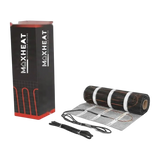

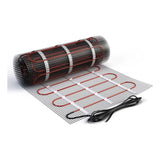


Every data sheet and manual: Product Library · All videos: MaxHeatUFH on YouTube

Design it in MaxHeatUFH ProLoop
Add your rooms, choose screed, overlay, joisted or electric, and get a free quick design and full kit list with prices.


