

In-screed electric underfloor heating cable: when to use it
When to lay electric heating cable in a screed rather than a thin mat, screed depths for direct and storage heating, cable spacing and fixing, sizing a storage floor for Economy 7, and testing and drying before switch-on.
Short answer: Use in-screed electric cable when you are laying a new screed or slab anyway and want electric floor heating as the main heat, or as a storage floor charged on an off-peak tariff. For direct heating, one manufacturer puts 3 to 7cm of screed over the cables. For storage heating it uses 7 to 15cm, with 125 to 200W/m² installed and cable of at least 18W/m. For a retrofit over an existing floor, a thin mat in the tile adhesive is usually the better choice.
Most electric underfloor heating in UK homes is a thin mat or loose cable bedded in tile adhesive. In-screed cable is different. It is laid on the insulation or mesh before the screed goes down, and the screed then becomes the heat emitter. That makes it slower to warm and cool, but it spreads the heat evenly and, with enough depth, can store heat from cheap night-time electricity.
This guide explains the three ways electric floor heating is used, when in-screed cable makes sense, how deep the screed should be, how to space and fix the cable, how storage floors are sized for Economy 7, and how to test and commission it.
What is the difference between comfort, direct and storage electric floor heating?
They differ in what the floor has to do. One electric floor heating maker sets out three types in its design manual.
| Type | What it does | Typical build-up |
|---|---|---|
| Comfort (warm floor) | Warms the floor surface; other heating does the room | Mat or cable in tile adhesive or levelling compound |
| Direct (total) | The only heating in the room, sized from heat loss × 1.2 to 1.3 | Cable in 3 to 7cm of screed, or a thin system |
| Storage (accumulating) | Charges a thick slab on a low tariff; the slab releases heat through the day | Cable in 7 to 15cm of concrete, typically over 10cm |
In-screed cable is used for direct and storage heating. Comfort heating is normally done with a thin mat, because it adds only a few millimetres and responds quickly.
When should you use electric cable in screed instead of a mat?
When a new screed is going down anyway, and you want the floor to heat the room on its own or to store off-peak heat. In a retrofit with no new screed, a mat in the tile bed is simpler.
- New builds, extensions and conservatories where the screed is part of the build.
- Electric as the main heat where gas is not available and a water system is not wanted.
- Storage heating on an off-peak tariff. Another manufacturer's storage system uses a heat-storing concrete layer, typically 8 to 10cm thick, run on a night tariff.
Weigh the running costs before you choose. The Energy Saving Trust says wet systems are generally cheaper to run than electric ones and suit heat pumps. For a whole floor, compare both. Our guide to water vs electric underfloor heating sets out the trade-offs.
How deep should the screed be over electric heating cable?
At least 20mm of screed over the cable, and typically 3 to 7cm for direct heating. Storage floors need much more, 7 to 15cm.
| Rule | Figure | Source |
|---|---|---|
| Minimum distance from cable to screed surface | 20mm | Manufacturer in-screed cable instructions |
| Cover in a structural slab | 25 to 75mm | Manufacturer in-slab instructions |
| Direct heating, concrete above cables | 3 to 7cm | Manufacturer design manual |
| Storage heating, concrete thickness | 7 to 15cm, typically over 10cm | Manufacturer design manual |
| Special UFH screed (one maker's build-up) | 30 to 50mm over 30 to 50mm high-density polystyrene | Manufacturer manual |
Insulation goes below the screed, not around the cable. One manufacturer says cables must not touch or be enveloped by insulation. One manufacturer raises reinforcing mesh 10mm above the insulation. One manufacturer also calls for vertical edge insulation at outside walls, which a perimeter edge insulation roll provides. For screed types and depths in general, see screed depths and drying times.
What cable spacing do I need in a screed?
Divide the cable's output per metre by the output you want per m². For a 20W/m cable, 150W/m² needs about 133mm spacing.
The formula from one manufacturer's instructions is: spacing (mm) = cable output (W/m) × 1,000 ÷ floor output (W/m²).
| Floor output | Spacing with 20W/m cable |
|---|---|
| 133W/m² | 150mm |
| 150W/m² | 133mm |
| 160W/m² | 125mm |
| 200W/m² | 100mm |
Three limits apply on top of the formula:
- Maximum spacing. One manufacturer gives 15cm as the maximum spacing in concrete over 3cm thick. One manufacturer also says spacing should not exceed twice the depth of concrete above the cables, or the surface will feel stripy.
- Maximum output per metre. One manufacturer caps direct-heating cable in concrete at 20W/m and recommends 10 to 18W/m. Storage floors need at least 18W/m.
- Minimum spacing and clearances. Never closer than the maker's minimum. One manufacturer keeps cables at least 50mm from walls and fixed items, and bends no tighter than 6 times the cable diameter.
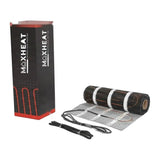
The MaxHeatUFH 20W/m loose heating cable can be laid in a screed. It comes in lengths from 10m (200W) to 125m (2,530W) and cannot be cut, so choose the length to suit the area at your spacing. The 10W/m version is for the tile bed only.
How do you fix heating cable before screeding?
Fix it to fixing strips or light steel mesh so it cannot move or float when the screed goes down.
- Lay insulation and edge strip. Then a separating layer, such as foil or mesh, so the cable does not touch the insulation.
- Fix the cable. One manufacturer's in-screed method uses fixing strips, or ties to light mesh at no more than 200mm. In a structural slab, ties to the reinforcement go no more than 600mm apart.
- Keep runs even. Cables must not touch or cross. Keep them clear of expansion joints: BS 7671 says heating units must not cross them.
- Fit the sensor conduit. One manufacturer uses a 16 or 20mm conduit with no more than two wide bends, with the sensor in an inner tube sealed at the end, laid between two cable runs. Each sensor needs its own conduit so it can be replaced.
- Test, then screed. See the testing section below.
BS 7671 Section 753 requires floor heating units set in concrete or similar to be at least IPX7, and the heating to be designed so it cannot exceed 80°C.
How is an electric storage floor sized for Economy 7?
The installed load must put a full day's heat into the slab during the off-peak hours, so storage floors are much more powerful than direct ones. One manufacturer sizes them at roughly 3 times the direct-heating output.
One manufacturer's design formula is: installed power = heat loss × 24 hours × 1.3 ÷ off-peak hours. Its worked example has a room heat loss of 1,320W and an 8-hour low-tariff window, giving 5,148W installed.
- Typical output: 125 to 200W/m². Above 200W/m², one manufacturer adds a rim zone of 200 to 250W/m², 0.5 to 1.5m wide, under no more than 3cm of concrete, on its own thermostat.
- Controls: One manufacturer uses a timer thermostat with an outdoor sensor, plus a floor sensor to limit floor temperature.
- Top-up heat: One manufacturer says daily room temperature variation should not exceed 4°C and advises a supplementary direct heat source.
- Load: 5,148W is well over a 16A thermostat. Use a contactor, as manufacturers require for larger loads.
On running cost, Economy 7 gives seven cheaper hours, typically from around midnight to 7am. On the coldest day, one manufacturer's example room loses 1,320W × 24 hours, about 31.7kWh. At the off-peak rates of about 12.5p to 14p per kWh listed for named Economy 7 tariffs in September 2026, that is roughly £3.96 to £4.44 a day, against about £8.34 at the October 2026 price cap single rate of 26.32p. Milder days use less. Check your own tariff's hours and rates, because many supplier windows differ.
Laying a new screed? It is the best time to compare electric cable with a water system. MaxHeatUFH ProLoop is a free online tool: design your UFH system yourself in 3 minutes and get an instant quick design and quote. Start your design
How do you test and commission in-screed heating cable?
Test the cable before, during and after screeding, and do not switch on until the screed has dried.
- Resistance: within −5% to +10% of the label value, says one manufacturer.
- Insulation resistance: over 20MΩ after one minute at a minimum of 500V DC, says one manufacturer.
- During the pour: One manufacturer uses a continuity monitor while screeding, and repeats the tests immediately before the pour and again when the thermostat is fitted.
- Drying: One manufacturer says not to switch on until the floor has fully hardened, about 30 days for concrete and about 7 days for moulding compounds.
- Records: BS 7671 requires a plan of the heating, including the layout, depth and rated power, fixed at or near the distribution board. Tell the owner not to drill or fix into the heated floor.
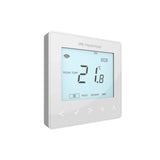
A qualified electrician must make the final connection, with a 30mA RCD, to BS 7671. The Heatmiser neoStat-e switches up to 16A with a floor sensor and has 24-hour programming for off-peak timing. A thick screed holds a lot of heat, so expect a slow response. See thermal mass and underfloor heating.
Frequently asked questions
Can you put electric underfloor heating cable in screed?
Yes, with cable made for it. MaxHeatUFH's 20W/m cable can be laid in screed. One manufacturer keeps at least 20mm of screed over the cable and typically 3 to 7cm for direct heating.
How thick does the screed need to be for electric storage heating?
One manufacturer uses 7 to 15cm of concrete, typically over 10cm. Another manufacturer's storage system uses a layer typically 8 to 10cm thick.
Is electric storage underfloor heating cheaper to run?
It can be, if almost all of it runs on cheap off-peak units. Night rates on named Economy 7 tariffs were about 12.5p to 14p per kWh in September 2026, about half the standard price cap rate. Day units are often dearer.
How long before I can switch on electric heating in a new screed?
One manufacturer says to wait until the floor has fully hardened, about 30 days for concrete. Then bring it up to temperature gradually.
Can I use 10W/m cable in a screed?
Not the MaxHeatUFH 10W/m cable, which is for the tile bed over a membrane. Use the 20W/m cable for screed.
What spacing should heating cable be in screed?
Spacing in mm equals cable W/m × 1,000 ÷ the W/m² you want. One manufacturer sets a 15cm maximum in concrete, and another manufacturer says spacing should not exceed twice the screed depth above the cable.
Do I need insulation under in-screed electric heating?
Yes. One manufacturer strongly advises it, plus edge insulation at outside walls. Keep the cable off the insulation with a separating layer such as foil or mesh.
Sources: IET Wiring Matters: floor and ceiling heating (BS 7671 Section 753), Energy Saving Trust: underfloor heating, Smart Energy GB: what is Economy 7, Ofgem: energy price cap unit rates
Products in this guide
Watch how each part works and how to fit it, and download its data sheet and install manual.


Every data sheet and manual: Product Library · All videos: MaxHeatUFH on YouTube

Design it in MaxHeatUFH ProLoop
Add your rooms, choose screed, overlay, joisted or electric, and get a free quick design and full kit list with prices.