

Replacing or upgrading an old UFH manifold
How to replace an old underfloor heating manifold without lifting the floor: checking your pipe fits a new manifold's eurocone connections, measuring up, the swap step by step, and worthwhile upgrades.
Short answer: Yes, an old UFH manifold can usually be replaced without touching the floor, because the loops connect through compression fittings, most commonly with a 3/4" (G¾) thread, and matching connector cores are made for the common pipe sizes. Count the ports, measure the manifold's width against the cabinet, identify the loop pipe's outside diameter and type, and buy the new manifold with the right cores or adaptors. The swap itself is a drain-down, a like-for-like exchange, and a loop-by-loop refill, typically a day's work at the manifold.
Manifolds outlive their welcome in stages: a weeping port seal here, a flow meter that fogged up years ago, valves that no longer close, a mixing pump on its last winter. The loops in the floor, meanwhile, are usually fine, and that is the key fact. The pipe is the expensive, disruptive part of a UFH system, and it almost never needs to come up just because the brassware at the wall has worn out.
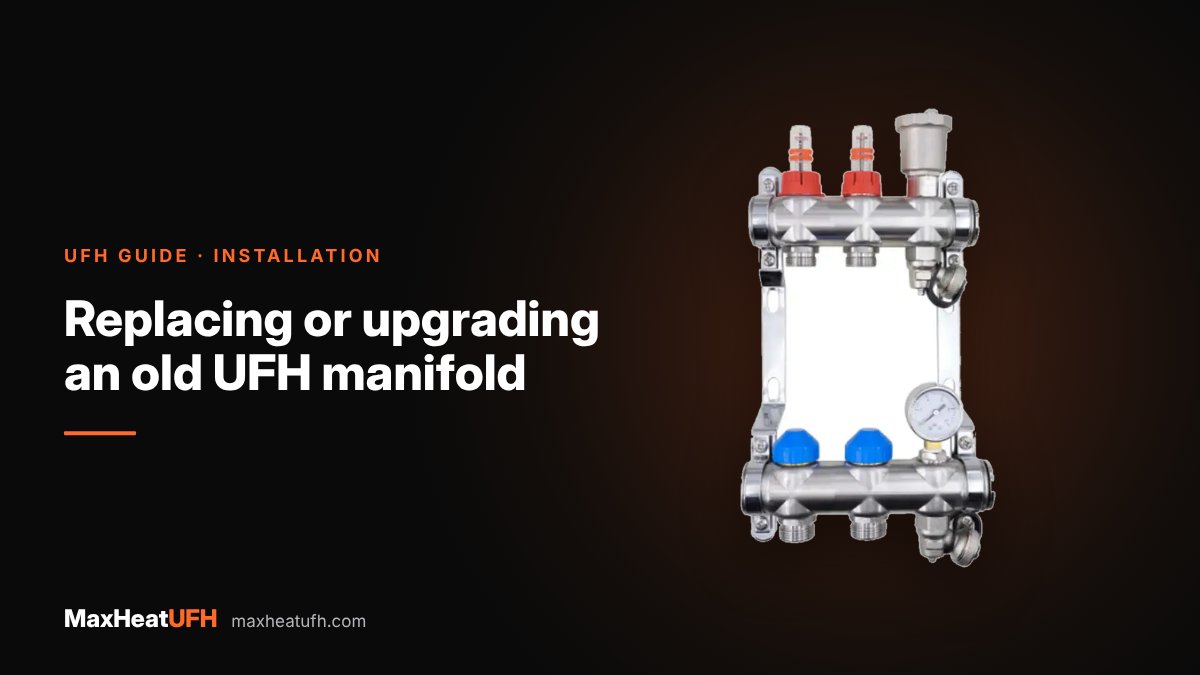
This guide covers when replacement beats repair, how to check a new manifold will fit your old pipe, how to measure up, the swap itself step by step, and the upgrades worth making while the system is open. For how a manifold works in the first place, start with our underfloor heating manifold guide.
When should you replace a UFH manifold rather than repair it?
Repair first when one part has failed and spares exist: port seals, flow meter tops, actuators, the pump and the blending valve are all replaceable on a decent manifold, and our guide to manifold leaks covers the common weep points. Replacement starts to win when:
- Several things have failed at once. Seized loop valves plus dead flow meters plus a tired pump adds up to most of a new manifold in parts and labour.
- Spares no longer exist. Obsolete or unbranded manifolds with no identifiable parts turn every small failure into an argument.
- Corrosion has taken hold. Heavy verdigris or rust around ports and valve bodies on an old manifold tells you the seals and threads are living on borrowed time.
- The system is changing. A new heat source, added loops for an extension, or a move from manual balancing to flow meters or auto-balancing all justify a fresh manifold.
- You cannot balance it. If loops cannot be set or even told apart because the valves no longer respond, the manifold has stopped doing its one job; see balancing UFH loops.
Will a new manifold fit my old pipe?
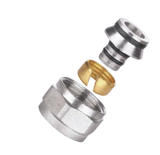
Usually, yes, and the reason is the loop connection. Manifold loop ports are threaded, and the pipe joins through a compression fitting, a connector core (often called a eurocone) sized to the pipe's outside diameter and wall thickness. On one manufacturer's manifold range, for example, every loop compression fitting has a G¾ internal thread, and that 3/4" pattern is the most common across the industry. MaxHeatUFH manifolds take 3/4" eurocone connector cores, so the question is rarely the manifold and almost always the core: you need one matched to your pipe's outside diameter and wall.
So before ordering:
- Measure the pipe. Outside diameter with callipers across a straight section of tail, and wall thickness at a cut end if any loop is ever opened. Printing on the pipe, size, type and standard, saves all the measuring if it is still legible.
- Note the pipe type. Plastic (PERT or PEX types), multilayer with an aluminium core, or copper tails on very old systems: the core must match the construction, and plastic pipe needs its support sleeve where the maker requires one.
- Check the thread. If the old loop nuts are not 3/4", adaptors exist, but confirm before the old system is in bits.
Two honest cautions. First, compression fittings have temperature limits, on that range 95°C for PEX and multilayer cores, which no sane UFH system approaches but matters if a loop was ever plumbed in something unusual. Second, if the pipe cannot be identified at all, no printing, odd size, unknown material, resolve that before buying anything, because the core is the one part that must be exactly right.
How do you measure up a replacement manifold?
Three numbers and a look around the cabinet:
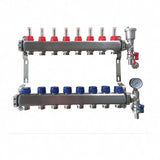
- Ports. Count the loops, not the rooms; each loop needs a port. If an extension is planned, buy the ports now, or choose a range with extensions, such as the Dualmix stainless steel manifold (2 to 12 ports) with its 1-port extension kits.
- Width. Manifold length grows with port count; on one manufacturer's manifold, for instance, the body runs from 111mm at 2 ports to 611mm at 12, growing 50mm per port pair. Measure the cabinet or recess before assuming the new one fits, and remember the pump set and isolation valves add width. Our guide to manifold sizes and dimensions has the typical figures.
- Primary connections. Which side the flow and return enter, the pipe size feeding the manifold, and whether the new mixing unit sits left or right. Swapping sides is possible but adds pipework.
- Drops and tails. Old loop tails are cut to reach the old manifold's ports. A new manifold mounted at a different height or offset may leave tails short, and multilayer pipe does not stretch. Mount like-for-like where you can.
How do you swap the manifold step by step?
- Photograph everything. Loop order, room labels, flow meter settings, actuator positions and the primary pipework. This is the cheapest insurance of the whole job.
- Isolate and drain. Heat source and pump off, electrics isolated, manifold isolated from the primaries, then drain the manifold and loops at the drain valve, one loop at a time, hose to a gully. Our guide to draining down underfloor heating covers this step in detail.
- Disconnect the loops. Undo each loop nut, label the pipe with its port number, and expect residual water from every tail.
- Strip and hang the new manifold. Remove the old brackets if they do not match, mount the new manifold level and at a height the tails reach, and fit the isolation valves, mixing unit and gauges to the new body before connecting pipe.
- Fit the new cores and reconnect. New connector cores on every loop, pipe ends cut square, reamed and sleeved as required, then nuts tightened to the maker's instruction. Reusing old cores on a new manifold is false economy.
- Fill, purge and test. Refill loop by loop, pushing air out through the drain valve as you go, then pressure test the manifold and connections before boxing anything back in; our pressure testing guide gives the method. Dose inhibitor and a UFH biocide on the final fill.
- Rebalance and rewire. Set the flow meters from your photographs as the starting point, refit actuators to the right ports, and run the system up gently.
The plumbing is within a competent installer's reach; anything on a gas boiler needs a Gas Safe registered engineer, and 230V wiring centre work belongs with a qualified electrician.
What is worth upgrading while the system is open?
- Flow meters. If the old manifold balanced blind, on lockshield-style valves, flow meters turn balancing from guesswork into a reading.
- A modern mixing unit. A blending valve and A-rated pump set, such as our 20 to 55°C blending valve pump pack with Grundfos UPM3, replaces an old fixed-head pump and tired thermostatic valve in one go.
- Isolation valves and gauges. Ball valves on the primaries and a pressure gauge end unit make every future service a smaller job.
- Heat pump readiness. Moving to a heat pump later? A stainless manifold with a non-mixing pump arrangement and auto-balancing suits low-temperature running; it is cheaper to choose now than to swap again.
- Fresh system water. The system is drained anyway: clean if the old water ran dirty, and always refill with inhibitor and biocide.
Free design tool: adding rooms as well as replacing the manifold? Design your UFH system yourself in 3 minutes with MaxHeatUFH ProLoop and get an instant quick design and quote. Start your design
Frequently asked questions
Can I replace a UFH manifold without lifting the floor?
Yes. The loops stay where they are; the manifold unbolts from the wall and the loops reconnect to the new one with fresh compression cores. The floor only becomes involved if the tails cannot reach the new ports.
Are UFH manifold connections a standard size?
The 3/4" eurocone-style compression connection is the most common loop port across manifold makers, one manufacturer documents a G¾ internal thread on its range, but it is not universal, so check your loop nuts and pipe size before ordering.
Can I connect old 16mm pipe to a new manifold?
If the pipe is sound, yes: fit new 3/4" eurocone connector cores matched to the pipe's outside diameter and wall thickness. Never reuse the old cores on new ports.
How long does a manifold replacement take?
Plan a day at the manifold for a typical house: draining, swapping, reconnecting each loop, refilling loop by loop, pressure testing and rebalancing. Add time if the primaries need re-routing to the new layout.
Can I add more ports when I replace the manifold?
Yes, and it is the right moment. Count current loops, add the planned ones, and size the manifold for the total, checking the longer body still fits the cabinet.
Do I need a new pump with a new manifold?
Not automatically, but an old fixed-speed pump on a new manifold is a mismatch; modern A-rated pump and blending packs are pre-assembled and sized for manifold duty.
What do I add to the water after the swap?
Corrosion inhibitor plus a biocide for low-temperature systems, dosed at the final fill and circulated. UFH runs cool enough for bacterial growth, so the biocide is not optional on a fresh fill.
Sources: BS 7593:2019 water treatment guidance, and manufacturers' manifold and biocide data sheets
Products in this guide
Watch how each part works and how to fit it, and download its data sheet and install manual.



Every data sheet and manual: Product Library · All videos: MaxHeatUFH on YouTube
Design it in MaxHeatUFH ProLoop
Add your rooms, choose screed, overlay, joisted or electric, and get a free quick design and full kit list with prices.