

Tools you need to install underfloor heating
A checklist of the tools for every type of UFH install: decoiler, tacker gun, cutters, bending springs, press tools and pressure test pumps, and which ones you can skip.
Short answer: For a clipped screed system you need a pipe decoiler, a tacker gun or clip rail, a pipe cutter, a bending spring, edge insulation and a pressure test pump. Routed board and overlay systems swap the tacker for a saw and a knife. If you are running multilayer primary pipework to the manifold, add a press tool, a cutter and a chamfering tool. Everything on this list costs less than a single call-back to fix a kinked or leaking pipe.
Underfloor heating does not need a van full of specialist kit, but three or four of the right tools make the difference between a tidy day's work and a wrestling match with 100m of coiled pipe. The pipe itself is the main reason: UFH pipe arrives in long coils under tension, must never be kinked, and has to be cut square and clean before it goes into a manifold or fitting.
This guide lists the tools for each type of install: pipe laying in screed, routed boards and overlay panels, manifold connection, primary pipework and testing. Every tool links to its product page, so you can check current prices before you start. For the laying method itself, see our guide to clip rail, tacker and screed installation.
What tools do I need to lay UFH pipe in screed?
You need a way to uncoil the pipe, a way to fix it, and a way to cut it. The rest is marking out.
| Tool | What it does |
|---|---|
| Pipe decoiler | Spins the coil so pipe pays out straight, without twists or kinks |
| Tacker gun | Fires barbed clips through the pipe saddle into insulation, standing up |
| Barbed pipe clips (300) | Hold the pipe to the insulation |
| Self-adhesive clip rail (1m) | Alternative fixing: stick rails down, press pipe in at any spacing |
| Pipe cutter | Square, clean cuts on plastic and multilayer pipe |
| External bending spring | Tight bends without kinking, especially at the manifold |
| Edge insulation roll | Perimeter expansion strip before the screed goes in |
One manufacturer's installation guide specifies roughly one fixing per metre of pipe, with extra clips around each loop end, so a 100m loop uses about 100 clips plus the turns. Buy clips by the box of 300, not the handful.
A decoiler is the tool people try to skip. Without one, two people unroll the coil across the floor and fight the memory in the pipe all day. With one, a single installer pulls pipe off the top of the coil as fast as it can be clipped. On any job over one room it pays for itself in time.
What tools do I need for routed boards and overlay panels?
Routed and castellated systems replace most of the fixing tools with cutting tools, because the board holds the pipe for you.
- Fine-tooth saw or track saw for chipboard panels, and a sharp knife for XPS and EPS boards.
- Tape, pencil and chalk line to set out header runs and room edges before any board is cut.
- Screwdriver or drill driver where boards are screwed to a timber subfloor.
- Wallpaper roller or hand pressure to walk pipe into grooves and castellations. No tacker needed.
- Bending spring still earns its place where tails drop to a manifold.
Castellated panels hold the pipe between studs at your chosen spacing; routed boards fix the spacing at the factory, so there is less to set out and less to get wrong. Compare systems in our floor systems guide.
Which tools do I need to connect the manifold?
Manifold connections are compression fittings, so the tools are ordinary: two adjustable spanners or grips, plus a cutter and a means of rounding the pipe end.
- Cut the tail square with a pipe cutter. A ragged or angled cut will not seal in a Eurocone fitting.
- Ream or chamfer the end. A star reamer or chamfering tool removes the burr and bevels the edge so the olive and insert seat properly.
- Fit the connector core and tighten. One spanner holds the manifold port, the other tightens the nut. Do not rely on the manifold bracket to take the strain.
- Support the bend. Plastic support bends hold the pipe in a smooth 90° turn where it rises into the manifold.
Do I need a press tool?
Only for the primary pipework, never for the UFH loops themselves. Each heating loop runs unbroken from the flow port to the return port, with no joints in the floor. But if you are running multilayer (MLCP) pipe from the boiler or cylinder to the manifold, those joints are usually press fittings.
| Option | Best for |
|---|---|
| Manual pressing clamp set, 16 to 32mm U profile | Occasional use, one or two manifolds |
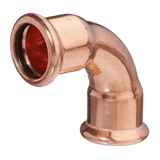
| Electric hydraulic press tool set, M & U profile | Regular installers; presses copper M profile and MLCP U profile |
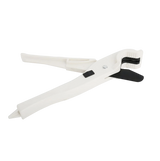
Add a ratchet plastic pipe cutter for larger MLCP sizes, a chamfering tool for every press joint, and a manual pipe bender if you want sweeping bends instead of elbow fittings. Our guide to pressing MLCP fittings covers the technique.
What do I need for pressure testing?
A hydraulic test pump and a hose to a fill point. One UK manufacturer's installation guide calls for the system to be filled with water, vented of air, raised to 6 bar and held for 60 minutes, then kept under pressure while the screed is laid so any strike from a shovel or rake shows up immediately.
The pump needs a gauge you can read from across the room and a lockable valve so the pressure holds while you walk the pipework. Do the test before the screed is booked, not the morning it arrives. Our pressure testing guide gives the full procedure and what to record.
What tools do I need for electric underfloor heating?
Far fewer. Electric mats and loose cable need a tape measure, scissors for the mat mesh (never the cable), a multimeter to check the element's resistance before, during and after tiling, and a notched trowel for the adhesive. There is no pipework, so no decoiler, tacker or test pump.
The one tool you cannot substitute is the electrician: the final connection of any electric UFH system must be made by a qualified electrician working to BS 7671, and in England and Wales the work falls under Part P. Budget for that alongside the kit.
Which tools can I hire or skip?
Be honest about how often you will use each one.
- Worth buying even for one job: pipe cutter, reamer or chamfer tool, bending spring, edge insulation.
- Buy for one big job or several rooms: decoiler, tacker gun, test pump.
- Buy only if you install regularly: electric press tool, pipe straightener, MLCP bender.
- Skip: anything that heats, flames or solders near the floor pipe. Plastic and multilayer UFH pipe is cut and compressed, never soldered.
Browse the full range in our tools and fixings collection.
Design your UFH system yourself in 3 minutes with MaxHeatUFH ProLoop and get an instant quick design and quote. Start your design
Frequently asked questions
Can I install underfloor heating with normal plumbing tools?
Mostly, yes. Spanners, grips, a tape and a knife cover a lot of the job. The UFH-specific additions are a decoiler, a tacker gun or clip rail, a bending spring and a pressure test pump.
Do I really need a pipe decoiler?
For one small room, you can manage without. For anything larger, a decoiler lets one person lay pipe instead of two and stops the coil twisting into kinks. A kinked pipe cannot be repaired by straightening; that section, or the coil, is scrap.
Can I cut UFH pipe with a hacksaw?
No. A hacksaw leaves swarf and a ragged edge that will not seal in a compression or press fitting. Use a rotary pipe cutter or ratchet shears, then ream or chamfer the end.
What pressure should I test underfloor heating to?
A common UK manufacturer specification is 6 bar held for 60 minutes with water, after venting the air, with the system kept under pressure while the screed is laid. Record the result on a test certificate.
How many clips do I need per metre of pipe?
Plan on about one fixing per metre of straight run, with several more around each loop end, following your system manufacturer's guidance. Plain, ungridded insulation may need more.
Do I need a press tool for the heating loops?
No. Loops run unbroken from manifold to manifold with no joints in the floor. Press tools are only for the primary pipework between the heat source and the manifold, and only if that pipework is multilayer or press-fit copper.
What does a bending spring actually do?
It supports the pipe wall so you can pull a tight bend without the pipe flattening or kinking. Multilayer pipe should not be bent tighter than 5 times its diameter, which is an 80mm radius on 16mm pipe, so use the spring wherever the pipe turns hard, such as up into a manifold.
Products in this guide
Watch how each part works and how to fit it, and download its data sheet and install manual.




Every data sheet and manual: Product Library · All videos: MaxHeatUFH on YouTube

Design it in MaxHeatUFH ProLoop
Add your rooms, choose screed, overlay, joisted or electric, and get a free quick design and full kit list with prices.