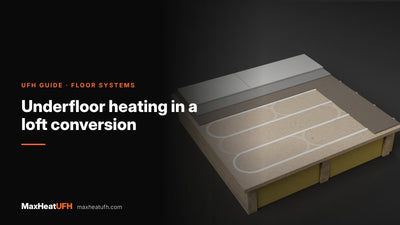
Spreader plates vs routed boards for UFH on joists
How aluminium spreader plates and routed chipboard boards compare for wet underfloor heating on joisted floors, how each is fitted, and which suits your floor.
Short answer: Use spreader plates when you want to keep the existing floor deck or floor height, or when you can only get at the joists from below. Use routed (grooved) boards when the floor deck is coming up anyway and you want a quick, fixed layout. Spreader plates are aluminium sheets that sit between or on the joists and spread heat across the underside of the deck, with insulation packed tight beneath them. Routed boards such as MaxHeatChip are 22mm chipboard with pipe grooves at 150mm centres that replace the deck, finished with a 6mm foil-backed top board.
A joisted timber floor cannot take a heavy screed, so wet underfloor heating goes in dry. The two common ways to do it are spreader plates and routed boards. Both carry the same pipe from the same manifold. The difference is where the pipe sits, what happens to the floor deck and how much work there is in the joists.
This guide compares the two side by side, explains how each is fitted, and helps you pick the right one for your floor. For an overview of every way to heat a timber floor, see UFH for joisted timber floors.
Which is better, spreader plates or routed boards?
Neither is better in every case. The right one depends on whether the floor deck stays, how you can reach the joists and how much height you have.
| Spreader plates | Routed boards | |
|---|---|---|
| Where the pipe sits | In plate channels under the floor deck | In grooves in the board itself |
| Floor deck | Separate deck laid over, or existing deck kept | The board is the deck |
| Pipe spacing | Set by plate type and joist centres | Fixed by the grooves: 150mm on MaxHeatChip |
| Insulation | Fitted between the joists, tight to the plates | Fitted between the joists under the boards |
| Fit from below | Yes, with fit-from-below plates | No, it replaces the deck from above |
| Joist work | Pipe crosses joists at the ends of runs | Return grooves turn the pipe within the boards |
| Top layer | The floor deck | 6mm foil-backed top board |
As a rule of thumb, plates suit floors you would rather not take up, and boards suit floors that are being stripped back to the joists anyway, such as a loft conversion or a full renovation.
How do spreader plates work?
Spreader plates are aluminium sheets with a groove pressed into them for the pipe. The pipe clips into the groove and the aluminium carries its heat sideways, so the whole underside of the floor deck warms instead of a stripe above each pipe.
One manufacturer's guide to UFH on suspended floors sets out how they go in:
- Joist centres: its plates are designed for joists at 400mm centres.
- Coverage: plates normally cover about 80% of the floor area, and must not overlap or touch.
- Fixing: plates rest on the joists or on battens fixed to them, and are stapled in place.
- Insulation: 100mm of mineral wool between the joists, in contact with the underside of the plates, with no air gaps between them.
- Deck: chipboard or plywood decking at least 15mm thick, with tongue and groove edges glued.
We stock aluminium heat diffuser plates in single, double and triple channel versions, the single being 1000 x 140mm. One manufacturer notes its double plates suit joists at typical 300 to 450mm centres. Choose the plate by how many pipe runs sit between each pair of joists.
How do routed boards work?
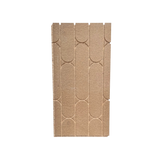
A routed board is a floor deck with the pipe grooves already cut in. You screw it to the joists like normal chipboard flooring, press the pipe into the grooves, then lay a thin top board over it.
Our MaxHeatChip panel works like this:
- Board: 22mm P5 moisture-resistant chipboard, in 1200 x 600mm (0.72m²) or 2400 x 600mm (1.44m²).
- Grooves: four per board at 150mm centres, with radius returns cut at both ends so the pipe can turn back at the end of each board.
- Pipe: versions for 12mm or 16mm pipe.
- Fixing: 5 x 80mm chipboard screws into the joists.
- Top board: a 6mm foil-backed fibre board, foil side down, with 150 micron aluminium foil to spread the heat. Fix it with 4 x 20mm screws, stagger the joints and keep the screws well away from the pipe.
Because the board is the deck, you lift the old floorboards, lay insulation between the joists and fit the boards in their place. The finished floor sits at the 22mm board plus the 6mm top board, so compare that with the deck you are taking up. Our guide to installing grooved chipboard underfloor heating walks through the fitting steps.
Which is quicker to install?
Routed boards are usually quicker on an open floor, because the layout is set out by the grooves. There are no plates to space, staple and keep apart, and the board goes down as the floor deck in one step. The trade-off is that you must lay boards to suit the groove pattern, and you cannot change the 150mm spacing.
Spreader plates take more setting out but give more freedom. You can vary the layout to suit the joists and the room, and you can keep the floorboards if they are worth saving.
Can I fit underfloor heating from below?
Yes, but only with spreader plates. If you can reach the joists from a cellar or a ceiling void below, fit-from-below plates let you add UFH without lifting the finished floor above. One manufacturer offers this for both traditional and engineered joists, and our fit-from-below double spreader plate is 150mm wide with two channels.
Routed boards cannot be fitted from below, because they replace the floor deck. Our guide to fitting spreader plates from below covers that job step by step.
Do I need to notch or drill the joists?
Sometimes, with either system. The pipe has to cross joists to reach the manifold, and with plates it also crosses at the ends of runs. Routed boards with return grooves keep more of the pipe within the boards, but the flow and return runs to the manifold still need a route.
Where you do cut solid timber joists, follow LABC's rules:
| Notches | Holes | |
|---|---|---|
| Maximum size | 0.125 x joist depth, up to 35mm deep | 0.25 x joist depth, up to 65mm diameter |
| Position along span | 0.07 to 0.25 of the span | 0.25 to 0.4 of the span |
| Other rules | Top or bottom only, not both | On the centre line, at least 3 diameters apart |
Engineered joists such as I-joists follow their maker's rules instead. If in doubt, check with Building Control or a structural engineer, as one manufacturer also advises.
Which floor finishes work over each system?
Both suit timber, laminate, vinyl and carpet if you keep to the finish maker's limits. One manufacturer says floor surface temperatures must not exceed 27°C with timber floors, so a timber finish over either system needs the water temperature set to keep within that.
- Laminate: One manufacturer suggests laminate over spreader plates should be at least 7mm thick with interlocking joints.
- Engineered wood: works over both. See our guide to wood flooring with UFH.
- Tiles: timber floors move, so tiling needs a suitable tile backer or decoupling layer. Follow the tile adhesive maker's advice for timber substrates.
- Carpet: keep the combined tog of carpet and underlay low so heat gets through.
Both systems are dry and light, with no screed to heat up. Check the output against the room's heat loss, especially in rooms with big windows, and ask for the output data for the exact build-up. As one example, one manufacturer's floating floor system, which uses spreader plates on insulation, quotes about 52W/m² at a 60°C mean water temperature.
Design your UFH system yourself in 3 minutes with MaxHeatUFH ProLoop and get an instant quick design and quote. Start your design
Frequently asked questions
Are spreader plates or grooved boards better for underfloor heating?
Spreader plates are better when you want to keep the floor deck or fit from below. Grooved boards are better when the floor is up anyway and you want a fast, fixed layout at 150mm centres.
Do spreader plates need insulation?
Yes. One manufacturer recommends 100mm of mineral wool between the joists, touching the underside of the plates with no air gaps, so the heat goes up into the room.
What goes on top of routed chipboard UFH boards?
A thin top board. Our 6mm foil-backed fibre board goes foil side down over MaxHeatChip to spread heat and give a flat base for the finish.
Can I keep my floorboards with underfloor heating?
Yes, with spreader plates fitted from below, if you can reach the joists from a cellar or the ceiling below. Otherwise the boards come up to fit plates or routed boards.
What joist spacing do spreader plates suit?
Plates are sized for common joist centres. One manufacturer designs its plates for 400mm centres, and another manufacturer's double plates suit 300 to 450mm.
Can I change the pipe spacing on routed boards?
No. MaxHeatChip grooves are fixed at 150mm centres. If a room needs a different spacing, spreader plates give more freedom.
Do I need to drill joists for underfloor heating?
Often, to get the flow and return pipes to the manifold. Keep to LABC limits: holes no more than 0.25 times the joist depth, up to 65mm, on the centre line.
Products in this guide
Watch how each part works and how to fit it, and download its data sheet and install manual.





Every data sheet and manual: Product Library · All videos: MaxHeatUFH on YouTube

Design it in MaxHeatUFH ProLoop
Add your rooms, choose screed, overlay, joisted or electric, and get a free quick design and full kit list with prices.