



Inhibitor, biocide and antifreeze for underfloor heating
Whether underfloor heating needs inhibitor, biocide or glycol, what Part L and BS 7593 require, how much water a UFH system holds and how to dose and test it through the manifold.
Short answer: Yes, put a corrosion inhibitor in a wet underfloor heating system. Approved Document L asks for the primary circuit to be cleaned, flushed and dosed with inhibitor when a new heating appliance is fitted, and BS 7593 says to test it every year and re-dose or lab-test every five years. A system running below 60°C, which includes most UFH and heat pump systems, should also have a biocide to stop bacteria and fungi growing. Add inhibited antifreeze, usually propylene glycol, only where the water could freeze, such as a monobloc heat pump, or use anti-freeze valves instead.
Underfloor heating pipe is plastic or multilayer, so it is easy to think water treatment does not matter. It does. The manifold fittings, pump, valves and the boiler or heat pump heat exchanger are all metal, and the low water temperature that makes UFH efficient is also warm enough for bacteria to grow.
This guide explains what inhibitor, biocide and antifreeze each do, when you need them, how much a UFH system holds and how to dose it through the manifold. It complements our guide to maintaining underfloor heating.
Do I need inhibitor in underfloor heating?
Yes. Water treatment is a building regulation requirement on new heating appliances, and the UFH loops are part of that heating system.
The Heat Pump Association and HHIC guide on healthy heating systems says Approved Document L in England, and Part L in Wales, requires cleaning, flushing and inhibitor dosing before a new appliance is put in. Scotland's Building Services Compliance Guide sets similar requirements, and Northern Ireland applies that guide. Since June 2022, Part L also brings in BS 7593, the code of practice for preparing, commissioning and maintaining domestic heating systems, and asks for a filter when a new heating appliance is fitted.
Oxygen-barrier pipe does not remove the need. The barrier slows oxygen getting in through the pipe wall. It does nothing about the metal parts already in the system, or about bacteria.
| Treatment | What it does | When you need it |
|---|---|---|
| Cleaner | Removes flux, debris and oils before filling | New and existing systems, before dosing |
| Inhibitor | Protects metals against corrosion and scale | Every wet system |
| Biocide | Stops bacteria and fungi growing | Systems running below 60°C |
| Inhibited antifreeze | Stops water freezing, with inhibitor included | Parts of the system that could freeze |
| Filter | Catches debris and magnetite | Required with a new heating appliance |
Why does underfloor heating need a biocide?
Because UFH runs cool. The HPA and HHIC guide says systems that run below pasteurisation temperature can suffer bacterial growth, and recommends considering a biocide for low-temperature systems. Summaries of BS 7593:2019 say a biocide is required in low-temperature heating systems below 60°C.
A gas boiler serving radiators runs hot enough to keep most bacteria in check. An all-UFH system, or one on a heat pump, may never get that hot. Forum discussions reflect this. On Buildhub, a heat pump owner with no radiators was told by a water treatment maker to use inhibitor plus biocide, while a combined UFH and radiator system was advised that inhibitor alone was enough because the radiator circuit runs hotter.
One maker's UFH biocide is an example made for this job:
- Use: low-temperature heating below 60°C, and named as ideal for underfloor heating.
- Dose: 1 litre per 300 litres of system water.
- When: add during the final fill of a new or cleaned system.
- With: always dose an inhibitor, or inhibited antifreeze, at the same time.
Biocide-treated water needs care when you drain it. The HPA and HHIC guide says systems containing biocide must not be flushed out to surface water drains.
Do I need antifreeze or glycol in UFH?
Only where part of the system could freeze. Indoor UFH loops in a heated house do not need it. The usual case is a monobloc heat pump, whose water circuit runs outside.
There are two ways to protect that outdoor pipework:
| Option | How it works | Points to know |
|---|---|---|
| Inhibited glycol | Lowers the freezing point of the whole system | Lower heat capacity, so more flow is needed. Test strength with a refractometer. |
| Anti-freeze valves | Open and drain the outdoor pipework near freezing | Water only, with inhibitor and biocide. System needs refilling and repressurising after they open. |
The figures for glycol are worth knowing:
- Strength: the Energy Saving Trust gives 25% glycol as protecting to −10°C. One heat pump design guide says about 30% glycol to 70% water is typical.
- Heat capacity: at 25%, the mix carries 3.835 kJ/kg°C against 4.184 for water, so the flow rate has to rise to move the same heat.
- Pipe sizing: Another design guide suggests taking about 10% off the pipe's carrying capacity with glycol.
- Minimum dose: One maker says its inhibited antifreeze, which is propylene glycol, needs at least 20% to reach the minimum inhibitor strength.
- Type: use a heating-grade propylene glycol. Design guidance notes that ethylene glycol is toxic.
Check the manifold and pump ratings before using glycol. One manufacturer, for example, limits its stainless manifold to under 50% glycol, and design guidance advises getting the pump maker's approval to keep the pump warranty. One maker's anti-freeze valve starts draining at 3°C, according to the Energy Saving Trust.
For a site in winter before the heat source is connected, the safer choices are draining the loops after the pressure test, or keeping the building above freezing. A Buildhub member whose slab would be exposed over winter filled the loops with inhibited water and drained them before it got very cold.
How much water does a UFH system hold?
Roughly 0.11 litres per metre of 16mm pipe, so about 11 litres per 100m loop. Add the manifold, the primaries and the heat source to get the full system volume for dosing.
A 16 × 2mm pipe has a 12mm bore, which holds 0.113 litres per metre. That gives:
| Loops of 16mm pipe | Pipe | Water in the loops |
|---|---|---|
| 4 loops | 400m | About 45 litres |
| 8 loops | 800m | About 90 litres |
| 12 loops | 1,200m | About 136 litres |
Then check the product's dose rate. One maker says 1 litre of its inhibitor treats 100 litres, and 1 litre of its biocide treats 300 litres. Another says one dose of its inhibitor covers up to 250m² of underfloor heating. Use the figures on the product you buy.
How do you add inhibitor to a UFH system?
Clean and flush the loops first, fill, then dose once every circuit is full and circulate it through all of them.
- Clean and flush. The HPA and HHIC guide says new and existing systems should be thoroughly cleaned and flushed. Check the heat source maker's instructions first, and isolate parts that may not suit the cleaner.
- Flush each loop on its own. At the manifold, close every loop but one, run clean water through it until it runs clear, then move to the next. Flush in the direction of flow.
- Fill the system. Vent the air as you go. See bleeding air from UFH loops.
- Dose. Add inhibitor and biocide once all circuits are filled. On a sealed system, use a dosing point such as a filter or towel rail, or a dosing vessel through the filling loop.
- Circulate. Open every zone and run the pump so the chemicals reach every loop. One inhibitor maker stresses that the water must be properly circulated before testing.
- Test and record. Check the inhibitor level with a test kit and record it. The HPA and HHIC guide says results should go on the Benchmark record.
- Fit a filter. The HPA and HHIC guide says filters belong on the return to the heating appliance, and heat pump makers usually want a strainer as well.
One manufacturer's manifold instructions also ask for water to VDI 2035 and a dirt trap with a mesh of 0.8mm or finer where the water may carry particles. For the first heat-up, see commissioning underfloor heating.
How often should UFH water be tested?
Every year. BS 7593:2019 asks for an annual check of inhibitor level, and for the system to be re-dosed every five years unless a lab test shows the water is still in good condition.
- Each year: test the inhibitor with a test kit and clean the filter.
- Every five years: re-dose, or send a sample for a lab test.
- After draining or a repair: re-dose for the water you added.
- With glycol: check its strength with a refractometer. Design guidance says glycol needs routine testing for degradation.
Water treatment cannot fix a system that loses pressure, because every top-up dilutes it. If you are topping up often, find the leak first with our guide to underfloor heating pressure dropping.
Design your UFH system yourself in 3 minutes with MaxHeatUFH ProLoop and get an instant quick design and quote. Your loop lengths show how much water the system holds. Start your design
Products for this job
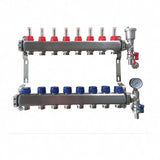
- Manifold Auto Air Vent End Unit
- Manifold Pressure Gauge End Unit
- Manifold Ball Valve Set 1", to isolate the manifold for flushing
- Hydraulic Pressure Test Pump
- PERT-AL-PERT Multilayer UFH Pipe, with aluminium oxygen barrier
- 5-Layer PERT-EVOH Oxygen Barrier UFH Pipe
- All manifolds and components
Frequently asked questions
Does underfloor heating need inhibitor if the pipe has an oxygen barrier?
Yes. The barrier slows oxygen getting through the pipe wall, but the manifold, pump, valves and heat source are metal and still need protecting. Inhibitor is also required under Part L when a new heating appliance is fitted.
Is biocide necessary in UFH?
For a system running below 60°C, such as an all-UFH or heat pump system, yes. Low-temperature water can grow bacteria and fungi. Add it at the final fill alongside the inhibitor.
Can I use car antifreeze in my heating?
No. Use a heating-grade inhibited propylene glycol. Car products and ethylene glycol are not made for heating systems, and ethylene glycol is toxic.
Do I need glycol in indoor UFH loops?
No. Loops inside a heated building will not freeze. Glycol, or anti-freeze valves, are for pipework outside, such as a monobloc heat pump circuit.
How much inhibitor does underfloor heating need?
Work out the system volume first. 16mm pipe holds about 11 litres per 100m. Then follow the product's dose rate, such as 1 litre per 100 litres for one common inhibitor.
Can I fill the UFH loops with inhibitor before the screed goes down?
You can, and some self-builders do when the floor will sit over winter. But you still need to clean, flush and dose the whole system when the heat source is connected, and drain the loops if they could freeze.
How do I test the inhibitor level?
Use the test kit from the inhibitor maker, or send a sample for a lab test. Test every year and keep a record.
Sources: HPA and HHIC: maintaining a healthy, efficient heating system, PHPI: Part L and water treatment, Energy Saving Trust Green Heat Toolkit: glycol and anti-freeze valves, Buildhub: UFH biocide, Buildhub: inhibitor in UFH
Products in this guide
Watch how each part works and how to fit it, and download its data sheet and install manual.


Every data sheet and manual: Product Library · All videos: MaxHeatUFH on YouTube
Design it in MaxHeatUFH ProLoop
Add your rooms, choose screed, overlay, joisted or electric, and get a free quick design and full kit list with prices.


