



Electric underfloor heating under carpet, laminate and wood
Which electric underfloor heating works under carpet, laminate and wood, the wattage and floor temperature limits for each finish, carpet tog limits, how to lay cable mats in levelling compound and foil mats under floating floors, and the electrician's role.
Short answer: Electric underfloor heating can go under carpet, laminate and wood, but the method changes with the finish. Under carpet, laminate and wood, a cable mat is set in self-levelling compound, and one manufacturer recommends 100W/m² over timber subfloors. Foil mats are made only for laminate and wood floors, not carpet. Always use a floor sensor under wood or laminate, keep the surface to about 27°C, and have the final connection made by a qualified electrician.
Most electric underfloor heating is sold for tiles, because a thin cable mat sits neatly in tile adhesive. But many rooms have carpet, laminate or engineered wood, and electric heating works under those too. The difference is how the heater is laid, what goes on top of it and how hot the floor is allowed to get.
This guide explains which type of electric heater suits each finish, how to build up the floor, what temperature limits apply and what the electrician needs to do. If you are still choosing between electric and water systems, start with our water vs electric UFH comparison.
Which electric underfloor heating works under carpet, laminate and wood?
There are two main types, and they suit different finishes.
| Heater type | How it is laid | Carpet | Laminate | Wood |
|---|---|---|---|---|
| Cable mat or loose cable | Bedded in flexible self-levelling compound | Yes | Yes | Yes |
| Foil mat | Laid dry on soft insulation under a floating floor | No | Yes | Yes, up to 18mm thick |
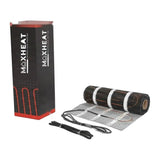
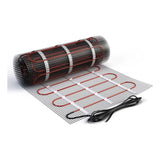
Cable mats and loose cable are the same heaters used under tiles. One manufacturer's mat guide says its mats can go under tiles, stone, laminate, carpet, wood and vinyl, with the mats covered in a flexible self-levelling compound. The levelling compound gives a smooth, solid surface for the floor finish and protects the cable. MaxHeatUFH electric mats come in 100, 150 and 200W/m², and loose cable suits awkward room shapes.
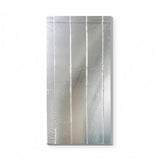
Foil mats have the heating wire bonded inside aluminium foil. They lie directly under a floating laminate or wood floor, on a soft insulating underlay. Foil heater makers state that they must not be used under any finish other than wood or laminate, so they are not an option for carpet.
What wattage should I use under carpet, laminate or wood?
Use a lower wattage under timber-based floors. One manufacturer recommends its 100W/m² mat for timber-based floors and its 150W/m² mat for concrete floors. It says 200W/m² is only for high heat loss areas, and only under tile or stone.
| Subfloor and finish | Manufacturer recommendation |
|---|---|
| Timber subfloor | 100W/m² |
| Concrete subfloor | 150W/m² |
| High heat loss, tile or stone only | 200W/m² |
The MaxHeatUFH 100W/m² mat suits timber subfloors. Under carpet, more of the heat is held back by the carpet itself, so the room needs to be well insulated for electric UFH to be the main heat source.
How hot can a laminate or wood floor get?
Keep the surface of wood and laminate to about 27°C. One manufacturer notes that wood flooring makers often set a maximum top surface temperature of about 27 to 28°C. It also warns that the underside of a wooden floor can be up to 10°C hotter than the top, which is why a floor sensor is mandatory under wood. Foil heater instructions set the thermostat to a maximum of 27°C, which they describe as the usual limit for wood laminate.
Because the sensor sits under the floor, not on top, the thermostat setting is higher than the surface temperature you want. One manufacturer publishes these sensor limits for a 25°C top surface:
| Floor finish | Thermal resistance (m²K/W) | Sensor limit for 25°C surface |
|---|---|---|
| 8mm HDF laminate | 0.05 | 28°C |
| 14mm beech parquet | 0.10 | 31°C |
| 22mm solid oak plank | 0.13 | 32°C |
| Carpet below 0.17m²K/W | under 0.17 | 34°C |
One manufacturer also says never to set the maximum floor temperature above 35°C under wood. Always check your flooring maker's own limit and use the lower figure.
What carpet and underlay can go over electric underfloor heating?
Choose carpet with a low thermal resistance. One manufacturer says to use only carpet below 0.17m²K/W, the limit it gives as suiting floor heating under EN 1307. One tog equals 0.1m²K/W, so that is under 1.7 tog. The NBS notes that heating makers quote combined limits for carpet and underlay of between 1.5 and 2.5 tog, and lists thick carpets and felt underlays as finishes to avoid.
- Add the carpet and underlay togs together.
- Use an underlay marked as suitable for underfloor heating.
- Keep large rugs and beanbags off the heated area where you can, as they trap heat.
Our guide to carpet tog ratings has worked examples.
How do you install a cable mat under carpet, laminate or wood?
The steps below follow one manufacturer's mat guidance. Your mat's own instructions take priority.
- Insulate. Lay insulation boards on the subfloor. One manufacturer says this gives the best performance and less heat lost downwards. Boards such as cement-coated XPS board give a firm surface.
- Plan the sensor. Cut a groove about 10mm deep and 10mm wide in the floor and up the wall for the sensor tube. Tape the end of the tube so compound cannot get in. The tube lets you replace the sensor later.
- Lay the mat. Never cut the heating cable. At the end of a run, cut the mesh and turn the mat. Keep cables at least 50mm apart and at least 30mm from conductive parts such as water pipes.
- Test. Measure the ohmic resistance and insulation resistance during installation and record the results. Sketch and photograph the layout.
- Cover. Pour a flexible self-levelling compound over the mat and let it dry fully before laying the floor finish.
- Lay the finish. Fit the underlay, laminate, wood or carpet as the flooring maker says for underfloor heating.
For the full process, see our guide to installing an electric mat.
How is a foil mat laid under laminate?
A foil mat goes straight under a floating floor, with no levelling compound. Foil heater instructions set these rules:
- Lay at least 6mm of soft insulation underlay beneath the foil. Do not lay foil directly on concrete or set it in cement.
- Use only wood or laminate on top. Not carpet, not parquet, and not laminate with a pre-attached underlay pad. Wood over 18mm thick is not recommended.
- Do not drive nails or screws into the floor, or cut floor panels on top of the foil.
- Use a thermostat with a floor sensor, set to a maximum of 27°C.
- Where mats are cut and turned, bridge the gaps with foil tape so the earth stays continuous.
Who can connect electric underfloor heating?
A qualified electrician must make the final connection. One manufacturer says all its underfloor heating must be RCD protected, and foil heater instructions specify 30mA RCD protection with no more than 7.5kW of heating on one RCD. In England, Approved Document P makes a new circuit notifiable. You can lay the mat and insulation yourself, then have the electrician test, connect and certify it.
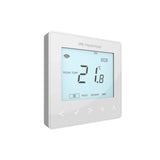
Under wood and laminate, use a thermostat made for electric floor heating with its floor sensor fitted, such as the Heatmiser neoStat-e, and set the floor limit to suit the finish.
What does it cost to run under carpet or laminate?
Running cost is watts multiplied by hours. A 10m² room with a 100W/m² mat draws 1kW at full power. At the October 2026 price cap of 26.32p per kWh, that is about 26p for each hour the mat is fully on. Once the room is warm, the thermostat switches the mat on and off, so real use is lower. Insulation under the mat cuts heat lost downwards. Our guide to running costs per m² works through more examples.
Design your UFH system yourself in 3 minutes with MaxHeatUFH ProLoop and get an instant quick design and quote. Start your design
Frequently asked questions
Can electric underfloor heating go under carpet?
Yes, with a cable mat set in self-levelling compound. Choose carpet below 0.17m²K/W (1.7 tog) and an underlay suitable for underfloor heating. Foil mats are not for carpet.
Can I put an electric heating mat directly under laminate?
Only a foil mat made for the purpose, laid on soft insulation. A standard cable mat must be covered with self-levelling compound first.
What temperature should electric underfloor heating be under laminate?
Keep the surface to about 27°C, or your flooring maker's limit if lower. Use a floor sensor and set the thermostat's floor limit to suit the finish.
Is a floor sensor needed under wood or laminate?
Yes. One manufacturer says a floor sensor is mandatory under wooden floors, and foil heater makers require one too.
What wattage mat should I use under a wood floor?
One manufacturer recommends 100W/m² over timber-based subfloors and 150W/m² over concrete. 200W/m² is for tile or stone only.
Can I install electric underfloor heating under laminate myself?
You can lay the insulation, mat and floor, but a qualified electrician must make the final connection and test the circuit.
Can I use nails or screws over a foil heating mat?
No. Do not drive nails or screws into the floor or cut panels on top of the foil.
Sources: NBS: underfloor heating, the cover up, Approved Document P (electrical safety), Ofgem energy price cap
Products in this guide
Watch how each part works and how to fit it, and download its data sheet and install manual.


Every data sheet and manual: Product Library · All videos: MaxHeatUFH on YouTube

Design it in MaxHeatUFH ProLoop
Add your rooms, choose screed, overlay, joisted or electric, and get a free quick design and full kit list with prices.


