








Can you fit electric underfloor heating yourself?
What a DIYer can legally do on an electric underfloor heating install (boards, mat, probe, testing) and what a qualified electrician must do under Part P and BS 7671, including notifiable work and the mistakes that ruin a mat.
Short answer: You can do most of an electric underfloor heating installation yourself: preparing the floor, fitting insulation boards, laying the mat, placing the floor probe and running the conduits. What you cannot do is the electrical work. A qualified electrician must make the final connection, provide the 30mA RCD protection, and test and certify the installation under Part P of the Building Regulations and BS 7671; a new circuit, a consumer unit change and work on circuits in a bathroom's bath or shower zones are all notifiable to building control.
Electric underfloor heating is the most DIY-friendly form of underfloor heating. There is no pipework, no manifold and no screed: an adhesive-backed mat rolls out over insulation boards, the tiler works over it, and the only trade you must bring in is an electrician at the end. That is why a confident DIYer can genuinely do the bulk of a bathroom or kitchen floor over a weekend.
The line between your work and the electrician's is not about skill, it is the law and your insurance. This guide draws that line precisely: what you can do, what the electrician must do, which jobs are notifiable, and the mistakes that write off a mat before it ever heats a tile. MaxHeatUFH electric mats are made for tile and stone floors; we supply the kit and do not install, and for the hands-on method see how to install an electric underfloor heating mat.
Which parts can you do yourself?
Everything that is not fixed electrical work:
- Plan and measure. Work out the free floor area, keeping the mat away from fixed units, WC pans and anywhere a fixing will later be screwed into the floor. Choose the mat size to fit the free area; a mat's heating cable must never be cut short.
- Prepare the base. Clean, sound and primed. Fit insulation boards so the floor warms in minutes rather than hours.
- Lay the mat. Roll out a 150W/m² mat or 200W/m² in high heat loss rooms, cutting only the mesh to turn the mat, never the cable. A mat stays within one room.
- Run the containment. Chase the wall for the thermostat back box, run conduit for the cold tail and a separate sealed conduit for the floor probe, laid between two cable runs. Fit a spare probe while the floor is open.
- Meter-test at each stage. Check the cable with a multimeter before laying, after laying and after the adhesive goes on, and write the readings down.
- Tile, or hand over to your tiler, with the heating off and the readings recorded.
Done carefully, that is most of the labour on the job. Our guide can I install underfloor heating myself? compares the DIY share on electric and water systems.
What must the electrician do?
All of the fixed wiring, which means:
- The circuit. Deciding whether the mat runs on a new dedicated circuit or, for a small mat, from an existing circuit via a fused connection unit, and installing the 30mA RCD or RCBO that BS 7671 Section 753 requires for electric floor heating.
- The final connection. Connecting the cold tail and floor probe to the thermostat, such as a Heatmiser neoStat-e, and the thermostat to the supply. Thermostats switch up to 16A, so larger floors need the electrician to split zones or switch through a suitable receiver.
- Inspection, testing and certification. Insulation resistance and continuity testing of the finished installation, the BS 7671 certificate, and the Section 753 plan of the heated floor fixed at the consumer unit showing the layout, rated power, RCD rating and test readings.
- Notification. Making sure notifiable work reaches building control, either through their competent person scheme registration or by the building control route.
Book the electrician before you start, not after the tiles are down. They may want to see the mat tested in place before it is covered, and they will tell you where to bring the cold tail and probe out.
Is electric underfloor heating notifiable under Part P?
Often, yes. Part P of the Building Regulations applies to fixed electrical work in homes in England, and the 2013 Approved Document makes three kinds of work notifiable: installing a new circuit, replacing a consumer unit, and any addition or alteration to existing circuits in a special location. A special location includes the space around a bath or shower, up to 2.25m high and extending 0.6m from the bath or shower tray, or 1.2m from the shower head where there is no tray, and rooms with a swimming pool or sauna heater.
So a new circuit for a kitchen floor is notifiable, and so is bathroom work within those zones. There are three compliant routes: an electrician registered with a competent person scheme who self-certifies and notifies for you, a registered third-party certifier who inspects and tests the work, or notifying building control before the work begins. An electrician on a competent person scheme is the simplest; you should receive a compliance certificate within 30 days of completion. Rules differ in the rest of the UK, so check with your local building control outside England.
Do not skip this. The certificate is what proves the work was done lawfully when you sell the house or claim on insurance after a fault.
How do you test the mat as a DIYer?
With a digital multimeter, at three stages: before you lay the mat, after it is fixed down, and after the adhesive or levelling compound has gone over it. Two measurements each time, with the mat disconnected from any supply:
- Continuity. Measure the resistance across the heating cable's conductors and compare it with the rating on the mat's label. One manufacturer's guide allows minus 5% to plus 10% of the stated figure; a reading far outside that, or no reading, means a damaged cable.
- Insulation. Measure between each conductor and the earth screen. The guide's pass is effectively infinite resistance; any measurable reading to the screen means damaged insulation. Your electrician will repeat this properly with an insulation resistance tester at test voltage.
Write every reading down with the date and stage. If a reading goes wrong between stages, you know exactly which trade damaged the cable and when, while it can still be fixed. Our guide to testing electric UFH during installation has the full routine, and fault finding covers what the readings mean when something is off.
What are the DIY mistakes that ruin a mat?
- Cutting or shortening the heating cable. Only the mesh may be cut. A mat that does not fit is the wrong size; heating cable resistance is matched to its length.
- Crossing or touching cable runs. Keep runs apart and never overlap mats; crossed cables overheat. The regulations also forbid heating units crossing expansion joints in the floor.
- Heating under fixed furniture. Leave heating-free areas under units and anywhere fixings will be driven, and warn your tiler and kitchen fitter that nothing may be screwed into the heated floor.
- Walking tools over an unprotected mat. Board over the mat while other trades work, and never drag mixing buckets across the cable.
- No floor probe conduit. A probe buried bare in adhesive cannot be replaced. Sealed conduit, probe between two cable runs, plus a spare.
- Switching on too soon. Not until the adhesive and grout have fully dried, and then gradually, never to force-dry the adhesive.
- Making the final connection yourself. It is the one shortcut that voids the certification, risks the warranty and leaves an unprotected heating element in your floor.
What does doing it yourself actually save?
The labour on the preparation, mat laying and making good, which on a small room is most of the installed cost; see electric underfloor heating installation costs for the full breakdown. The kit itself is simple: mats, insulation boards, a floor thermostat and a floor probe, all in our electric underfloor heating collection with next working day UK delivery on orders by 12pm Monday to Friday.
Budget properly for the electrician's visit and certification; it is not the place to economise. And if you would rather not do any of it, MaxHeatUFH works with vetted approved installers across the UK; send the job through our installation enquiry page.
Free design tool: doing a bigger project with water underfloor heating too? Design your UFH system yourself in 3 minutes with MaxHeatUFH ProLoop and get an instant quick design and quote. Start your design
Frequently asked questions
Can I legally install electric underfloor heating myself?
You can legally do the non-electrical work: boards, mat, probe conduit and preparation. The fixed electrical work must comply with Part P and BS 7671, and the final connection, RCD provision, testing and certification are a qualified electrician's job.
Do I need an electrician for a small bathroom mat?
Yes. Bathroom work within the zones around a bath or shower is notifiable under Part P even on an existing circuit, and every electric floor needs 30mA RCD protection and certification.
Can I connect underfloor heating to a plug?
No. It is fixed wiring and must be permanently connected through a thermostat on a properly protected circuit.
What tools do I need for the DIY part?
A digital multimeter for the stage tests, sharp scissors for the mesh, a trowel and primer for the boards, and the usual chasing and conduit tools for the thermostat drop. No specialist electrical tools; the testing instruments for certification are the electrician's.
Can I cut the heating mat to fit my room?
You can cut only the mesh backing to turn and shape the mat. The yellow heating cable itself must never be cut, shortened or joined on site. Choose the mat size to match the free floor area.
Will DIY laying void the warranty?
Laying the mat yourself is fine if the instructions are followed and the stage test readings are recorded. Skipping the electrician, cutting the cable or burying an untested mat are what cause rejected claims.
How long does a DIY install take?
For a typical bathroom: a day for preparation and boards, a few hours to lay and test the mat and conduits, then the tiler, and a short electrician visit for connection and certification once the adhesive has dried.
Sources: Approved Document P: electrical safety (2013 edition), IET Wiring Matters: floor and ceiling heating systems (BS 7671 Section 753)
Products in this guide
Watch how each part works and how to fit it, and download its data sheet and install manual.
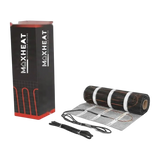


Every data sheet and manual: Product Library · All videos: MaxHeatUFH on YouTube
Design it in MaxHeatUFH ProLoop
Add your rooms, choose screed, overlay, joisted or electric, and get a free quick design and full kit list with prices.
Related guides
 What's in an underfloor heating kit? A complete parts checklistElectric UFH · 6 min read
 Underfloor heating trade accounts: how installers buy UFH supplies at trade pricesElectric UFH · 5 min read
 Buying underfloor heating supplies online: what to check before you orderElectric UFH · 6 min read