








Electric underfloor heating not working: testing mat resistance and finding faults
A step-by-step fault-finding guide for electric underfloor heating: thermostat checks and error codes, resistance and insulation tests, what the readings mean, locating a break and repairing it.
Short answer: First check the simple things: power to the thermostat, its mode and set point, and any error code. E1 on a Heatmiser neoStat-e means the floor probe is missing or faulty. If the thermostat is fine, an electrician should isolate the circuit and test the heating cable. The resistance across live and neutral should match the value on the mat's label, usually to within about 5%. An insulation test from the cores to the earth braid should read very high: one maker asks for more than 50MΩ at 1000V DC. No reading at all means the cable is broken. A low reading to earth means it is nicked or shorted. Many damaged cables can be found with a thermal camera or fault locator and repaired with a maker's repair kit, without lifting the whole floor.
When electric underfloor heating stops working, the heating cable is rarely the first thing at fault. The thermostat, its floor probe, the RCD and the settings cause most callouts. When the cable is damaged, it is almost always because of something that happened during installation: a trowel, a tile cutter, a dropped tile or a screw.
This guide takes you from the easy checks you can do yourself to the tests an electrician will carry out, what the readings mean, how faults are located under a finished floor, and when a repair is possible. Testing live circuits is dangerous. Anything beyond the thermostat checks should be done by a qualified electrician with the circuit isolated.
Is it the thermostat or the heating mat?
Start with the thermostat, because it is the most common cause and the easiest to check. Work through these in order:
- Power. Is the display on? Check the fused spur or circuit breaker and the RCD in the consumer unit.
- Mode. Is the thermostat in standby, frost mode or holiday mode? On a neoStat-e, frost protection holds a default of 12°C, which will feel off.
- Set point and schedule. Is the set temperature above the current room or floor temperature, and is the programme calling for heat now?
- Floor limit. The neoStat-e floor limit can be set from 20 to 45°C and defaults to 28°C. A low limit stops the heating early, especially under rugs.
- Sensor mode. If the thermostat has been set to use only the floor probe or only the air sensor, it may behave unexpectedly.
- Error codes. Look for a code on the display and check the manual.
If the thermostat shows it is calling for heat but the floor stays cold, the next step is to test the output and the heating cable. That is a job for an electrician.
What do Heatmiser E0, E1 and E2 error codes mean?
They are sensor faults. E1 is the one you will see most often on electric floor heating.
| Code | Meaning | What to check |
|---|---|---|
| E0 | Built-in sensor failed | The thermostat itself is faulty |
| E1 | Floor probe missing or faulty | Probe wired to RT1 and "-", correct probe type, probe not damaged |
| E2 | Remote air sensor missing | Probe wired to RT2 and "-", or setting changed by mistake |
Heatmiser says version 1 neoStat-e units accept only 10K3A1 probes, while version 2 also accepts 12K3A1 and 15K3A1. If you have electric floor heating or engineered wood and see E1, Heatmiser says a floor probe must be fitted, so ask an electrician to check it rather than switching to air-only mode.
To test a 10K floor probe, set a multimeter to the 20k ohm range and measure across the two probe wires with them disconnected from the thermostat. A working 10K probe reads about 10,000 ohms at 25°C. An open circuit or a reading near zero means the probe or its cable is damaged. If the probe is faulty, a replacement 10K floor probe must match the probe type your thermostat accepts.
How do I test an electric underfloor heating mat with a multimeter?
An electrician isolates the circuit, disconnects the cold tail from the thermostat, and measures resistance across the live and neutral cores. The reading is compared with the value on the mat's label or in its manual.
- Isolate and prove dead. Switch off and lock off the circuit, and check it is dead with an approved voltage tester.
- Disconnect the cold tail from the thermostat's load terminals.
- Measure live to neutral on a suitable ohms range. One maker uses the 0 to 500 ohm range.
- Compare with the label. One maker's reference bands are about plus or minus 5% of nominal.
- Check each core to the earth braid. On a multimeter this should read open circuit. One maker asks for more than 500MΩ, or infinite, on the 1MΩ or higher range.
- Insulation test. With an insulation resistance tester, test live and neutral to the earth braid. One maker asks for more than 50MΩ after 1 minute at 1000V DC. Another asks for more than 200MΩ at 500V. Use the figures in your heater's manual.
Always use the maker's figures for your mat, and compare the reading with the one recorded at installation if you have it.
What do the readings mean?
| Reading | Likely meaning |
|---|---|
| Live to neutral matches the label | Heating element is continuous |
| Live to neutral open circuit (no reading) | Full break in the heating cable or cold tail joint |
| Live to neutral well below the label | Possible short between cores |
| Core to earth braid below the maker's minimum | Nick, crush or moisture letting current leak to earth |
| Readings that drift and will not settle | Intermittent fault, often damage near the surface |
An ordinary multimeter cannot always detect a damaged cable jacket, which is why the insulation resistance test matters. A cable can pass the ohms test and still trip the RCD.
Why does my underfloor heating trip the RCD?
The RCD trips when current leaks to earth. On electric floor heating that usually means damage to the cable insulation, but it can also be the RCD itself or another circuit sharing it.
- Cable damage. The insulation test will show a low reading from a core to the earth braid.
- Wiring or thermostat fault. A loose or wet connection at the thermostat or junction box.
- Shared RCD. Leakage from other circuits adds up. One heater maker says no more than 7.5kW of heating should be connected to each RCD or RCBO, and time-delay RCDs must not be used.
- Faulty RCD. An electrician can test its trip time and current.
Do not keep resetting an RCD that trips as soon as the heating comes on. It is protecting you. Every electric floor heating circuit must have 30mA RCD protection under BS 7671.
How do you find a break in an underfloor heating cable?
Narrow it down first, then pinpoint it. The aim is to lift one or two tiles, not the whole floor.
- Cold area. On some cable types the floor heats up to the fault and is cold beyond it. The edge of the cold area gives a rough position.
- Thermal camera. With the heating run, a camera shows the warm cable runs as lines. Where a line stops, or a hot spot appears, is the fault. Darkening the room and switching off other heat sources helps.
- Fault locator (TDR). A time-domain reflectometer sends a pulse down the cable and measures the distance to the fault, including the cold tail. You then follow the layout plan to that point.
- High-voltage methods. Some fault-finding kits use a high voltage or a controlled current to heat the fault so a thermal camera can see it. These must only be used by a trained electrician.
This is where the layout plan and test records from installation pay off. Many heater makers ask installers to complete a layout drawing and electrical test records and keep them at the consumer unit.
Can a damaged heating cable be repaired?
Often, yes. Once the fault is found, the electrician carefully removes the tile above it, exposes the cable and joins it with the heater maker's repair kit. The joint must restore the insulation and the earth braid, then be fully covered and retested before the tile is relaid.
- Use a proper repair kit. Never use electrical tape. It is not rated for floor heating.
- Never shorten the heating cable or cut a section out. A cut-out section leaves that area cold and changes the resistance.
- Cold tails are different. The cold tail can be extended or cut, but a damaged flexible cold tail must be replaced by the maker or a similarly qualified person.
- Check the warranty first. Some makers say not to attempt a DIY repair and to contact them, and warranties can be void if the floor covering has been damaged or lifted.
If the cable is damaged in several places, or the floor is due for replacement anyway, a new mat may be the more sensible fix.
How do I stop faults happening in the first place?
Test at every stage, record the readings and protect the cable while it is exposed.
- Test out of the box before laying, and record the resistance and insulation values.
- Test after laying, before tiling or levelling.
- Test after tiling, before connecting to the thermostat.
- Test the floor probe before the finish goes down.
- Protect the floor. Keep foot traffic, ladders and tools off exposed cable until it is covered.
- Label the circuit at the consumer unit and keep the layout plan with it, so nobody drills or screws into the heated area later.
Our guide to installing an electric underfloor heating mat covers the full sequence, and electric underfloor heating in bathrooms covers RCDs and Part P.
Planning a replacement floor? You can design your UFH system yourself in MaxHeatUFH ProLoop and get a quick underfloor heating design and a fully priced kit in 3 minutes. Start your design
Products for this job
- 10K Floor Probe for UFH Thermostats (3m)
- Heatmiser neoStat-e thermostat
- Heatmiser Slimline-E thermostat
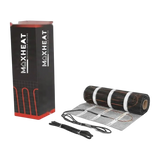
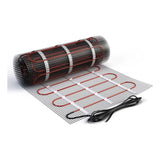
- Electric Underfloor Heating Mat 150W/m²
- All electric UFH thermostats
Frequently asked questions
What resistance should an underfloor heating mat read?
It depends on the mat's wattage and size. The correct value is printed on the mat's label or in its manual. Compare your reading with that figure: one maker's acceptable band is about plus or minus 5%.
Can I test an underfloor heating mat myself?
You can check the thermostat settings and error codes yourself. Testing the cable means isolating the circuit and disconnecting it from the thermostat, which should be done by a qualified electrician.
Why is only part of my floor warm?
On some cable types, the floor heats up to a break and is cold beyond it. It can also be a second mat on the same thermostat that has failed or been wired incorrectly. A resistance test on each mat tells you which.
My thermostat shows E1. What does it mean?
On a Heatmiser neoStat-e, E1 means the floor probe is not connected, is the wrong type or is faulty. Check it is wired to RT1 and "-" and measure its resistance. A 10K probe reads about 10,000 ohms at 25°C.
Can a broken heating mat be fixed without lifting the floor?
Usually only one or two tiles need lifting. The fault is located with a thermal camera or fault locator, the tile above it is removed, and the cable is joined with a repair kit.
Is it safe to keep resetting the RCD?
No. An RCD that trips when the heating comes on is detecting current leaking to earth. Leave the heating off and have an electrician test the circuit.
Can I cut the heating cable to remove a damaged section?
No. The heating cable must never be cut or shortened. Only the cold tail can be cut or extended.
Sources: Heatmiser: neoStat E0, E1 and E2 error codes, IET EngX forum: electric underfloor heating cable repair, IET Wiring Matters: BS 7671 Section 753
Products in this guide
Watch how each part works and how to fit it, and download its data sheet and install manual.



Every data sheet and manual: Product Library · All videos: MaxHeatUFH on YouTube

Design it in MaxHeatUFH ProLoop
Add your rooms, choose screed, overlay, joisted or electric, and get a free quick design and full kit list with prices.


