

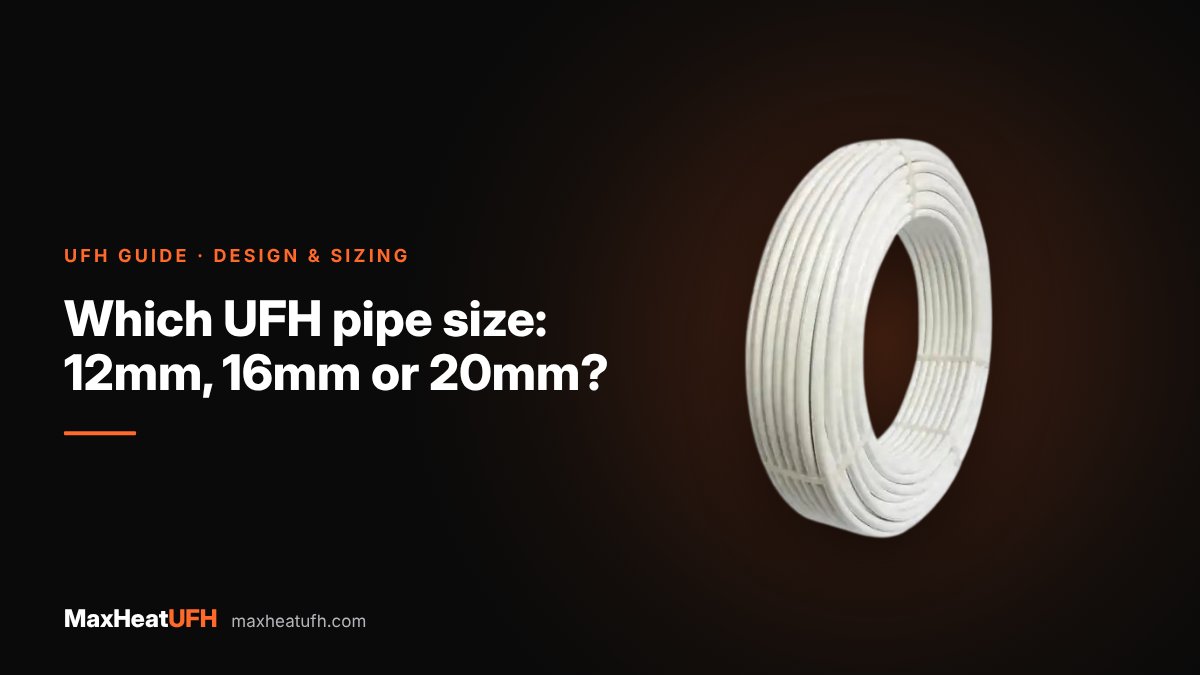
Which UFH pipe size: 12mm, 16mm or 20mm?
How to choose underfloor heating pipe size. 16mm is the UK standard for screed and routed boards, 12mm suits low-profile overlay floors, and 20mm and above feeds manifolds and commercial floors.
Short answer: 16mm is the standard pipe size for wet underfloor heating in UK homes, and it is the right choice for screed, castellated panels and routed boards. Use 12mm where the floor build-up is tight, such as low-profile overlay panels, and accept shorter loops. Use 20mm and larger for the primary flow and return between the heat source and the manifold, and for some commercial floors. Design guidance keeps 16mm loops to about 100m and water velocity under 1m/s.
UFH pipe is named by its outside diameter. A 16mm pipe with a 2.0mm wall has a 12mm bore, and that bore is what sets how much water the loop can carry, how long the loop can be and how hard the pump has to work. Pick the wrong size and you end up with too many loops, a starved manifold or a floor build-up that will not fit under the door.
This guide compares the sizes MaxHeatUFH stocks, 10mm to 32mm, and shows where each one belongs. It covers the loops in the floor, the primaries that feed the manifold, and what the choice does to loop lengths and fittings, and which sizes you can buy. For the difference between pipe materials rather than sizes, see UFH pipe types compared.
What do UFH pipe sizes actually mean?
The size is the outside diameter, and the wall thickness decides the bore. Most UFH pipe has a 2.0mm wall, so the bore is 4mm smaller than the name suggests. That matters because the water inside, not the plastic outside, carries the heat.
| Pipe | Bore | Water per metre |
|---|---|---|
| 10 x 1.3mm | 7.4mm | 0.043 litres |
| 12 x 2.0mm | 8mm | 0.050 litres |
| 16 x 2.0mm | 12mm | 0.113 litres |
| 20 x 2.0mm | 16mm | 0.201 litres |
The step from 12mm to 16mm pipe more than doubles the water the pipe holds per metre, because the bore goes from 8mm to 12mm. A bigger bore means less resistance, so the same pump pushes water round a longer loop. A smaller bore means the loop must be shorter, but the pipe bends tighter and hides in a thinner floor build-up.
Is 16mm the standard UFH pipe size?
Yes. 16 x 2.0mm is the size most UK wet systems are designed around, and it is the size our own designs default to. One UK design guide keeps 16mm loops to about 100m and water velocity below 1m/s, and that is the rule of thumb we follow too.
- Floor systems: 16mm suits clipped screed, castellated panels, and routed boards such as MaxHeatChip, MaxHeatPanel and MaxHeatDeck.
- Pipe centres: 16mm is normally laid at 150 to 200mm centres in homes.
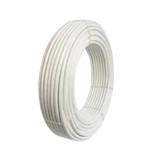
- Coils: our 3-Layer PERT-EVOH pipe comes in 16mm coils from 100m to 500m, so most loops are cut from one coil with no joints in the floor.
- Loops per manifold port: one 100m loop at 150mm centres covers roughly 13 to 14m² once tails are allowed for, so an average room is one or two loops.
If the pipe will be dragged across the floor or laid into screed, the 5-Layer PERT-EVOH 16mm pipe keeps the oxygen barrier sealed inside the pipe wall where it cannot be scuffed. Both are PERT with an EVOH barrier, rated 6 bar at 70°C and 10 bar at 20°C.
When should I use 12mm pipe?
Use 12mm where floor height is the problem. A 12mm pipe fits low-profile systems that add as little as 15mm to the floor, which is why retrofit and overlay jobs are where it earns its keep.
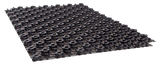
- Low-profile panels: the MaxHeatFix panel is 15mm high, takes 12mm pipe and can be tiled directly. The MaxHeatSolo egg crate panel takes 12mm pipe under levelling compound.
- Tighter bends: a smaller pipe turns more easily, which helps at 100mm centres and around fixtures.
- Closer centres: 12mm is typically laid at 100 to 150mm centres, which puts more pipe in the floor and offsets the smaller bore.
- Shorter loops: the 8mm bore adds resistance, so we design 12mm loops to about 80m against 100m for 16mm. A large room needs more loops and more manifold ports. Our guide to loop lengths and loops per room has the sums.
12mm is a trade-off, not a lesser pipe. In a thin floor it is the only sensible choice. In a 75mm screed it just means extra loops for no benefit, so use 16mm there instead.
When is 20mm or larger the right size?
20mm and above is primary pipe, not loop pipe, in almost every domestic job. Its job is to move the whole system's flow from the boiler or heat pump to the manifold without throttling it.
- Manifold primaries: a manifold serving several loops needs more flow than one loop carries, so the flow and return feeding it are a size up. We stock PEX-AL-PEX multilayer pipe in 20mm, 25mm and 32mm for these runs, plus a pre-insulated version with red and blue insulation already fitted. Our guide to manifold primary pipe size covers which size feeds how many loops.
- Long runs to outbuildings: pre-insulated 25mm or 32mm keeps heat loss down between a plant room and a garden room or annexe.
- Commercial floors: larger pipe at wide centres, around 250mm and up, is used in halls and warehouses, where our 20mm 3-layer PERT-EVOH pipe comes in 300m coils.
Laying 20mm as loop pipe in a house gains little: the floor surface temperature, not the pipe bore, caps the output, and the bigger pipe is harder to bend and needs a deeper floor.
Does a bigger pipe give more heat?
Not in itself. BS EN 1264 limits the floor surface to 29°C in occupied areas, which is about 100W/m² in a 20°C room, and no pipe size gets past that ceiling. Output is set by pipe spacing, flow temperature and the floor build-up.
What size really changes is the hydraulics:
- Loop length: a bigger bore allows a longer loop for the same pump effort, so fewer ports and fewer loops.
- Response: less water in a 12mm loop means slightly less to heat up, though the screed or board above the pipe dominates warm-up time.
- Noise and wear: keeping velocity under about 1m/s avoids flow noise, which is another reason loops have length limits.
So choose the size from the floor build-up and the loop lengths, then get the output you need from spacing and flow temperature.
Which fittings and connections fit each size?
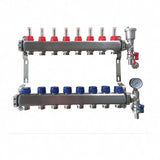
Every size connects to the manifold with a 3/4" Eurocone connector core matched to the pipe, two per loop. Check the core size matches both the diameter and the wall, for example 16 x 2.0.
| Size | Manifold connection | Joins and repairs |
|---|---|---|
| 12mm | Eurocone core 12 x 2.0 | 12mm compression coupling |
| 16mm | Eurocone core 16 x 2.0 | 16mm compression or MLCP press |
| 20 to 32mm | Usually primaries, 1" manifold valves | MLCP press fittings |
Multilayer pipe such as PERT-AL-PERT comes in 12mm, 15mm and 16mm, holds a bend without clips fighting you, and takes MLCP press fittings. Note that 15mm multilayer is not the same as 15mm copper, so always match fittings to the pipe, not the habit.
What sizes can I buy?
Pipe is cheap next to the rest of the system, so size decisions should follow the design, not the price list. MaxHeatUFH pipe comes in these sizes:
| Pipe | Sizes |
|---|---|
| 3-Layer PERT-EVOH | 10, 12, 16, 20mm |
| PERT-AL-PERT multilayer | 12, 15, 16mm |
| 5-Layer PERT-EVOH | 16mm |
| PEX-AL-PEX multilayer | 20, 25, 32mm |
| Pre-insulated PEX-AL-PEX | 16, 20, 25, 32mm |
All our barrier and multilayer pipe is oxygen tight, which protects the manifold, pump and heat source from corrosion. Browse the full range in UFH pipe.
Design your UFH system yourself in 3 minutes with MaxHeatUFH ProLoop and get an instant quick design and quote. Start your design
Frequently asked questions
What size is standard underfloor heating pipe in the UK?
16mm outside diameter with a 2.0mm wall. It suits screed, castellated panels and routed boards, and coils run up to 500m so most loops have no joints in the floor.
Is 12mm underfloor heating pipe any good?
Yes, in the right place. It is the pipe for low-profile overlay systems from 15mm high. Its 8mm bore means shorter loops, about 80m against 100m for 16mm, so large areas need more manifold ports.
Can I mix pipe sizes in one system?
Yes. Loops of different sizes can share a manifold as long as each loop uses a Eurocone core matched to its own pipe, and the primaries are sized for the total flow.
What pipe size should feed the manifold?
A size up from the loops, typically 20mm for a small manifold and 25mm or 32mm for larger ones or long runs. The loop pipe size does not change this; the number of loops does.
Does 20mm loop pipe heat a room faster than 16mm?
No. The floor surface is limited to 29°C in occupied areas under BS EN 1264, so the ceiling on output is the same. Spacing and flow temperature set the output, not the bore.
What pressure and temperature is UFH pipe rated for?
Our PERT-EVOH pipe is rated 6 bar at 70°C and 10 bar at 20°C, with a short-term peak of 95°C. UFH itself runs far below this, typically 35 to 55°C.
Is your barrier pipe PEX or PERT?
Our plain barrier pipe is PERT-EVOH, in 3-layer and 5-layer forms. Our multilayer pipe is PERT-AL-PERT in loop sizes and PEX-AL-PEX in the larger primary sizes.
Products in this guide
Watch how each part works and how to fit it, and download its data sheet and install manual.





Every data sheet and manual: Product Library · All videos: MaxHeatUFH on YouTube
Design it in MaxHeatUFH ProLoop
Add your rooms, choose screed, overlay, joisted or electric, and get a free quick design and full kit list with prices.