

UFH flow rate and delta T explained
What delta T means in underfloor heating, the flow rate formula in L/min with worked examples, how much flow a whole manifold needs, setting the flow meters and what a big or small delta T tells you about the system.
Short answer: Delta T is the temperature drop between the water entering a loop and the water coming back. Flow rate is how much water goes round, in litres per minute. They are tied together: a loop's flow in L/min is its heat output in watts divided by 69.8 times the delta T. Most UK design guides work to a 5°C drop, and some output tables use 10°C. A 700W loop at a 5°C drop needs about 2 L/min, which is why manifold flow meters read 0 to 4 or 0 to 5 L/min.
Flow rate and delta T are the two numbers behind every wet underfloor heating design, and the two you can actually see on a working system: the flow meters show the flow, and a thermometer on the flow and return pipes shows the delta T. Between them they tell you how much heat each loop is carrying into the floor.
This guide explains what each number means, how to work out the flow a loop needs, how much flow the whole manifold takes, and what it means when the delta T you measure is much bigger or smaller than the design figure. For setting the meters themselves, see UFH flow meter settings explained.
What is delta T in underfloor heating?
Delta T (ΔT) is the difference between the flow temperature going into a heating loop and the return temperature coming back out. If water leaves the manifold at 40°C and comes back at 35°C, the delta T is 5°C.
That drop is the heat the loop has given to the floor. Water carries about 4,190 joules per kilogram for every degree it cools, a figure one manufacturer's underfloor heating handbook uses in its flow calculations. So for a fixed heat output, delta T and flow rate trade off against each other:
- Small delta T: the water cools only a little, so more of it has to go round. Higher flow, higher pump work, a more even floor temperature along the loop.
- Large delta T: the water cools a lot, so less flow is needed. Lower pump work, but the end of the loop runs noticeably cooler than the start.
One manufacturer's handbook puts it simply: raising the differential temperature reduces the flow rate, and a smaller differential means higher flow, higher water speed and higher pressure loss in the pipe.
Delta T also sets the mean water temperature, which is what the output tables are based on. A loop running 45°C flow and 35°C return has a mean of 40°C. Hold the mean the same and the floor gives roughly the same heat whether you get there with a small or a large drop.
What delta T should underfloor heating be designed to?
Most UK design material works to a 5°C drop, and you will also meet tables based on 10°C. Some manufacturers use a design differential of 5°C in their room calculations, and their UFH performance tables all assume a 5°C drop across the system. Another manufacturer, by contrast, publishes its screed outputs for flow/return pairs of 50/40°C, 45/35°C and 40/30°C, which is a 10°C drop.
Neither is wrong. The design delta T is a choice the designer makes, and the flow rates on the design sheet only make sense alongside the delta T used to calculate them. If you have a quick design from MaxHeatUFH ProLoop or a full loop design, use the delta T and flow rates printed on it rather than a general figure.
What matters on site is that the delta T you measure at steady state is in the same region as the design figure. A system designed at 5°C that runs at 15°C is short of flow somewhere.
How do I work out the flow rate for each loop?
Divide the loop's heat output in watts by 69.8 times the delta T. The 69.8 comes from the 4,190 J/kg°C that water carries, divided by 60 to get from seconds to minutes:
Flow in L/min = loop output in W ÷ (69.8 × delta T in °C)
| Loop output | At 5°C delta T | At 10°C delta T |
|---|---|---|
| 350W | 1.0 L/min | 0.5 L/min |
| 700W | 2.0 L/min | 1.0 L/min |
| 1,050W | 3.0 L/min | 1.5 L/min |
| 1,400W | 4.0 L/min | 2.0 L/min |
To find the loop output, multiply the area the loop heats by the room's heat demand per m². One manufacturer's installation guide notes that maximum UFH output is usually quoted between 70 and 100W/m², so a loop covering 10m² of a room needing 70W/m² carries 700W. At a 5°C drop that is 700 ÷ 349, or about 2 L/min. Our guide to heat loss and UFH output shows how to get the W/m² figure properly.
Loops of different sizes need different flows, so the meters on a balanced manifold should not all read the same. All meters on one number usually means nobody has balanced the system, which our guide to balancing underfloor heating loops walks through.
How much flow does the whole manifold need?
Add up the loops. A six-loop manifold with loops set between 1 and 2.5 L/min might total 10 to 12 L/min, and one manufacturer rates its 12-port manifold at a maximum combined flow of 50 L/min. The pump has to deliver the total flow at the pressure the system loses, and the longest loop sets that pressure.
One manufacturer's handbook says loop pressure loss of 250 mbar must not be exceeded, because the pump also has to push water through the manifold, valves, mixing unit and primary pipes. Keeping loops at or under 100m, with 110m as the absolute maximum in the manufacturer guidance, keeps the loss down. Our guides to loop lengths and choosing a UFH pump cover the sums.
How do I set and check the flow on the manifold?
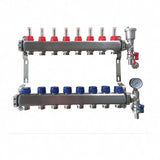
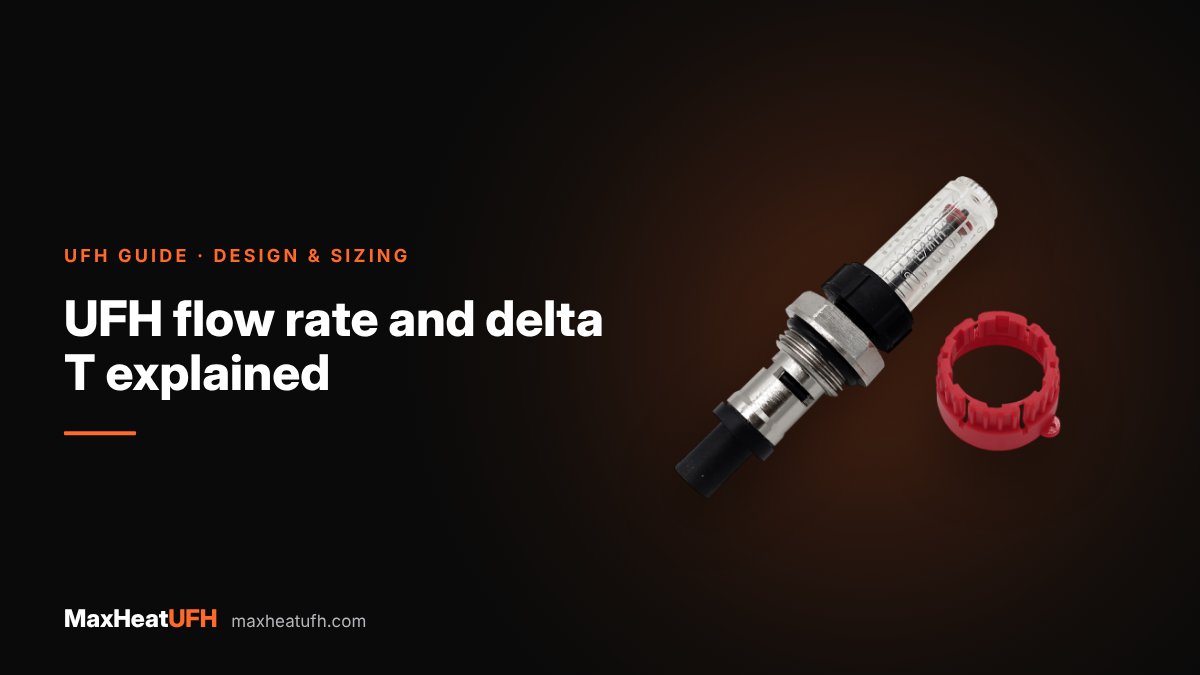
With the flow meters on the manifold's flow bar. Each meter shows one loop's flow and has a valve to adjust it. One manufacturer's manifold meters read 0 to 5 L/min with a stated tolerance of ±10%, and the flow meters on the MaxHeatUFH auto-balancing manifold read 0 to 4 L/min.
- Run the pump with all actuators open and the system full and vented.
- Set each loop's meter to its design flow from the loop schedule.
- Re-check after adjusting the last loop, because each change nudges the others.
- Note the final settings on the commissioning record.
On an auto-balancing manifold the dynamic valves hold each loop at its preset flow as other zones open and close, so you set each circuit once with the key and the valve does the rest.
Delta T is checked at the manifold too. Many mixing units carry a thermometer, and clip-on pipe thermometers on a loop's flow and return tails do the same job loop by loop.
What does it mean if my delta T is too big or too small?
Measured at steady state, with the floor up to temperature, delta T is a diagnosis tool.
| Symptom | Likely meaning | First checks |
|---|---|---|
| Return barely cooler than flow | Too much flow for the heat being drawn | Meter set too high, short loop, room near set point |
| Very large drop, cool room | Too little flow | Meter set low, air in the loop, kinked pipe, pump setting too low |
| Large drop on one loop only | That loop is starved | Balance the manifold, check its actuator opens fully |
| Large drop everywhere at switch-on | Normal: a cold floor absorbs heat fast | Re-check once the floor is up to temperature |
Delta T only means something alongside the flow temperature. If the flow temperature itself is wrong at the manifold, start with our guide to UFH flow temperatures with boilers and heat pumps. One manufacturer's guidance is that the supply from the heat source should be at least 10°C above the designed manifold flow temperature, so the mixing valve has something to blend down from.
Does delta T work differently with a heat pump?
The arithmetic is the same, but the margins are thinner. A heat pump runs the lowest flow temperature it can, so the mean water temperature is already low. Choosing a small design delta T keeps the mean close to the flow temperature, which protects the floor's output: a 38°C flow at a 5°C drop gives a 35.5°C mean, while a 10°C drop pulls the mean down to 33°C and with it the W/m² the floor can deliver.
The cost of the small delta T is more flow, which is why heat pump systems lean on full-bore connections and careful loop design. The published manufacturer screed figures show how quickly output falls with mean temperature: the same floor that gives 94W/m² under tile at 45/35°C gives 69W/m² at 40/30°C. See our guide to underfloor heating with a heat pump.
Design your UFH system yourself in 3 minutes with MaxHeatUFH ProLoop and get an instant quick design and quote. A full loop design with per-loop flow rates can be ordered afterwards. Start your design
Frequently asked questions
What is a normal delta T for underfloor heating?
Around the design figure, which is 5°C in some manufacturers' UK design material and 10°C in some makers' output tables. During warm-up from cold the drop is much wider, which is normal.
What flow rate should each UFH loop have?
Its heat output in watts divided by 69.8 times the delta T. A 700W loop at a 5°C drop needs about 2 L/min. Loops of different sizes need different settings.
Why is my UFH return pipe cold?
A cold return with a hot flow means a very large delta T: the loop is passing too little water. Check the flow meter setting, bleed air from the loop and check the pump is running and set high enough.
Is a higher flow rate always better?
No. Beyond the design flow you gain almost no output, the delta T collapses and the pump works harder. One manufacturer notes that smaller temperature differences mean higher flow speeds and higher pressure loss.
What do the manifold flow meters read?
Litres per minute for one loop each. Typical scales are 0 to 4 L/min on the MaxHeatUFH auto-balancing manifold and 0 to 5 L/min on one manufacturer's, with about ±10% tolerance, so treat them as setting aids rather than precision instruments.
How do I measure delta T at home?
Read the thermometers on the manifold or mixing unit, or strap a pipe thermometer on the flow and return pipes. Take readings with the system at steady state, not during warm-up.
Does delta T change the floor temperature?
It changes how even it is. The floor near the start of a loop runs warmer than the end by roughly the delta T spread through the screed. BS EN 1264 caps the surface at 29°C in occupied areas either way, per one manufacturer's handbook.
Products in this guide
Watch how each part works and how to fit it, and download its data sheet and install manual.


Every data sheet and manual: Product Library · All videos: MaxHeatUFH on YouTube
Design it in MaxHeatUFH ProLoop
Add your rooms, choose screed, overlay, joisted or electric, and get a free quick design and full kit list with prices.