








How to identify old underfloor heating pipe (and find fittings for it)
How to work out what UFH pipe is in your floor: reading the print line, measuring outside diameter and wall, telling PB, PE-X, PE-RT, multilayer and copper apart, the 16mm vs 17mm trap, and how to find fittings that actually fit.
Short answer: Read the print line on the pipe first: makers print the material (PE-X, PE-RT, PB or a multilayer construction), the size as outside diameter x wall (for example 16 x 2.0), and the standard it is made to. If the print has worn off, measure the outside diameter with a vernier at several points and check the wall thickness at a cut end. Fittings seal on the exact diameter and wall, so a 17 x 2mm pipe will not seal in a 16 x 2mm fitting. Send your measurements and a photo to sales@maxheatufh.com and we will match a fitting or an adaptor.
Underfloor heating pipe has been laid in UK floors for decades, in several materials and more sizes than most people expect. When you extend a system, move a manifold or repair a damaged loop, the first job is to work out exactly what pipe is in the floor, because every connection you make must seal on that specific pipe.
This guide shows you how to read the markings, how to measure an unmarked pipe, which old pipe types you are likely to meet, and how to find fittings that fit them. If the pipe itself is damaged, see our guide to repairing a damaged UFH pipe once you know what you have.
Why does the exact pipe type and size matter?
Because fittings grip and seal on the pipe's outside diameter and wall thickness, not on a nominal name. A compression or press fitting made for 16 x 2mm pipe relies on the pipe being 16mm outside and 2mm thick: on a 17mm pipe it will not close, and on a thinner wall the insert will be loose. Material matters too. Plastic pipes need a support insert in compression fittings, multilayer pipe has an aluminium core that suits press fittings, and the fitting standard differs between polybutylene and PEX systems.
The material also tells you whether the pipe has an oxygen barrier. Early plastic heating pipe was often laid without one, which lets oxygen diffuse into the water and corrode steel and iron parts into black sludge. Our guide to oxygen barrier (EVOH) pipe explains what that means for an old system.
What do the markings printed on the pipe mean?
Most pipe carries a repeating print line along its length. Wipe a clean section and look for these elements:
| Marking | What it means |
|---|---|
| PE-Xa, PE-Xb, PE-Xc | Cross-linked polyethylene, letter shows the cross-linking method |
| PE-RT | Polyethylene of raised temperature resistance, not cross-linked |
| PB | Polybutylene, common in UK push-fit plumbing and some UFH |
| AL, PE-X/AL/PE-X or similar | Multilayer pipe with an aluminium core |
| EVOH or "oxygen barrier" | The pipe has an oxygen diffusion barrier layer |
| 16 x 2.0, 17 x 2.0, 20 x 2.0 | Outside diameter x wall thickness in mm |
| EN ISO 15875 | The product standard for PE-X pipes |
| BS 7291 | British Standard for thermoplastic pipes in heating and hot water, used for polybutylene systems |
A date or batch code often follows, which can help a manufacturer identify the exact product. Photograph the full repeat of the print line before you contact anyone: it is the single most useful piece of information.
How do I measure the pipe if the print has worn off?
Measure, never guess, because the common sizes are close together:
- Measure the outside diameter with a vernier or caliper at two or three points, away from fittings and bends. If you only have a tape, wrap it round and divide the circumference by 3.14.
- Check the wall thickness at a cut end or at the manifold connection. Common walls are 1.5mm and 2.0mm.
- Look at a cut end for layers. A thin silver ring in the wall is an aluminium core (multilayer). A coloured outer skin over a different coloured core suggests a barrier layer.
- Test the bend memory. Multilayer pipe holds its shape when bent; plain plastic pipe springs back.
- Note the colour. Colour alone never identifies a pipe, but it narrows the field: UK polybutylene plumbing pipe is typically white, while UFH pipe is often natural, white, orange or red depending on maker.
The 16mm versus 17mm trap is the one that catches most people. 16 x 2.0 is the common UK UFH size today, but 17 x 2.0 has been widely used in Europe and appears in older UK floors: pipe to EN ISO 15875 is still made in 17 x 2.0. One millimetre is hard to see by eye and impossible to feel, so use the vernier.
What old underfloor heating pipe types might be in my floor?
Most UK floors contain one of these:
| Pipe | How to recognise it | Notes |
|---|---|---|
| Polybutylene (PB) | Flexible, usually white, marked PB or BS 7291; UK sizes 10, 15, 22 and 28mm | Used with push-fit systems; barrier and non-barrier versions exist |
| PE-X single layer | Marked PE-Xa/b/c, EN ISO 15875; springy, strong bend memory absent | Early coils were often non-barrier; sizes include 16, 17 and 20mm |
| PE-RT | Marked PE-RT, often with EVOH barrier noted | Handled and jointed much like PE-X |
| Multilayer (PEX-AL-PEX or PERT-AL-PERT) | Aluminium ring visible at a cut end, holds its bent shape | Suits press and compression fittings made for multilayer pipe |
| Copper | Obvious metal pipe, sometimes plastic coated, in much older floors | Specialist territory: have the system surveyed before working on it |
Note that plumbing sizes and UFH sizes differ: a polybutylene system built around 15 and 22mm is a different family from continental-style 16 and 17mm UFH coils, and their fittings do not interchange. See our guide to UFH pipe types compared for how the current materials differ.
Does my old pipe have an oxygen barrier?
Check the print line for EVOH or the words oxygen barrier. If it is absent, assume the pipe is non-barrier until proven otherwise. A non-barrier system is not a write-off, but it should be protected: keep inhibitor levels up and fit a magnetic filter to catch the black oxide the oxygen creates. Our guides to inhibitor and water treatment and magnetic filters and water quality cover this. If you are replacing any pipework, replace it with barrier pipe such as our PERT-EVOH oxygen barrier pipe.
How do I find fittings for old underfloor heating pipe?
Do not buy fittings until the pipe is identified. The safe route:
- Photograph the print line, including any standard number and batch code.
- Measure outside diameter and wall as above and write both down.
- Email sales@maxheatufh.com with the photos and measurements. We will tell you whether a current fitting fits your pipe, whether an adaptor exists, or whether the honest answer is to joint onto new pipe.
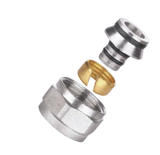
For common sizes the answer is often simple. 16 x 2.0 multilayer pipe suits a 16mm compression coupling, and a 16mm to 15mm copper adaptor joins it to copper. At the manifold, many pipes connect through eurocone adaptors sized to the exact pipe. What you should never do is force a near-miss: a 16mm fitting pulled up hard on 17mm pipe may hold on test and fail under a screeded floor later.
Can I connect new pipe to an old system?
Usually yes, and it is often the cleanest fix. An extension or a new zone can run in current 16mm PERT-EVOH pipe back to its own manifold ports, joined to the old system only at the manifold or primary pipework, where the joint is accessible. That keeps unmatched joints out of the floor. If the old manifold has no spare ports, see our guide to how many manifold ports you need before deciding between a manifold extension and a second manifold.
Free design tool: extending a room or adding a zone? Design your UFH system yourself in 3 minutes with MaxHeatUFH ProLoop and get an instant quick design and quote. Start your design
Frequently asked questions
How do I tell 16mm pipe from 17mm pipe?
Measure with a vernier or caliper; the 1mm difference is not reliably visible. Check at two or three points and confirm the wall thickness at a cut end, because 16 x 1.5, 16 x 2.0 and 17 x 2.0 all exist.
What is the grey or white flexible pipe in my floor?
In a UK home it is often polybutylene, marked PB or BS 7291. Confirm from the print line rather than the colour, because white PE-X and PE-RT pipes also exist.
My pipe has no markings at all. What now?
Measure the outside diameter and wall, photograph a cut end so the layers are visible, and email the details to sales@maxheatufh.com. A cut-off sample a few centimetres long is even better if you have one.
Can I use push-fit plumbing fittings on UFH pipe?
Only if the fitting maker lists your exact pipe type and size as compatible. Push-fit systems are designed around their own pipe sizes, and UFH coil sizes such as 16 and 17mm are usually not among them.
Does old non-barrier pipe have to be replaced?
No. It can keep working for years if the system water is treated with inhibitor and a magnetic filter protects the boiler and pump. Replacement becomes the better option when the pipe is failing, not merely because it lacks a barrier.
Is 17mm pipe still available?
Yes, 17 x 2.0 pipe is still manufactured to EN ISO 15875, mainly for continental systems. Whether you match it or adapt to 16mm depends on the fitting options for your exact pipe, which is worth an email before you order anything.
Who can identify the pipe for me?
The original manufacturer can identify it from the print line and batch code. If that trail is cold, send your measurements and photos to sales@maxheatufh.com and we will work from the dimensions.
Products in this guide
Watch how each part works and how to fit it, and download its data sheet and install manual.



Every data sheet and manual: Product Library · All videos: MaxHeatUFH on YouTube

Design it in MaxHeatUFH ProLoop
Add your rooms, choose screed, overlay, joisted or electric, and get a free quick design and full kit list with prices.


