



Several electric heating mats on one thermostat: wiring and load limits
How many electric heating mats one thermostat can run, how to add up the load in amps, why mats are wired in parallel, when to fit a contactor and when to split the floor into zones.
Short answer: Yes, you can run several electric heating mats from one thermostat, as long as they are wired in parallel (never in series), they are all in the same room with the same output per m², and their total current stays within the thermostat's rating. Heatmiser's neoStat-e and Slimline-E switch up to 16A, which at 230V is 3,680W, or about 24m² of 150W/m² mat. Above that, an electrician fits a contactor or splits the floor into zones, and makes the final connection to BS 7671.
Rooms are rarely the shape of one mat. A kitchen with an island, an L-shaped living area or a long hallway often needs two, three or four mats to cover the free floor. The question is then how to connect them, and how many one thermostat can carry before it is overloaded.
This guide shows how to add up the load, how mats are wired together, when a contactor is needed, and when it is better to split the floor into separate zones with their own thermostats. It uses Heatmiser's thermostat ratings, heating mat manufacturers' installation guides and the BS 7671 rules for floor heating.
How many heating mats can one thermostat run?
As many as you like, until the total current reaches the thermostat's switching rating. The number of mats does not matter; the total watts do. Add up the wattage printed on every mat label, then divide by 230 (the UK supply voltage) to get amps.
Amps = total watts ÷ 230
| Floor area at 150W/m² | Total load | Current at 230V | On one 16A thermostat? |
|---|---|---|---|
| 10m² | 1,500W | 6.5A | Yes |
| 15m² | 2,250W | 9.8A | Yes |
| 20m² | 3,000W | 13.0A | Yes, but a 13A fused spur is at its limit |
| 24m² | 3,600W | 15.7A | Only just |
| 30m² | 4,500W | 19.6A | No: contactor or two zones |
At 200W/m², 3,680W covers about 18m². At 100W/m², it covers about 36m². For help choosing the output, see what wattage of electric underfloor heating you need.
The 16A figure is the thermostat's switching limit, not a target. Leave your electrician room to choose the circuit, the protective device and the cable size. The supply matters too: a 13A fused spur can carry no more than 13A, and more than that needs its own circuit from the consumer unit.
How do you wire two heating mats to one thermostat?
In parallel. The cold leads (the plain supply tails) of every mat are joined live to live, neutral to neutral and earth to earth, and that joint feeds the thermostat's load terminals. Manufacturers' guides say not to connect heating elements in series, and to bring all the cold leads to the connection box in parallel. Each mat's earth screen must be connected to earth.
Series wiring is a real mistake that does happen. Two identical mats in series share the 230V between them, so each gets half the voltage and gives out only a quarter of its rated power. The floor never gets warm, and no fault shows on the thermostat.
The thermostat terminals are small, so with more than two mats the electrician usually joins the cold leads in a suitable junction box near the thermostat, with a single feed to the thermostat. The cold leads can be shortened if needed, but never the heating cable itself.
- Plan each mat's start point so its cold lead reaches the junction box without a joint in the floor.
- Label each cold lead with the mat's wattage and position before the floor goes down.
- Test every mat on its own before the leads are joined, so you know each one is sound.
Can different mats share one thermostat?
Only if they are in the same room and have the same output per m². Manufacturers' guides say all elements in one room must have the same heat density, unless each one has its own floor sensor and thermostat. They also say a single element must not run into two rooms.
The reason is the floor sensor. One thermostat has one floor probe, under one mat. If a second mat gives more watts per m², its part of the floor will run hotter than the sensor reads, and the floor limit no longer protects it. If you want a 200W/m² mat by a cold patio door and 150W/m² elsewhere, give each its own thermostat and sensor.
Two rooms on one thermostat is also a poor choice even when the rules allow it, because one room always ends up too warm or too cool. Separate rooms are better as separate zones. Our guide to underfloor heating zoning and wiring explains how to plan zones.
When do I need a contactor for underfloor heating?
When the total load is more than the thermostat can switch. Manufacturers' guides note that larger areas need a suitably sized supply contactor. The thermostat then switches only the contactor's coil, and the contactor switches the heating load. The floor sensor still connects to the thermostat, so control works the same way.
A contactor is chosen and fitted by the electrician, along with the circuit size and protection. It is usually the right answer for one large open space, such as a big kitchen diner, where you want a single set temperature. Where the floor naturally splits into areas, two thermostats are often simpler.
Should I use a contactor or split into zones?
Split into zones if the areas are separate rooms or need different temperatures; use a contactor if it is one space that should run as one. The table sets out the trade-offs.
| Two or more thermostats | One thermostat and contactor | |
|---|---|---|
| Best for | Separate rooms, mixed outputs | One large open area |
| Floor sensors | One per zone | One for the whole area |
| Control | Separate times and temperatures | One time and temperature |
| If one fails | Other zones keep working | Whole area off |
| Extra parts | Thermostats and probes | Contactor and enclosure |
Both options need an RCD. BS 7671 Section 753 requires 30mA RCD protection for floor heating, and notes that keeping the load on one 30mA RCD to about 7.5kW at 230V generally avoids unwanted tripping. Very large floors may therefore need more than one RCD-protected circuit.
Design your UFH system yourself in 3 minutes with MaxHeatUFH ProLoop and get an instant quick design and quote. Start your design
Which thermostats can carry several mats?
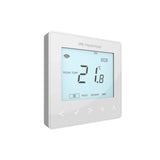
Most electric floor thermostats are rated at 16A. Heatmiser rates both the neoStat-e and the Slimline-E to switch up to 16A. Check the rating of any other thermostat before you add up your mats, because some are lower. For more on ratings, see our guide to 16A electric UFH thermostats.
Whatever you choose, the final connection is not a DIY job. A qualified electrician must connect the mats, thermostat and supply to BS 7671. In England, a new circuit, or adding to a circuit around a bath or shower, is notifiable under Part P; a registered electrician can self-certify it and give you a certificate.
Products for this job
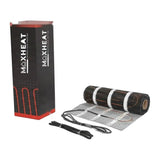
- MaxHeatUFH Electric Underfloor Heating Mat 150W/m²
- MaxHeatUFH Electric Underfloor Heating Mat 200W/m²
- Electric UFH thermostats
Frequently asked questions
Can I connect two underfloor heating mats together?
Yes, in parallel, by joining their cold leads in a junction box or at the thermostat. Never join them in series, and never cut or join the heating cable itself.
How many watts can a 16A thermostat take?
16A x 230V is 3,680W. That is about 24m² of 150W/m² mat, 18m² of 200W/m² or 36m² of 100W/m².
What happens if I wire mats in series?
Each mat gets only part of the voltage. Two identical mats in series give a quarter of their rated output each, so the floor stays cool.
Can one thermostat control mats in two rooms?
Manufacturers say a single mat must not cross into two rooms, and one thermostat has only one floor sensor. Give each room its own thermostat.
Can I mix 150W/m² and 200W/m² mats on one thermostat?
Not in the same room, unless each mat has its own floor sensor and thermostat. Mats with different outputs need separate control.
Do I need a contactor for a 20m² floor?
At 150W/m², 20m² is 3,000W or 13.0A, within a 16A thermostat. Your electrician will still check the circuit and supply can carry it.
Do multiple mats need separate RCDs?
Not usually, but floor heating must have 30mA RCD protection, and BS 7671 guidance suggests about 7.5kW per 30mA RCD at 230V to avoid nuisance tripping.
Sources: Heatmiser neoStat-e product page, Heatmiser Slimline-E datasheet, ELECSA: BS 7671 Section 753 floor heating, Planning Portal: electrics and Part P
Products in this guide
Watch how each part works and how to fit it, and download its data sheet and install manual.




Every data sheet and manual: Product Library · All videos: MaxHeatUFH on YouTube

Design it in MaxHeatUFH ProLoop
Add your rooms, choose screed, overlay, joisted or electric, and get a free quick design and full kit list with prices.


