Compression vs press fittings for underfloor heating pipe
When to use compression and when to use press fittings on underfloor heating and multilayer pipe, whether either can be buried, how to fit a compression joint and how they compare on cost.
Short answer: Use press fittings for permanent joints on multilayer UFH and heating pipe, and compression fittings where the joint stays accessible, such as at the manifold, on appliance connections and on repairs under a hatch. A compression joint needs only spanners, but makers ask for it to stay reachable for inspection. A press joint needs a U-profile tool but is permanent. Neither should be the first choice for a joint buried in screed: check the pipe maker's rules first.
Every wet underfloor heating system has at least two compression joints per loop, because the Eurocone fittings that connect each loop to the manifold are compression fittings. The question is what to use everywhere else: tails that need extending, a loop nicked during the build, a run from the manifold to the boiler, or a joint that has to go somewhere awkward.
This guide explains how each type seals, where each belongs, how to fit a compression joint on multilayer pipe properly, and how they compare on cost. For copper tube, see our guide to copper press vs solder vs compression instead.
What is the difference between compression and press fittings on UFH pipe?
A compression fitting seals when you tighten a nut onto the pipe. A press fitting seals when a press tool permanently squeezes a sleeve around the pipe. Both rely on an insert inside the pipe bore to stop it collapsing.
| Point | Compression | Press |
|---|---|---|
| How it seals | Nut, olive or split ring, insert | Insert with O-rings, pressed sleeve |
| Tools | Two spanners | U-profile press tool |
| Can it be undone? | Yes | No, cut out |
| Check it is right | Visual, then pressure test | Inspection window, then test |
| Typical rating | 10 bar, 5 to 110°C (one maker) | 10 bar, 80°C (95°C peak) |
| Best place | Accessible joints | Permanent joints |
The compression rating is one manufacturer's, for its compression fittings for plastic and multilayer pipe. The press rating is for MaxHeatUFH MLCP press fittings. Both are well above what a domestic UFH system runs at.
When should I use a compression fitting?
Use compression where the joint will stay reachable, or where you may need to take it apart later. That covers most of the joints at the manifold and the heat source.
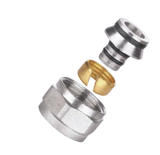
- Manifold outlets. Each loop connects with a 3/4" Eurocone connector core: a nut, a split olive and a pipe insert, sold in sizes from 10 × 1.3mm to 20 × 2.0mm. You need two per loop.
- Short repairs in reach. A 16mm MLCP compression coupling joins two lengths of 16mm multilayer with two spanners.
- Joining to copper. A 16mm PEX to 15mm copper adaptor connects a pipe run to existing 15mm copper.
- No press tool on the van. For a one-off job, compression avoids buying or hiring a tool.
One manufacturer confirms that its MLC multilayer pipe can be connected to compression bodies to BS EN 1254, and uses Eurocone compression adapters for 1/2" and 3/4" manifold outlets.
When should I use a press fitting?
Use press fittings for permanent joints, especially on runs with many joints, and wherever you want a consistent result from one joint to the next.
- Primary pipework. Long runs from the boiler or heat pump to the manifold, with tees, elbows and valves.
- Radiator circuits. Many joints, made quickly.
- Joints that will be hard to reach. Behind kitchen units or in ceiling voids, a permanent joint is the better choice, if the maker allows it there.
- Loop repairs in the floor. Where the pipe maker permits a joint in that location, a press coupling makes a permanent repair.
MaxHeatUFH MLCP press straight connectors have a brass body, a stainless steel sleeve with an inspection window and an insulating ring, and factory-fitted EPDM O-rings. They are sold in bags, 10 to a bag in 16mm. They need a U-profile press tool, such as the Manual Pressing Clamp Tool Set.
Can compression or press fittings be buried in screed?
Avoid any buried joint if you can. Where one is unavoidable, use only a fitting the pipe maker approves for burial, and follow their instructions for protecting it. Compression joints are the worse choice for burial.
- One fitting maker says its compression fittings for multilayer pipe should be kept accessible for inspection, for example in a flush-mounted box, and that cement mixture should not touch the metal parts.
- Water supply pipework in floors should have as few joints as possible, be in a duct or void and stay accessible for inspection and replacement, according to Water Regs UK. Its guidance also says pipework supplying underfloor heating should be a single run with no inaccessible joints.
- Pipe makers' rules vary. Read the instructions for the pipe you are using before you bury anything.
In practice, design the loops so every joint sits at the manifold. If a loop is damaged during the build, a new loop or a joint brought to an access point is often better than a buried repair. Our guide to repairing damaged UFH pipe sets out the options.
How do I fit a compression fitting on multilayer pipe?
Prepare the pipe as carefully as you would for a press fitting. A compression joint on a burred or oval pipe end leaks just as easily.
- Cut square. Use a pipe cutter, turning it slightly as you cut, as one manufacturer describes.
- Calibrate and deburr. Re-round the bore and remove the inside burr with a reamer.
- Lubricate. One manufacturer says to lubricate the seals and the inner surface of the pipe.
- Slide on the nut and olive. Put them on the pipe before the insert goes in.
- Fit any insulating barrier. One manufacturer fits one on multilayer pipe only, to separate the aluminium from the brass.
- Push the pipe fully onto the insert. Push until it stops.
- Tighten the nut. Hand tight, then with spanners as the maker states. Do not overtighten: one manufacturer warns that excessive torque can compromise the fitting.
- Test. Pressure test before you close anything up.
Match the fitting to the pipe. Eurocone cores and compression couplings are made for a stated outside diameter and wall thickness, which are printed along the pipe, for example 16 × 2.0. Pick the core with the same figures as the pipe, not just the same outside size. Our guide to connecting a UFH manifold covers Eurocone cores in detail.
Which is cheaper, compression or press?
Per fitting, a press connector is cheaper. The press tool is the extra cost.
For two or three repairs, compression costs less overall. On a job with many joints, the cheaper press connectors soon pay for the manual tool. On a full primary or a set of radiator circuits, press usually wins on both cost and time.
How do I test the joints?
Pressure test with water before any pipe or fitting is covered, whichever type you used. A compression joint that was not tightened enough, or a press fitting that was not pressed, shows up under test.
One manufacturer's press fittings have a leak-path feature, so an unpressed joint leaks during the test. One manufacturer's guarantee on its compression fittings depends on there being no visible flaws at installation or during the seal test on the pressurised system. For the full method on UFH loops and manifolds, see pressure testing underfloor heating.
Design your UFH system yourself in 3 minutes with MaxHeatUFH ProLoop and get an instant quick design and quote. Start your design
Frequently asked questions
Can I use compression fittings on underfloor heating pipe?
Yes, if the fitting is made for your pipe type and size, and the joint stays accessible. Eurocone manifold connectors are compression fittings.
Are press fittings better than compression for UFH?
For permanent joints, yes. They are quicker on multi-joint runs and the joint is permanent. For joints you may need to undo, compression is more practical.
Do compression fittings on multilayer pipe need an insert?
Yes. Compression fittings for plastic and multilayer pipe include a pipe insert that supports the bore. Eurocone cores come with the nut, split olive and insert together.
Can I bury a compression fitting in screed?
Avoid it. Makers ask for compression joints to stay accessible, and the Water Fittings Regulations guidance calls for accessible joints in floors on water supply pipework.
Do I need a press tool for MLCP?
Only for press fittings. Compression fittings for MLCP need just spanners. A manual U-profile press set from MaxHeatUFH needs no power.
Can I join UFH pipe to copper with a compression fitting?
Yes. A 16mm PEX to 15mm copper compression adaptor does it with spanners. For a pressed joint, use an MLCP press to copper brass tail.
Should I re-tighten compression fittings after the system heats up?
Check every joint during the pressure test and at the first heat-up. Tighten only to the maker's instructions, because overtightening can damage the fitting.
Sources: Water Regs UK: concealed and accessible, MaxHeatUFH fitting product data
Products in this guide
Watch how each part works and how to fit it, and download its data sheet and install manual.




Every data sheet and manual: Product Library · All videos: MaxHeatUFH on YouTube

Design it in MaxHeatUFH ProLoop
Add your rooms, choose screed, overlay, joisted or electric, and get a free quick design and full kit list with prices.