








Frost protection and power cuts with underfloor heating
How to protect underfloor heating from frost when you are away, what boilers and heat pumps do on their own, what happens in a power cut and what to check when the power returns.
Short answer: When you go away in winter, put your UFH thermostats into frost mode rather than switching them off, and leave the power and the boiler or heat pump on. On a Heatmiser neoStat, frost mode holds the room at 12°C by default and can be set from 7°C to 17°C. Frost protection only works while there is power, so in a power cut nothing heats the system. After the power comes back, check the boiler or heat pump has restarted, the system pressure is right and every thermostat is back on.
Frost damage to a wet underfloor heating system is rare in a lived-in home, because the floor and the house hold a lot of heat. The risk rises when a house is empty for days in cold weather, when pipework runs through a cold loft or garage, or when a heat pump sits outside with water in it. A power cut during a cold snap combines several of those risks at once.
This guide explains how frost protection works on a UFH thermostat, what your boiler or heat pump does on its own, what happens during a power cut and what to check afterwards. Figures for thermostats come from Heatmiser's own support pages, and figures for boilers, valves and antifreeze come from the makers' instructions.
What does frost mode do on a UFH thermostat?
Frost mode keeps the heating off unless the room falls below a low frost temperature, then heats just enough to bring it back up. It overrides the normal programme until you switch it off.
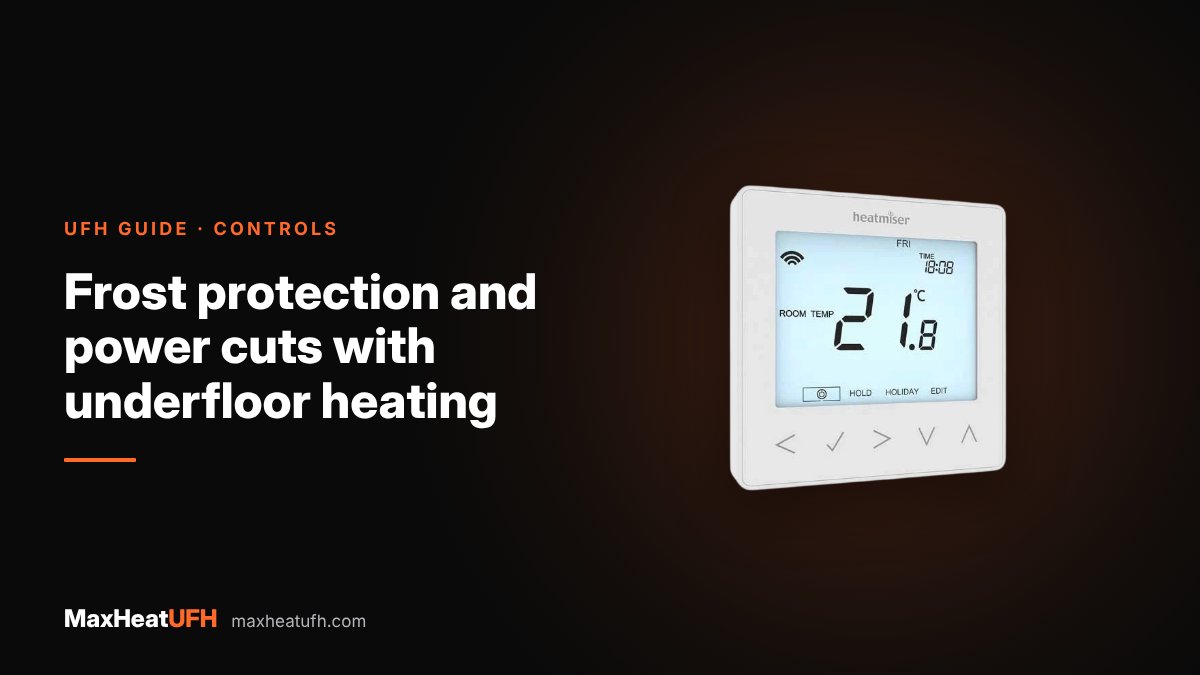
On a Heatmiser neoStat, the frost temperature defaults to 12°C and can be set from 7°C to 17°C. While frost mode is on, a frost icon shows on the screen, and the flame appears if the thermostat calls for heat to protect the room. Pressing tick on the power icon switches frost mode on and off.
| Setting | What it does | Use it when |
|---|---|---|
| Frost mode | Heats only if the room drops below the frost temperature | Away for an unknown time in cold weather |
| Holiday mode | Runs a holiday setting for the dates you choose, then returns to the programme | Away for known dates and want the house warm on return |
| Lower set point or setback | Keeps a lower temperature on the normal programme | Away for a night or two |
| Thermostat off | No heating at all | Summer only, never in freezing weather |
If the set temperature will not go above 17°C, the thermostat is still in frost mode, because 17°C is the top of the frost range. Switch frost mode off at the power icon and the programme will resume.
Does my boiler protect the system from frost?
It protects itself, not the rest of the system. Many boilers have a built-in frost function that fires the boiler when the water inside it gets very cold, but it does not protect pipework elsewhere.
One boiler maker, for example, says its built-in frost protection activates when the boiler water falls below 8°C, works regardless of the room thermostat setting and has little effect on bills. It also says this protects the boiler only, not external pipework. If the boiler or pipes are in a loft, garage or outbuilding, that maker recommends extra frost or pipe thermostats fitted outside the boiler.
- Leave the boiler's electrical supply switched on, or its frost function cannot work.
- Leave the gas or oil supply on for the same reason.
- Check your own boiler's manual for its frost settings, as they vary between makers.
How are heat pumps protected from frost?
A heat pump runs its own frost protection while it has power. The risk is a long power cut, when water sitting in an outdoor monobloc unit and its external pipes can freeze. Installers protect against this with anti-freeze valves or glycol.
Anti-freeze valves. These fit on the flow and return pipes outside and open to drain a little water if it gets close to freezing, so ice cannot form. One manufacturer's valve for monobloc heat pumps opens when the water falls to 1°C and keeps draining until it warms to about 4°C. The maker says it matters most when the heat pump is off for a long time, such as during a power cut. Another maker's version opens at about 3°C and closes at 4°C.
Because these valves release water, the system pressure can fall. One manufacturer advises keeping an automatic filling unit installed and active, and checking the system pressure after a power cut to the heat pump.
Glycol. Some systems are filled with an antifreeze and inhibitor mix instead. One inhibitor maker's mono-propylene glycol product gives this protection:
| Concentration | Frost protection to |
|---|---|
| 25% (minimum recommended) | -11°C |
| 30% | -15°C |
| 35% | -18°C |
| 40% | -22°C |
The maker recommends checking the concentration annually, with a refractometer or test kit. Whether to use glycol or valves is the heat pump installer's decision, as it affects the heat pump's performance and warranty. Our guide to inhibitor, biocide and antifreeze in UFH covers water treatment in more detail.
What happens to underfloor heating in a power cut?
Everything stops. The boiler or heat pump, the pump, the wiring centre and the actuators all need mains power, so no heat reaches the floor until the power returns.
The good news is that a screed floor holds a lot of heat, so the house cools slowly. In a typical home with the doors shut, rooms lose temperature gradually over a power cut of a few hours. Our guide to thermal mass and underfloor heating explains why heavy floors hold their warmth.
- Mains thermostats go blank and come back on when power returns.
- Battery thermostats keep showing a temperature, but nothing happens because the wiring centre is off.
- Actuators stop responding until the wiring centre has power and calls for heat again.
- App control drops out until the hub and router have restarted.
Keep doors and curtains closed to hold the heat in. If a power cut runs on in freezing weather and you have a monobloc heat pump without anti-freeze protection, speak to your installer.
What should I check after a power cut?
Check that the heat source, the pump and every thermostat are working again, and that the system pressure has not dropped. Most systems restart on their own, but a few things can need a nudge.
- Boiler or heat pump. Check it has restarted and is not showing a fault code. Reset it following the maker's instructions if needed.
- System pressure. Check the gauge on the boiler or manifold. If anti-freeze valves have opened, the pressure may have dropped. Our guide to UFH pressure dropping covers topping up.
- Thermostats. Check each one is on, not showing just a power icon or sitting in a menu, and that the clock is right.
- Wiring centre. Check the power light is on and zone lights come on when thermostats call for heat.
- Pump. Check it is running. A pump that hums but does not turn after a long stop may need attention.
- App. If thermostats show offline, give the router and hub a few minutes to reconnect, then reboot the hub if needed.
Heatmiser notes that the heating still works from the wall thermostats while the app is offline. If a neoHub does not reconnect on its own, unplug it, wait a couple of minutes and plug it back in. Our neoHub setup guide covers re-adding zones.
Why does the heating come on by itself after a power cut?
On a wireless system, the wiring centre may have gone into fail-safe. If a Heatmiser UH8-RF wiring centre loses the signal from a battery thermostat, it runs that zone for 12 minutes every hour until the link returns, so the room does not get too cold.
Zone lights on at the wiring centre with no flame on the thermostat is the sign. Check the thermostat's batteries and that it is still paired with the wiring centre. Once the link is back, the zone returns to normal control.
How should I protect UFH when the house is empty in winter?
Keep the heating in frost mode, keep the power on and make sure the water is treated. Draining a UFH system is rarely the right answer, because floor loops are hard to empty fully and the system then needs refilling and bleeding.
- Set every thermostat to frost mode or holiday mode, not off.
- Leave the boiler or heat pump powered, with gas or oil on.
- Fit frost or pipe thermostats if pipework runs through a loft, garage or outbuilding.
- Ask someone to check the house, the system pressure and the boiler display in a long cold spell.
- Make sure the system has inhibitor at the right level, and glycol or anti-freeze valves where a heat pump needs them.
For summer, when the risk is the opposite, see our guide to underfloor heating summer shutdown. Thermostats such as the Heatmiser neoStat V3 have frost and holiday modes built in.
Frequently asked questions
What temperature should I set for frost protection?
Heatmiser's default frost temperature on the neoStat is 12°C, and you can choose anything from 7°C to 17°C. Use the higher end if the house has cold rooms or pipework in unheated spaces.
Should I turn underfloor heating off when I go on holiday in winter?
No. Use frost mode or holiday mode so the heating can still come on if the house gets cold. Leave the boiler or heat pump powered.
Does underfloor heating keep the house warm in a power cut?
For a while. The pump and heat source stop, but a screed floor releases stored heat slowly, so rooms cool gradually. Keep doors and curtains closed.
Will my neoStat lose its settings in a power cut?
Check the clock and programme once the power returns. If the thermostat shows only a power icon, press tick to turn it back on.
Can underfloor heating pipes freeze?
Pipes inside a heated, lived-in home are very unlikely to freeze. The risk is in empty homes, pipework in unheated spaces and outdoor heat pump pipework during a long power cut.
Why has my system pressure dropped after a power cut?
If you have a heat pump with anti-freeze valves, they may have opened and drained some water to stop it freezing. Top up the pressure and check the valves have closed.
Does a boiler's frost protection protect the underfloor heating?
Not on its own. A boiler's built-in frost function protects the boiler. The rooms and pipework are protected by thermostats in frost mode calling for heat.
Sources: Heatmiser: neoStat frost mode and 17°C limit, Heatmiser: frost mode on the neoStat WiFi, Heatmiser: neoStat icons, Heatmiser: UH8-RF fail-safe, Heatmiser: thermostat showing offline
Products in this guide
Watch how each part works and how to fit it, and download its data sheet and install manual.


Every data sheet and manual: Product Library · All videos: MaxHeatUFH on YouTube
Design it in MaxHeatUFH ProLoop
Add your rooms, choose screed, overlay, joisted or electric, and get a free quick design and full kit list with prices.


