Underfloor heating pump not working: noisy, not running or air-locked
How to find why an underfloor heating pump will not run, is noisy or is air-locked, using the Grundfos UPM3 and Wilo Para fault tables: lights, seized rotors, venting, cavitation and pump settings.
Short answer: Most underfloor heating pump faults come down to three things: no call for heat or no power reaching the pump, a rotor that has seized after standing unused, or air in the pump or loops. Check the wiring centre is calling for heat and look at the pump's light: on a Grundfos UPM3, red means an alarm such as a blocked rotor. Modern pumps vent themselves, so run the pump for a couple of hours and purge the loops. Noise is usually air, low system pressure or a pump setting that is too high.
The circulating pump on the manifold pump pack is the only moving part in most water underfloor heating systems. When it stops, every room goes cold. When it struggles, some loops run warm and others don't, and the manifold often tells you with a gurgle, rattle or whistle.
This guide works through the three common symptoms: a pump that won't run, a pump that is noisy, and a pump that runs but moves no water. It uses the fault tables in the Grundfos and Wilo pump manuals, which cover the pumps fitted to most UFH packs. Any work inside the pump's electrical box or the wiring centre should be done by a qualified electrician with the power isolated.
Why is my underfloor heating pump not running?
Usually because nothing is telling it to run. On most UFH systems the pump only gets power when a room thermostat calls for heat, so a pump that is silent with every room warm is normal.
- Make a call for heat. Turn one room thermostat a few degrees above room temperature and check its zone light comes on at the wiring centre.
- Check the wiring centre pump output. On a Heatmiser UH8, the UFH pump has its own output, and the maker recommends feeding it through a high limit thermostat on the manifold. If that high limit has tripped because the water got too hot, the pump will not run.
- Check the fuse. On the UH8, one 5A anti-surge fuse protects every 230V output, including the pump. If no zone, actuator or pump works, look there first.
- Look at the pump's light. No light at all means no power reaching the pump, or a failed pump. A red light means the pump has power and has found a fault.
- Check the cable. A loose or damaged plug-in power lead stops the pump. Replacement leads are available for common pumps.
Grundfos lists the same order in its fault table: with no power supply, check the system controller, the fuse and the supply. With normal supply but no running, check the controller settings, then whether the pump is blocked by debris.
What do the lights on my UFH pump mean?
Green means running normally and red means a fault on both the Grundfos UPM3 and the Wilo Para pumps. The pattern of the red light tells you which fault.
| Pump and light | Meaning | What to do |
|---|---|---|
| Grundfos UPM3, green | Normal running | No action |
| Grundfos UPM3, green flashing fast | Under external (PWM) control | No action |
| Grundfos UPM3, red: rotor blocked | Retries start every 1.33 seconds | Wait, or free the shaft |
| Grundfos UPM3, red: voltage low | Keeps running with a warning | Have the supply checked |
| Grundfos UPM3, red: electrical error | Pump stops | Check supply, then replace pump |
| Wilo Para, steady red | Rotor blocked or winding fault | Use the restart function |
| Wilo Para, flashing red | Under or over voltage, overheating or short circuit | Have the supply checked |
| Wilo Para, red and green alternating | Water flowing through with no mains power | Restore power to the pump |
Other pumps use their own codes, so check the manual for the pump fitted to your pack.
How do I free a seized UFH pump?
Use the pump's own restart function first, then the deblocking screw if it has one. A pump that has stood unused for a long spell, such as over summer, can stick and show a blocked rotor alarm when the heating comes back on.
- Wilo Para: press and hold the operating button for 5 seconds. A restart routine runs for up to 10 minutes, with the lights moving round in a circle. The pump also tries to restart by itself when it detects a blockage.
- Grundfos UPM3: the pump keeps trying to start by itself. If it stays blocked, switch off the power at least 5 minutes before you start, close the isolating valves or drain down, then undo the deblocking screw on the front of the pump head and turn the shaft with a screwdriver.
The water inside can be hot and under pressure, so let the system cool and isolate it before you open anything. To stop it happening again, see our guide to summer shutdown for underfloor heating.
How do I get air out of an underfloor heating pump?
Let it run. Grundfos says its UPM3 pumps are self-venting and do not need venting before start-up. Air in the pump is carried into the system shortly after it starts, and the pump should run for two hours after installation to vent the system.
The Wilo Para has a venting routine. Press and hold the button for 3 seconds and it runs for 10 minutes, with the top and bottom rows of lights flashing in turn. Wilo points out that this vents the pump, not the heating system.
Air pushed out of the pump collects at the manifold, where the automatic air vent lets it out. Air trapped out in the loops needs purging loop by loop with mains water. Our guide to bleeding air from underfloor heating covers the method. After purging, top the system back up to the pressure the heat source maker gives.
Why is my underfloor heating pump noisy?
A noisy pump usually has air in it, too little pressure at its inlet, or too much pump pressure for the system. The sound helps you tell which.
| Noise | Likely cause | Fix |
|---|---|---|
| Gurgling or rushing at start-up | Air in the pump | Let it run; the pump vents over time |
| Gurgling that doesn't clear | Air in the system | Purge the loops and vent the manifold |
| Rattling, like gravel in the pump | Cavitation from low inlet pressure | Raise system pressure within its limits; check the expansion vessel |
| Whistling at the manifold or valves | Pump pressure too high | Turn the pump setting down |
Grundfos lists these causes and fixes in its UPM3 manual. For low inlet pressure, it says to increase the system pressure or check the air volume in the expansion vessel. Wilo gives the same fix for cavitation, within the permitted range. If the pressure keeps falling, there is a leak or a vessel fault to find first. See underfloor heating pressure dropping.
Why is the pump running but the loops are cold?
The pump can run without moving water if valves are closed, a strainer is blocked or the actuators have not opened. Check the flow meters: if none of them move with the pump running, the water has nowhere to go.
- Isolating valves: the ball valves on the pump pack and manifold must be open, with handles in line with the pipe.
- Strainer and non-return valve: Grundfos lists checking the non-return valve and filter for insufficient flow.
- Actuators: if every actuator is closed, the pump is pushing against a dead end. Check that zones are calling.
- Pump setting: on a low setting, long loops get too little flow. Wilo's advice for a building that won't warm up is to raise the setpoint, or change from constant to variable pressure control.
- Blending valve: if the water reaching the loops is barely warm, the blending valve may be set too low rather than the pump at fault.
Why does my pump run flat out all the time?
On a PWM pump such as the Grundfos UPM3 Flex, a missing signal can mean full speed. On the heating profile, Grundfos says the pump runs at maximum speed when the PWM value is zero. If the pump runs at maximum and cannot be controlled, check that the signal cable is connected; if it is, replace the cable.
If you are not using PWM control, choose one of the pump's own settings instead. Our guide to choosing a UFH pump explains the constant curve, proportional pressure and constant pressure modes.
Is my pump fitted the right way round?
Check the motor shaft is horizontal. Grundfos says the UPM3 must always be installed with the motor shaft horizontal within ±5°, and the control box can be turned to the 3, 6, 9 or 12 o'clock position. Wilo says the electrical connection on the Para must never face upwards. The arrow on the pump body must point the way the water flows.
Free design tool: Planning a new manifold or replacing an old system? Design your UFH system yourself in 3 minutes with MaxHeatUFH ProLoop and get an instant quick design and quote. Start your design
Products for this job
- Grundfos UPM3 Flex 25-70 Circulation Pump
- Wilo A-Rated UFH Circulating Pump 6m
- Bastion A-Rated UFH Circulating Pump
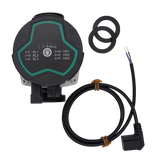
- Grundfos Replacement Pump Power Cable (UPM3)
All three pumps fit the standard 130mm position with 1½in unions used on our UFH pump packs, so a like-for-like swap needs no pipework changes.
Frequently asked questions
Why has my underfloor heating pump stopped working?
Most often there is no call for heat, a fuse or high limit thermostat has cut the supply, or the rotor has seized after standing. Check the wiring centre, then the pump's light.
How do I know if my UFH pump is airlocked?
It gurgles, runs but moves little water, and the flow meters flicker or stay low. Let a self-venting pump run, use the venting function if it has one, then purge the loops.
Can I bleed an underfloor heating pump?
Modern A-rated pumps such as the Grundfos UPM3 vent themselves and have no bleed screw for routine use. Air is carried to the manifold, where the air vent removes it.
Why is my underfloor heating pump making a rattling noise?
Usually cavitation, caused by too little pressure at the pump inlet. Raise the system pressure within its permitted range and check the expansion vessel.
Should the UFH pump run all the time?
No. It should run when a zone calls for heat and stop when none does. A pump that never stops points to a thermostat that is always calling or a wiring fault.
What setting should my UFH pump be on?
The lowest setting that gets every loop to its design flow. Start in the middle, check the flow meters, and go up only if the longest loop is short of flow.
Can I replace a UFH pump myself?
The pipework swap is simple on a 130mm pump with 1½in unions: isolate, drain the pack, swap the pump and refill. The electrical connection should be made by a qualified electrician.
Sources: Grundfos UPM3 installation and operating instructions, Wilo-Para installation and operating instructions, Heatmiser UH8 wiring centre manual
Products in this guide
Watch how each part works and how to fit it, and download its data sheet and install manual.




Every data sheet and manual: Product Library · All videos: MaxHeatUFH on YouTube

Design it in MaxHeatUFH ProLoop
Add your rooms, choose screed, overlay, joisted or electric, and get a free quick design and full kit list with prices.