



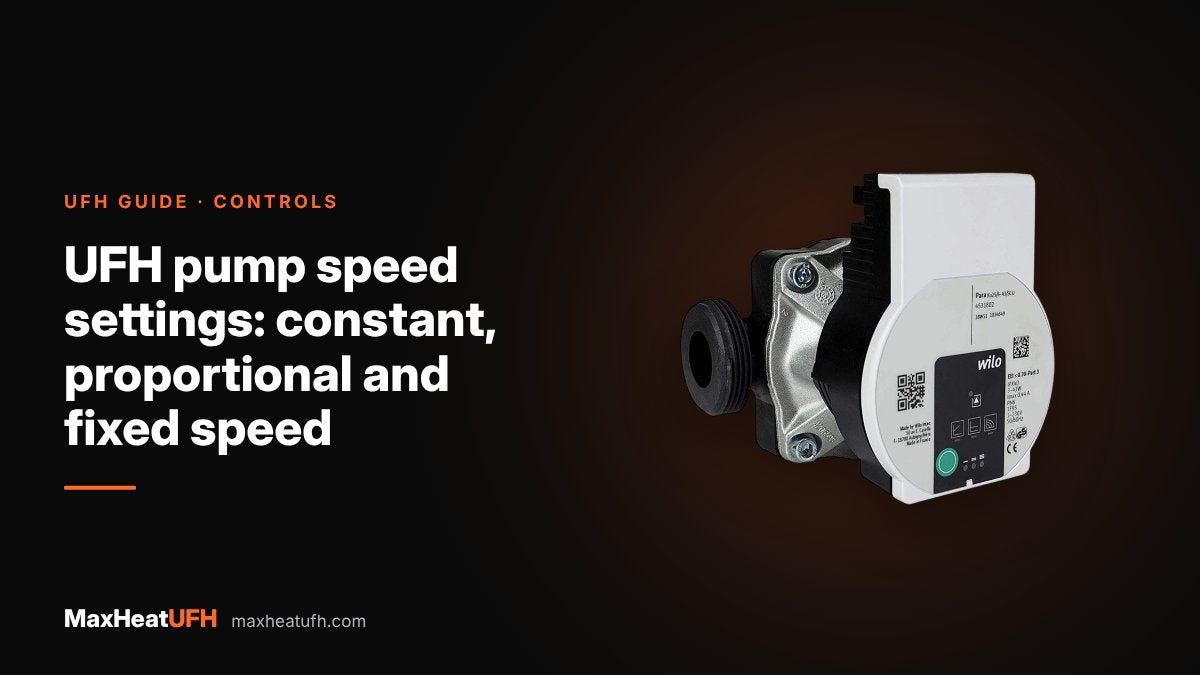
UFH pump speed settings: constant, proportional and fixed speed
What constant pressure, proportional pressure, constant curve, AUTOADAPT and PWM mean on a UFH pump, why Grundfos points underfloor heating at constant pressure, and how to read and change the setting on a UPM3 with its button and LEDs.
Short answer: For a UFH manifold with zone actuators, set the pump to constant pressure. Grundfos's UPM3 data booklet lists floor heating with variable flow under constant pressure control and says that in underfloor heating systems it can be better than proportional pressure. Use constant curve (fixed speed) only for constant-flow systems and during commissioning, and PWM only when the boiler or heat pump manual describes the connection. On a Grundfos UPM3 you change the setting with the single button: hold it for 2 to 10 seconds, then press to step through the modes shown by the LEDs.
Every modern UFH circulation pump has a handful of settings behind one button or dial: proportional pressure, constant pressure, constant curve and, on some models, AUTOADAPT and PWM. The names are not obvious, the right choice is not the default on every pump, and a wrong setting shows up as noisy valves, cool rooms or a pump working harder than it needs to.
This guide explains what each mode actually does, which one suits an underfloor heating manifold, and how to read and change the setting on the Grundfos UPM3 fitted to our pump packs. For choosing between pump brands and heads in the first place, see choosing a UFH pump.
What do the UFH pump settings mean?
Each setting is a rule for how the pump reacts when the system's resistance changes, which on a UFH manifold happens every time a zone's actuators open or close.
| Setting | What the pump does | Typical use |
|---|---|---|
| Constant pressure (CP) | Holds the same head however many zones are open | UFH manifolds |
| Proportional pressure (PP) | Reduces head as flow falls | Systems with long shared pipe runs |
| Constant curve (CC) | Fixed speed, like an old three-speed pump | Constant-flow systems, commissioning |
| AUTOADAPT (AA) | Pump picks and adjusts its own curve | Hands-off setup on PP or CP |
| PWM | Boiler or heat pump sets the speed by signal | Heat sources with a PWM output |
On the UPM3, Grundfos gives each internal mode three curves (PP1 to PP3 and CP1 to CP3, each with an AUTOADAPT option) and four fixed-speed curves (CC1 to CC4, with CC4 the maximum). Other pump brands offer the same modes under their own labels.
Which setting should a UFH manifold pump be on?
Constant pressure. Grundfos's control mode selection table lists "floor heating system with variable flow" under constant pressure and AUTOADAPT constant pressure, and the data booklet adds that in underfloor heating or one-pipe systems constant pressure control can be the better choice.
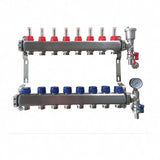
The reason is where the resistance lives. On a manifold, each loop is its own parallel path, and the loops are most of the system's resistance. When one room's actuator closes, the remaining loops still need the same pressure across them to keep their design flow. A constant pressure pump keeps that pressure there; the flow simply falls as paths close.
Which curve? Start on the lowest constant pressure curve, run the system with all zones calling, and check the flow meters reach their set values. If the farthest loops cannot make their flow, step up a curve. The balancing routine in our guide to balancing UFH loops tells you quickly whether the pump has enough in hand. AUTOADAPT on constant pressure starts from the medium curve and tunes itself from there, which suits a boiler-fed manifold you want to set and forget.
Why not proportional pressure for underfloor heating?
Proportional pressure drops the pump's head as flow falls. That is designed for systems where much of the resistance is in shared pipework: less flow means less friction in the shared pipes, so less pressure is needed at the pump.
A UFH manifold is the opposite case. When zones close, the open loops still need full pressure across them, but a proportional pressure pump has just reduced it, so the remaining rooms can end up short of flow exactly when they are the only ones calling. That is why Grundfos points UFH at constant pressure instead. Proportional pressure is not harmful, just the wrong shape for a manifold, and a system that heats poorly with only one or two zones open is the classic sign.
When is constant curve (fixed speed) the right choice?
Constant curve makes the pump behave like a traditional fixed-speed pump on one of four curves, CC1 to CC4. Grundfos recommends it for systems with constant flow, including systems where a minimum flow is guaranteed by an automatic bypass valve.
- Commissioning and balancing: a fixed speed removes one variable while you set the flow meters.
- Single-zone systems: one loop, no actuators, nothing varies, so a fixed curve is fine.
- Fault-finding: CC4 (maximum) is a quick way to prove whether a poor-flow problem is the pump setting or something else, such as the airlocks covered in UFH pump not working.
Left on maximum permanently, a fixed-speed setting wastes electricity and can make closed actuators and the bypass hiss as zones shut.
How do I read and change the setting on a Grundfos UPM3?
With the single button and the five LEDs on the front. In normal running the display shows performance: LED 1 is green when the pump runs, and the four yellow LEDs show how much of maximum power the pump is using, in quarters from 0 to 25% up to 75 to 100%.
- View the current setting: press the button once. The LEDs switch to the settings view for 2 seconds and show the current mode. Nothing changes at this stage.
- Unlock setting selection: hold the button between 2 and 10 seconds until the display starts cycling.
- Step through the modes: each press moves to the next setting. You cannot step backwards, so if you overshoot, keep going round.
- Store it: stop pressing. After 10 seconds the pump stores the last setting shown and returns to the performance view.
In the settings view, a green LED 1 means an internal mode (PP, CP or CC) and a red LED 1 means external PWM control; LEDs 2 and 3 identify the mode and LEDs 4 and 5 the curve. The booklet also describes a key lock: holding the button for more than 10 seconds toggles it, all LEDs except the red one flash, and while locked all long presses are ignored. If the button seems dead, unlock it the same way. A steady red LED 1 is an alarm: red plus yellow LED 5 is a blocked rotor, red plus LED 4 low supply voltage, red plus LED 3 an electrical fault.
How does PWM control work on the UPM3 Flex?
The Grundfos UPM3 Flex 25-70 has a signal connector that lets the boiler or heat pump set its speed with a PWM signal, using Grundfos's heating profile A. The signal logic is inverted: a low duty cycle means fast.
| PWM input signal | Pump behaviour |
|---|---|
| 0 to 10% | Maximum speed |
| 10 to 84% | Variable speed, maximum down to minimum |
| 84 to 91% | Minimum speed |
| 91 to 95% | Hysteresis band, on/off |
| 95 to 100% | Standby, pump off |
If the signal cable breaks, the pump fails safe to maximum speed. The Flex's four settings, A1 to A4, choose the curve it works to, which on the 25-70 means 4, 5, 6 or 7m of maximum head; with no PWM signal connected the pump simply runs on the curve you have selected. Only wire PWM where the heat source's manual describes it. This is the pump fitted to our pre-assembled non-mixing sets for heat pumps, while the UPM3 Auto blending pack uses the internally controlled UPM3 Auto, which offers the full PP/CP/CC/AUTOADAPT set and no PWM input.
Does the pump setting affect the bypass valve?
Yes. If the manifold or primary circuit has an automatic bypass valve to guarantee a minimum flow, Grundfos says you must set the pump's pressure control so the bypass can still do its job, and gives the example of choosing a constant pressure curve higher than the bypass valve's differential pressure. Set lower, the pump never generates enough pressure to open the bypass, and the heat source can be left with no flow path when all zones close. How the bypass fits into the mixing set is covered in UFH mixing and blending valves explained.
Whatever the setting, the UPM3 25-70 is a light load: its maximum power input is 52W, with an energy efficiency index of 0.20 or less, and on constant pressure it spends most of its life well below that.
Design your UFH system yourself in 3 minutes with MaxHeatUFH ProLoop and get an instant quick design and quote. Start your design
Frequently asked questions
What speed should my underfloor heating pump be set to?
Set the mode first: constant pressure for a manifold with zone actuators. Then use the lowest curve on which every loop still reaches its design flow on the manifold flow meters.
What is the difference between constant pressure and proportional pressure?
Constant pressure holds the same head at any flow. Proportional pressure reduces the head as flow falls. UFH manifolds want constant pressure, because closed zones do not reduce the pressure the remaining loops need.
What does AUTOADAPT do on a Grundfos UPM3?
It lets the pump choose its own curve. It starts on the medium curve of the selected mode and adjusts itself to the system over time. On the UPM3 it is available on both proportional and constant pressure.
How do I know which setting my UPM3 is on now?
Press the button once. The five LEDs show the setting for 2 seconds: green LED 1 for an internal mode, red for PWM control, with LEDs 2 to 5 identifying the mode and curve, then the display returns to showing power.
Why is my pump running flat out all the time?
On a UPM3 Flex, no PWM signal means the pump runs on its selected curve, and a broken signal cable sends it to maximum by design. On any UPM3, check it is not set to CC4, the maximum fixed curve.
Can I fit a UPM3 to my existing pump pack?
Usually yes. The UPM3 25-70 is a standard 130mm pump with 1½in unions, the size our valve-only and no-pump packs take. The pump uses its own plug-in cable.
Does the wrong setting damage anything?
No, but it costs comfort and electricity. Too low a curve starves the far loops; a fixed maximum speed wastes power and makes valves noisy. The right constant pressure curve sits between the two.
Sources: Grundfos UPM3 data booklet
Products in this guide
Watch how each part works and how to fit it, and download its data sheet and install manual.


Every data sheet and manual: Product Library · All videos: MaxHeatUFH on YouTube
Design it in MaxHeatUFH ProLoop
Add your rooms, choose screed, overlay, joisted or electric, and get a free quick design and full kit list with prices.


