








Zone valves and actuators: how UFH zones switch on
How thermal actuators and 2-port motorised zone valves work in an underfloor heating system, how they are wired, how long they take to open, and when you need a zone valve.
Short answer: A UFH actuator is a small electric head on the manifold that opens one loop when its room thermostat calls for heat. Inside, a heater warms an expansion element that pushes the valve open, and a spring closes it again when the power goes off, so it is slow: makers quote about 3 to 5 minutes. A 2-port motorised zone valve does the same job for a whole circuit, such as the whole UFH manifold off a boiler. It opens in about 20 seconds, springs shut without power, and has an end switch that tells the boiler and pump to run.
When a room on underfloor heating calls for heat, several things happen in order. The thermostat tells the wiring centre. The wiring centre powers the actuators for that room. The actuators open the loops. Then the pump runs and the boiler or heat pump fires. If the system shares a boiler with radiators or hot water, a zone valve may sit between them. Knowing how each part works makes the system easier to design, wire and fix.
This guide explains how thermal actuators and 2-port zone valves work, how they differ, how they are wired, and when you need each. It uses manufacturer data and Heatmiser's wiring centre manuals. If something is not working now, go to our actuator and zone valve fault guide.
How does a UFH actuator work?
It uses heat to move the valve. When the wiring centre sends power, a small heater inside the actuator warms an expansion element. The element pushes a piston down onto the valve pin on the manifold and opens the loop. When the power stops, the element cools and a spring pushes the piston back, closing the valve.
One manufacturer's actuator data sheet describes it this way: a PTC resistor heats an expansion element, which moves an internal piston, and a compression spring provides the closing force. Other makers use a wax element, as in one manufacturer's thermal wax actuator. Either way, there is no motor and almost nothing to wear out.
| Actuator data | Maker A, type 1 | Maker A, type 2 | Maker B |
|---|---|---|---|
| Voltage | 24V or 230V | 24V or 230V | 24V AC |
| Power in operation | 1W | 2W | 0.083A max |
| Start-up current (230V) | Under 550mA for up to 100ms | Under 250mA | - |
| Travel time | Not stated | About 3 minutes | 3 to 5 minutes to open or close |
| Types | Normally closed or normally open | Normally closed or normally open | - |
| Position indicator | Yes | Yes | - |
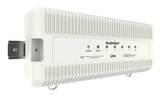
Each loop has its own actuator, even when two loops serve the same room. The MaxHeatUFH 2-wire thermal actuator is a 230V type for 230V wiring centres such as the Heatmiser UH4 and UH8.
Are UFH actuators normally open or normally closed?
Both types exist. A normally closed actuator keeps the loop shut until the thermostat calls, and opens only while power is applied. A normally open actuator holds the loop open until it is powered. One manufacturer makes both in 24V and 230V. Check which type your wiring centre and thermostats expect, because the two behave in opposite ways.
Normally closed actuators often have a "first open" feature. One manufacturer's actuator ships set to open, so the heating can run before the room controls are wired, for example to dry screed or commission the system. It locks into normal operation once it has had power for more than 6 minutes. So if your actuators are all open on a new system before the thermostats are connected, that can be normal.
Check the indicator on top of the head. On one manufacturer's actuator, the indicator on a normally closed model goes off when the valve opens.
Why does an actuator take minutes to open?
Because the element has to warm up before it moves. One manufacturer gives about 3 minutes of spindle travel for its thermal actuator, and another manufacturer gives 3 to 5 minutes to open or close for its 24V actuator.
That delay matters for the pump. If the pump starts before any loop is open, it runs against shut valves. Heatmiser's UH8-RF wireless wiring centre has a pump delay setting that holds the pump and boiler off for 2 minutes so the valves can open first. When you test a zone, turn the thermostat up and wait a few minutes before you decide an actuator has failed.
Actuators also take a little more current for a moment when they start. One manufacturer quotes under 550mA for up to 100ms on its 230V actuator, against 1W while holding open. Heatmiser's FAQ says to connect no more than 4 actuators to one zone on its wiring centres and to keep the total load under 5A.
What is a 2-port zone valve?
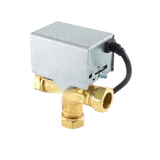
It is a motorised valve that opens or closes the flow to a whole circuit, such as the underfloor heating manifold, the radiators or the hot water cylinder. Where an actuator controls one loop, a zone valve controls everything downstream of it.
Here is how a typical 2-port zone valve works, from one maker's installation instructions:
- Motor: 230V AC, 5W.
- Opening: about 20 seconds when powered.
- Closing: it springs back to closed if the power is lost, so it is normally closed.
- Manual lever: opens the valve by hand for filling, testing, flushing and draining. Return it to Auto for normal running.
- End switch: a 3A auxiliary switch that closes when the valve is open.
- Limits: 0.5 bar maximum differential pressure, 8.6 bar static, 5 to 88°C flow.
- Fitting: follow the flow arrow, and do not mount the actuator head below the horizontal.
Another maker's data for its 2-port valve gives a 240V, 6W motor, normally closed, with an auxiliary switch and a manual lever, in sizes from 15mm to 28mm. MaxHeatUFH's 2-port motorised zone valve comes in 22mm and 28mm.
How is a 2-port zone valve wired?
A 2-port valve has four wires: two for the motor and two for the end switch. One maker's instructions give this colour code:
| Wire | Connects to | Job |
|---|---|---|
| Brown | Switched live from the thermostat or programmer | Drives the motor open |
| Blue | Neutral | Motor neutral |
| Grey | Permanent live | Feed to the end switch |
| Orange | Boiler and pump switched live | Live out when the valve is fully open |
That valve is double insulated and needs no earth. Always check the instructions for the valve you have, because colours and switch ratings vary between makers.
The key point is the end switch. The boiler and pump only get a live from the orange wire once the valve is open. That is how a zone valve gives boiler interlock: no valve open, no boiler. On Heatmiser's UH8, a valve on the UFH valve output has its end switch wired to the Gr and Or terminals, and the manual says to link Gr and Or if the valve has no end switch.
When does underfloor heating need a zone valve?
You need one when the underfloor heating shares a boiler with radiators or hot water and has to be switched on its own. The manifold's actuators control the rooms, and the zone valve controls whether boiler water reaches the manifold at all.
- UFH added to a radiator system. One 2-port valve for the UFH, one for the radiators, one for hot water. This is an S-plan layout. See UFH and radiators together.
- UFH on a system boiler with a cylinder. The UFH gets its own 2-port valve so hot water can run without heating the floor.
- Y-plan systems. A 3-port mid-position valve splits heating and hot water. Heatmiser's manuals say mid-position valves, or valves that need a closing signal, need a separate changeover relay on its wiring centres.
- UFH as the only heating. The wiring centre can fire the boiler directly through its volt-free heat enable, so a zone valve may not be needed for the UFH itself.
Our guide to UFH with a combi or system boiler shows the pipework for each case.
How do actuators, zone valves, the pump and the boiler switch on together?
In order, from the room to the heat source. Here is the sequence on a typical Heatmiser wired system with a zone valve.
- The room thermostat calls. It sends a switched live back to its zone on the wiring centre.
- The wiring centre powers the actuators for that zone. They start to open over the next few minutes.
- The pump output goes live for an underfloor zone, through the manifold high limit thermostat that Heatmiser recommends.
- The heat enable or valve output switches. If there is a zone valve, it opens in about 20 seconds and its end switch sends a live to the boiler.
- The boiler or heat pump fires and hot water reaches the manifold.
- When the room is warm, the thermostat stops calling, the actuators close, and if no other zone is calling the pump and heat source stop.
BEAMA's underfloor heating controls guide says that when there is no demand for heat, the heat source and the circulating pump should be switched off. For heat pumps, BEAMA also says wet systems should keep a minimum flow of water to avoid short cycling, so check the heat pump maker's guidance on how many loops must stay open. For the wiring centre side, see UFH zoning and wiring.
Should I use 230V or 24V actuators?
Use whatever voltage your wiring centre switches. Heatmiser's UH4, UH8, UH8-RF and UH8-N all switch 230V to the actuators, so they need 230V actuators. A 24V system needs a 24V wiring centre with its own transformer.
A 230V actuator on a 24V output will not move, and a 24V actuator on a 230V output is likely to be damaged. If you are replacing an actuator, check the voltage printed on the old one and the thread or adaptor that fits your manifold. One manufacturer, for example, supplies its actuators with valve adaptors for different manifold makes. Browse pumps, actuators and valves for replacements.
One manufacturer says a thermal actuator can last up to 250,000 on-off cycles, which it puts at up to 20 years of service.
Design your UFH system yourself in 3 minutes with MaxHeatUFH ProLoop and get an instant quick design and quote. Start your design
Frequently asked questions
How does a UFH actuator know when to open?
It does not decide for itself. The room thermostat tells the wiring centre, and the wiring centre sends power to the actuator. With power on, a normally closed actuator opens. With power off, its spring closes it.
How long does an underfloor heating actuator take to open?
About 3 to 5 minutes. One manufacturer gives about 3 minutes of travel for its thermal actuator, and another manufacturer gives 3 to 5 minutes to open or close.
What is the difference between an actuator and a zone valve?
An actuator sits on the manifold and controls one loop. A motorised zone valve sits on the pipe to the manifold, radiators or cylinder and controls the whole circuit. A zone valve opens in about 20 seconds and has an end switch to start the boiler.
Why are my actuators open when the thermostats are off?
On a new system, they may still be in their first-open position. One manufacturer's actuator, for example, ships open and switches to normal operation after it has had power for more than 6 minutes.
What do the grey and orange wires on a zone valve do?
They are the end switch. On one common 2-port valve, grey takes a permanent live and orange sends a live to the boiler and pump once the valve is fully open.
Do I need a zone valve for underfloor heating?
Only if the UFH shares a boiler with radiators or hot water and must switch on its own. If UFH is the only heating, the wiring centre's volt-free heat enable can call the boiler directly.
How many actuators can one thermostat control?
On Heatmiser wiring centres, up to 4 actuators per zone, within a 5A total board load.
How long do UFH actuators last?
One manufacturer quotes up to 250,000 on-off cycles, which it puts at up to 20 years.
Sources: Heatmiser UH8 manual, Heatmiser UH8-RF manual, Heatmiser FAQ: actuators per zone, BEAMA underfloor heating controls guide, BEAMA heat pump and electric heating controls guide
Products in this guide
Watch how each part works and how to fit it, and download its data sheet and install manual.





Every data sheet and manual: Product Library · All videos: MaxHeatUFH on YouTube

Design it in MaxHeatUFH ProLoop
Add your rooms, choose screed, overlay, joisted or electric, and get a free quick design and full kit list with prices.


