

UFH pipe layout patterns: serpentine, double serpentine and spiral
The three UFH laying patterns compared: serpentine, double serpentine and spiral (snail/counterflow), which gives the most even floor, and how bend radius decides the pattern at tight pipe centres.
Short answer: UFH pipe is laid in one of three patterns: serpentine (a single snaking meander), double serpentine (flow and return meander together), or spiral (also called snail or counterflow, winding to the centre and back out). The spiral gives the most even floor temperature because warm flow and cooler return pipes alternate across the room, and its gentler turns suit tight pipe centres. The serpentine is the simplest to lay and works well in small or narrow rooms if the first, hottest runs are placed along the coldest wall.
Every heating loop carries water that leaves the manifold hot and comes back cooler, so where you put the start of the loop, and how the warm and cool legs sit next to each other, decides how evenly the floor heats. That is all a laying pattern is: a plan for spending the loop's heat across the room in the right places.
This guide explains the three patterns, when each one wins, how bend radius limits your choice at close centres, and what happens on routed boards where the pattern is decided for you. Pattern and spacing go together, so read it alongside our guide to pipe centres.
What is a serpentine pipe layout?
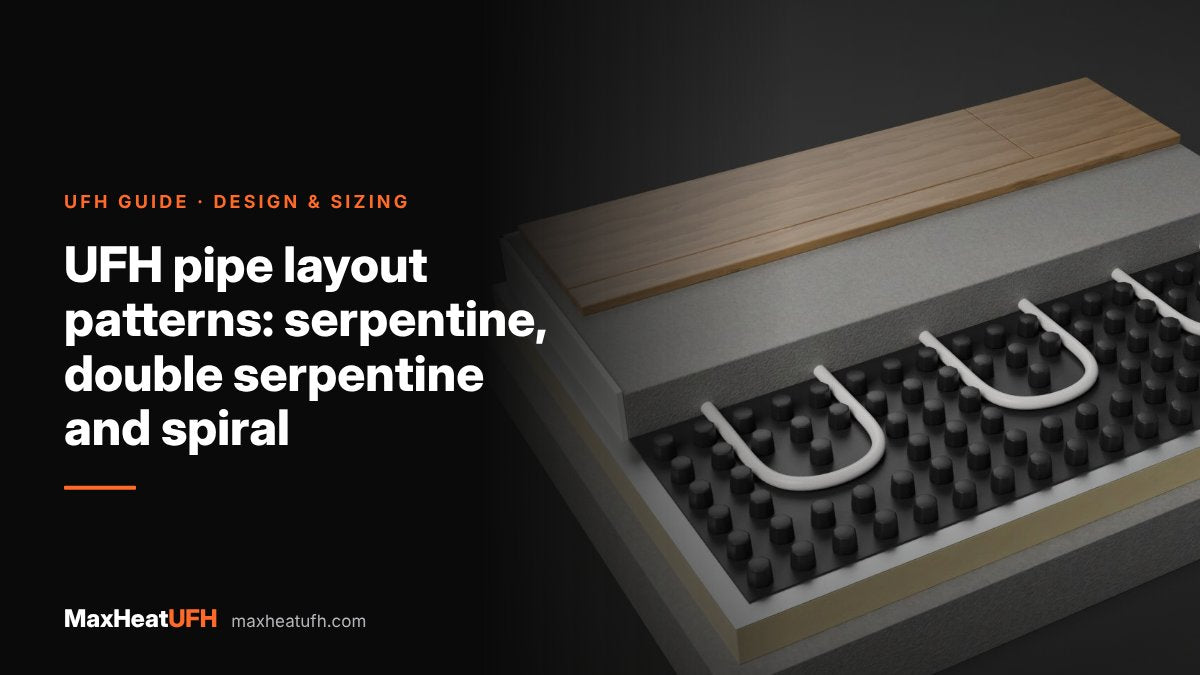
A serpentine (or meander) runs the pipe up and down the room in straight passes, like mowing stripes in a lawn, with a 180° turn at the end of each pass. The water enters at one side of the room and is coolest by the time it reaches the far side.
That temperature fall across the room is the serpentine's defining feature. Used well, it is an advantage: start the loop along the outside wall or glazing and the hottest water lands exactly where the heat loss is highest, with the cooler end of the loop finishing by the internal door where less heat is needed.
Serpentines suit:
- Small and narrow rooms, where there is not enough area for a spiral to develop.
- Rooms with one clearly cold side, aiming the first passes at it.
- Routed board systems, whose straight grooves and end-return pieces are made for it.
- Joisted floors, where pipe must run along the joist bays in straight passes.
The weakness is the 180° turn. At tight centres the end bends get sharp, which is where kinks happen on site.
What is a double serpentine?
A double serpentine interleaves the flow and return passes: the pipe runs out across the room on alternating passes, turns, and comes back through the gaps, so a hot pass sits next to a cooler one all the way across. Think of it as a serpentine folded back on itself.
It smooths out the single serpentine's hot-to-cold drift while keeping straight, easy-to-clip passes, and it is a common choice in medium rooms on clip rail or staple systems. The turns come in pairs at each end of the room, so setting out takes slightly more care than a single serpentine.
What is a spiral (snail or counterflow) layout?
A spiral starts at the room edge, winds inwards to the centre with a gap between each ring, then turns and winds back out through the gaps. Flow and return rings alternate across the whole floor, so every warm run has a cooler neighbour and the surface temperature averages out.
A CFD study comparing the two patterns found the spiral configuration gave better surface temperature uniformity across inlet temperatures, with the serpentine showing banding along its straight runs. That matches what installers see with a thermal camera: spirals photograph as an even disc, serpentines as stripes that fade across the room.
The spiral has a second, practical advantage: apart from the turn in the centre, the pipe only ever bends through gentle 90° corners, and each turn is made at twice the pipe spacing because the return ring sits between the flow rings.
Which pattern gives the most even floor temperature?
The spiral, and it is not close in large rooms. Here is how the three compare:
| Pattern | Evenness | Bends | Best use |
|---|---|---|---|
| Serpentine | Warm side fades to cool side | Tight 180° at each pass | Small, narrow rooms; routed boards; joisted bays |
| Double serpentine | Good: hot and cool passes alternate | Paired 180° turns | Medium rooms on clips or rail |
| Spiral | Best: flow and return alternate everywhere | Gentle 90° corners | Large and square rooms, tight centres, heat pumps |
Evenness matters more at low flow temperatures. A heat pump system running cool water cannot afford to waste its small temperature advantage on a lopsided floor, which is why heat pump designs lean on spirals and close centres together.
Whatever the pattern, EN 1264 caps the floor surface at 29°C in occupied areas, 33°C in bathrooms and 35°C in edge zones, so a pattern cannot push more heat out of the floor than those limits allow. It only changes how evenly the heat arrives.
Why does bend radius decide the pattern at tight centres?
Multilayer and PE-RT pipe must not be bent tighter than 5 times its outside diameter: an 80mm radius for 16mm pipe, 90mm for 18mm and 100mm for 20mm. A serpentine turn at 100mm centres would need the pipe to double back within 100mm, a 50mm radius, which the pipe cannot do.
Installers handle this three ways:
- Choose a spiral. Its corners turn at twice the spacing, so even 100mm centres only ask for 200mm turns.
- Use a keyhole turn. The serpentine pass swings wide at the end, loops round, and comes back into line, borrowing a little floor area at each end of the room.
- Support the bend. An external bending spring lets the pipe take its minimum radius without flattening; a kinked pipe must be scrapped, not straightened. Technique is covered in how to bend multilayer pipe.
At 150mm and 200mm centres a serpentine turns comfortably, which is why the pattern question only becomes forced on tight-spaced, high-output floors.
Do routed boards and joisted floors fix the pattern for you?
Largely, yes. A routed board has straight grooves and matching end-return pieces, so the floor is laid as a serpentine whether you like it or not; the same goes for grooved chipboard. Spreader plates in a joisted floor run along the bays, so the pipe serpentines bay by bay. Only clipped, stapled and castellated systems leave the pattern genuinely open, because the pipe can be fixed anywhere on the grid.
That is not a defect. Routed systems are designed around the serpentine at their fixed centres, and their aluminium or cement faces spread the heat sideways to soften the striping a bare serpentine would show.
Where should the loop start, whatever the pattern?
At the coldest part of the room. The first metres of every loop carry the hottest water, so spend them where the losses are:
- Run the first passes, or the outer spiral rings, along external walls and glazing.
- In rooms with an edge zone, lay the tight-spaced band first in the loop. One manufacturer's planning guidance uses around 100mm spacing for edge zones against older, poorly insulating windows.
- Keep manifold tails that cross a room on their way elsewhere insulated in conduit, or they become an accidental hot strip in the wrong room.
Loop length still rules everything: pattern changes shape, not metres, and each loop must stay within its design length with roughly equal loops on the manifold. See loop lengths and loops per room.
Design your UFH system yourself in 3 minutes with MaxHeatUFH ProLoop and get an instant quick design and quote. Start your design
Frequently asked questions
Which is better, spiral or serpentine underfloor heating?
Spiral for even temperature and gentle bends, serpentine for simplicity and for directing the hottest pipe at a cold wall. Large or square rooms and heat pump systems favour spirals; small rooms, joisted bays and routed boards favour serpentines.
Does the laying pattern change how much pipe I need?
No. Pipe quantity is set by the heated area and the pipe centres, not the pattern. A 20m² room at 150mm centres needs roughly the same pipe as a spiral or a serpentine.
Can I mix patterns in one house?
Yes, and most designs do: spirals in the big open rooms, serpentines in bathrooms, corridors and routed-board areas. Each loop is its own pattern; the manifold does not care.
What pattern should I use at 100mm pipe centres?
A spiral, or a serpentine with keyhole turns. A plain 180° serpentine turn at 100mm centres would bend 16mm pipe tighter than its 80mm minimum radius.
Why does my floor heat in stripes?
A serpentine pattern under a thin build-up shows its passes as stripes, fading from the warm inlet side to the cooler return side. More screed depth, a foil spreader layer or a spiral pattern all even it out.
Is a spiral harder to lay than a serpentine?
It takes more setting out, because you must leave a return path between the rings on the way in. On a gridded or castellated floor it is straightforward; freehand on plain insulation, mark the rings first.
Does the pattern matter with a heat pump?
More than with a boiler. Heat pumps run low flow temperatures, so the floor has little spare temperature to waste on cold corners. Even coverage, spirals in the main rooms and tight centres where losses are high protect the heat pump's efficiency.
Sources: IIETA: comparative numerical study of spiral and serpentine radiant floor pipe layouts
Products in this guide
Watch how each part works and how to fit it, and download its data sheet and install manual.


Every data sheet and manual: Product Library · All videos: MaxHeatUFH on YouTube
Design it in MaxHeatUFH ProLoop
Add your rooms, choose screed, overlay, joisted or electric, and get a free quick design and full kit list with prices.