



Underfloor heating flow temperature: what it should be for a boiler and a heat pump
What flow temperature water underfloor heating should run at for each floor system, how it differs between a gas boiler and a heat pump, how to set it and how to tell if it is wrong.
Short answer: Most water underfloor heating runs at a flow temperature between about 35 and 50°C. One major maker designs its screed systems for 50°C and its 12mm overlay systems for 45 to 50°C, and a sand and cement or calcium sulphate screed should not see more than 55°C. With a heat pump, use the lowest flow temperature that keeps the rooms warm, often 35 to 40°C, because every extra degree costs about 2 to 2.5% more electricity. With a boiler, the blending valve at the manifold sets the floor temperature, and a cool return below 55°C lets the boiler condense.
Flow temperature is the temperature of the water leaving the manifold and going into the floor loops. It is not the same as the thermostat setting, and it is not how warm the floor feels. It is the one number that decides whether a room reaches temperature, whether a wood floor stays flat and how much the system costs to run.
This guide explains what flow temperature to use for each floor system, how the answer changes between a gas boiler and a heat pump, how to set it on the manifold and how to tell if yours is wrong. For room thermostat settings and floor surface limits, see our guide to underfloor heating temperature settings.
What flow temperature should underfloor heating run at?
Design for 50°C or below on most floors, and as low as 35°C on a screed floor with a heat pump. The right figure depends on the floor build-up, the pipe spacing, the floor covering and the room's heat loss, so treat the table as a starting point, not a setting.
| Floor system | Typical design flow temperature | Source |
|---|---|---|
| Screed, 16mm pipe, boiler | 50°C design | Manufacturer installation guide |
| Sand and cement or calcium sulphate screed | 55°C maximum | Manufacturer UFH handbook |
| 12mm overlay panels | 45 to 50°C | Manufacturer overlay guide |
| Screed, tiles, heat pump, 100mm centres | 35°C (top MCS rating) | MCS heat emitter guide |
| Aluminium panel system, tiles, heat pump, 150mm centres | 45°C | MCS heat emitter guide |
A floating timber floor system from the same maker lists a 60°C design flow temperature, but that sits above the 55°C limit that Building Regulations in England now set for new heating systems. In practice, timber floors are designed at a lower temperature and protected with a floor limit, because the wood surface must stay at or below 27°C.
Two things push the figure down: closer pipe spacing and a thinner, lower-tog floor covering. Our guide to pipe centres shows how 100mm spacing lets you get the same heat from cooler water.
What is the difference between flow, return and mean water temperature?
Flow is the water going into the loop, return is the water coming back, and the mean is halfway between. Makers quote floor output at a mean water temperature, so a "50°C mean" figure needs a flow temperature a few degrees higher.
- Flow temperature: what you set on the blending valve or heat pump, and what the gauge on the flow side of the pump pack shows.
- Return temperature: lower than the flow, because the floor has taken heat out. The gap is called the temperature difference or delta T.
- Mean water temperature: the average of the two. One maker's screed system gives 91W/m² at 100mm centres and 76W/m² at 200mm centres, both at a 50°C mean.
- Floor surface temperature: the result. BS EN 1264 limits it to 29°C in occupied areas, 35°C in an edge zone and 33°C in a bathroom at 24°C.
So flow temperature is a tool to reach a floor surface temperature, and the floor surface temperature is what heats the room. Raising the flow does not help once the floor is already at its limit.
What flow temperature should I use with a gas boiler?
Let the boiler run at its normal temperature and let a blending valve at the manifold bring the water down to the floor's design temperature. Most boilers send out water hotter than a floor can take, so a thermostatic blending valve mixes cooler return water into the flow before it reaches the loops.
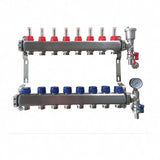
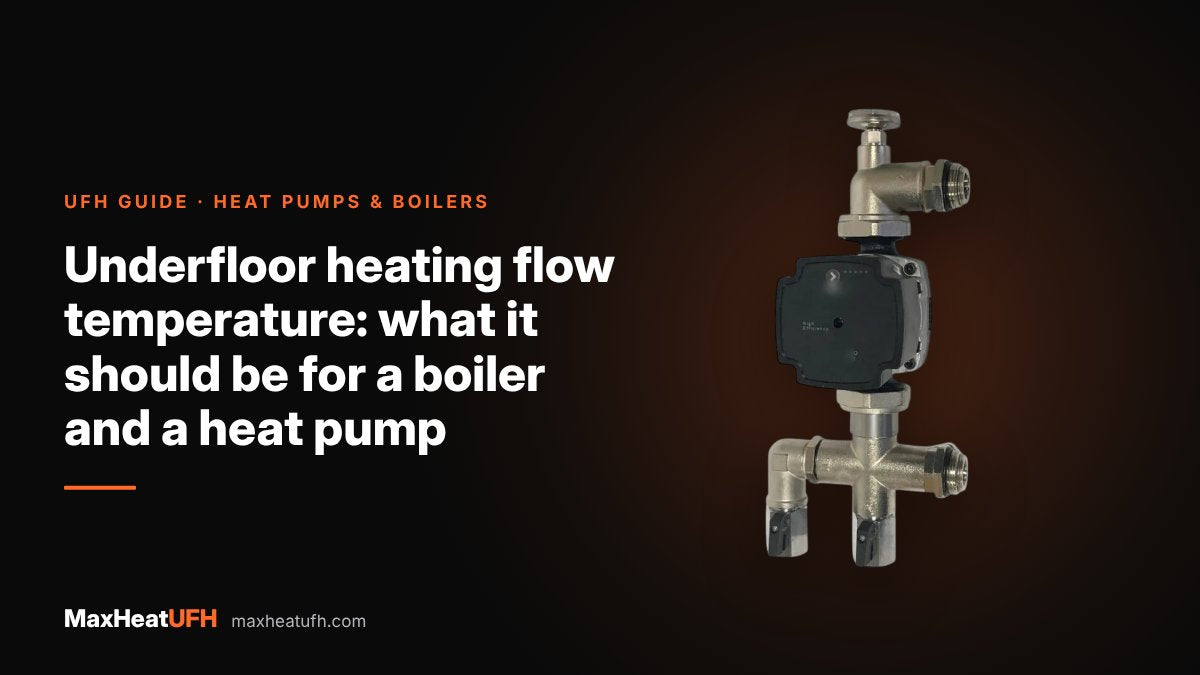
Our blending valve pump pack holds an adjustable 20 to 55°C flow to the floor. A blending valve can only take temperature away, so the boiler flow must always be hotter than the figure you set at the manifold.
The return temperature matters for efficiency. A condensing boiler only recovers its extra heat when the water coming back to it is cooler than about 55°C. Underfloor heating returns cool water, which helps. Where radiators and UFH share one boiler, the radiators decide the boiler flow temperature and the blending valve looks after the floor.
- Boiler feeding UFH only: you can turn the boiler flow down towards the UFH design temperature, which keeps the return low.
- Boiler feeding radiators and UFH: set the boiler for the radiators, and set the blending valve for the floor.
- Gas combi boiler in England: a new or replacement combi must also have one of the Boiler Plus measures, such as weather compensation, load compensation, flue gas heat recovery or a smart thermostat with automation and optimisation.
For pipework and wiring with a boiler, see underfloor heating with a combi or system boiler.
What flow temperature should I use with a heat pump?
Use the lowest flow temperature that keeps every room warm on a cold day, and let weather compensation lower it on milder days. One heat pump maker puts the cost of running too hot at about 2 to 2.5% more electricity for every degree above the ideal flow temperature, or up to about 12% for 5°C.
The MCS heat emitter guide ranks emitters with stars. A screed floor with tiles at 35°C flow and pipe spacing of 100mm or less gets the top six-star rating. A 45°C system earns four stars. The same guide says to add 5°C to the heat pump flow temperature if a blending valve is fitted, because the valve wastes some of the temperature it is given.
That is why heat pump systems normally use a non-mixing pump set rather than a blending valve. The heat pump makes water at floor temperature directly, so there is nothing to mix. Our guide to underfloor heating with a heat pump covers design for low flow temperatures.
| Flow temperature | MCS example | Star rating |
|---|---|---|
| 35°C | Screed UFH, tiles, 100mm max spacing | 6 stars |
| 40°C | Fan-assisted radiators | 5 stars |
| 45°C | Aluminium panel UFH, tiles, 150mm max spacing | 4 stars |
| 55°C | Standard radiator | 2 stars |
| Above 60°C | Existing radiator | No stars |
More stars means a higher expected efficiency. A floor that can heat the house at 35°C is one of the best emitters a heat pump can have.
Does Building Regulations Part L limit the flow temperature?
Yes, in England. Since 15 June 2022, Approved Document L asks for new and fully replaced wet heating systems in homes to be sized to run at a maximum flow temperature of 55°C. That applies to boilers as well as heat pumps.
Underfloor heating meets this easily, because most floors are designed below 55°C anyway. The rule matters more for radiators, and for mixed systems where radiators share a boiler with UFH. Part L also asks for boiler interlock, so the boiler and pump switch off when no room or hot water needs heat. Our guide to Part L and underfloor heating has the detail.
Design your UFH system yourself in 3 minutes with MaxHeatUFH ProLoop and get an instant quick design and quote. Start your design
How do I set the flow temperature on my underfloor heating?
On a boiler system, turn the head of the blending valve on the pump pack. On a heat pump system, set the flow temperature or weather compensation curve in the heat pump controller. Then check the gauge on the flow side and give the floor time to respond.
- Find the design figure. It should be on the design or commissioning sheet. If not, start at the low end of the table above for your floor.
- Set the valve or controller. Turn the blending valve head to the number that matches your target, or enter the figure in the heat pump.
- Read the gauge. A temperature gauge on the flow side shows what is actually going into the loops. Blending valve scales are a guide, so trust the gauge.
- Wait a day. A screed floor responds over many hours. Change the setting in small steps and leave a full day between changes.
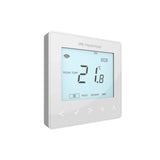
- Protect wood and vinyl floors. Use a thermostat with a floor probe and set the floor limit to the flooring maker's figure.
On a new screed, do not use the heating to dry or cure the screed. Once it has cured, raise the flow temperature slowly up to the design figure. Under a timber floor, run the system for at least two weeks before the boards go down.
How do I know if my flow temperature is wrong?
Too low and the room never quite reaches its set point on cold days. Too high and the floor feels hot, rooms overshoot, wood floors move and running costs rise.
| Symptom | Likely meaning | What to try |
|---|---|---|
| Rooms fall short only in cold weather | Flow slightly low | Raise a little, or steepen the weather curve |
| Every room cool, manifold only warm | Blend set too low or boiler off | Check the gauge and the heat call |
| Floor hot to the touch, rooms overshoot | Flow too high | Lower the blending valve setting |
| Wood floor gapping | Surface above 27°C | Lower the flow and set a floor limit |
| One room cold, others fine | Not flow temperature | Check that loop's actuator, air and balance |
If only one room is cold, the flow temperature is rarely the cause. Work through our underfloor heating not getting warm fault-finding steps instead.
Products for this job
- Blending valve pump pack 20 to 55°C, for boiler-fed systems
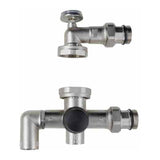
- Non-mixing pump set, for heat pumps
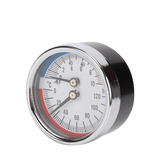
- Pressure and temperature gauge
Frequently asked questions
What temperature should the water be in underfloor heating?
Usually 35 to 50°C going into the loops. Screed floors with a heat pump can run at about 35°C. A sand and cement or calcium sulphate screed should not see more than 55°C.
Is 45°C or 50°C better for underfloor heating with a boiler?
Use whichever is the lower figure that still heats the rooms. One maker designs screed systems for 50°C and overlay systems for 45 to 50°C. Lower water also gives a cooler return, which helps a condensing boiler.
Can I set my combi boiler to 50°C for underfloor heating?
You can if the boiler only feeds the floor, as long as the boiler flow stays above the blending valve setting. If radiators share the boiler, set the boiler for the radiators and let the blending valve control the floor.
What flow temperature should my heat pump run at for underfloor heating?
As low as keeps the house warm, often 35 to 40°C on a screed floor. Each extra degree adds about 2 to 2.5% to the electricity used.
Do I need a blending valve with a heat pump?
Usually not. Most heat pumps make water at floor temperature already. The MCS guide says to add 5°C to the heat pump flow if a blending valve is fitted, so a non-mixing pump set is the normal choice.
Why is my blending valve setting different from the gauge?
The numbers on a thermostatic valve head are a guide. Set it by the flow gauge, then leave the floor a day to settle before adjusting again.
What is the maximum flow temperature for underfloor heating under wood?
There is no single water figure, because it depends on the build-up. The limit that matters is the wood surface, which should stay at or below 27°C. Use a floor probe and floor limit to hold it there.
Sources: BEAMA Part L 2022 heating controls guidance, and manufacturers' installation guidance to BS EN 1264
Products in this guide
Watch how each part works and how to fit it, and download its data sheet and install manual.




Every data sheet and manual: Product Library · All videos: MaxHeatUFH on YouTube
Design it in MaxHeatUFH ProLoop
Add your rooms, choose screed, overlay, joisted or electric, and get a free quick design and full kit list with prices.


