

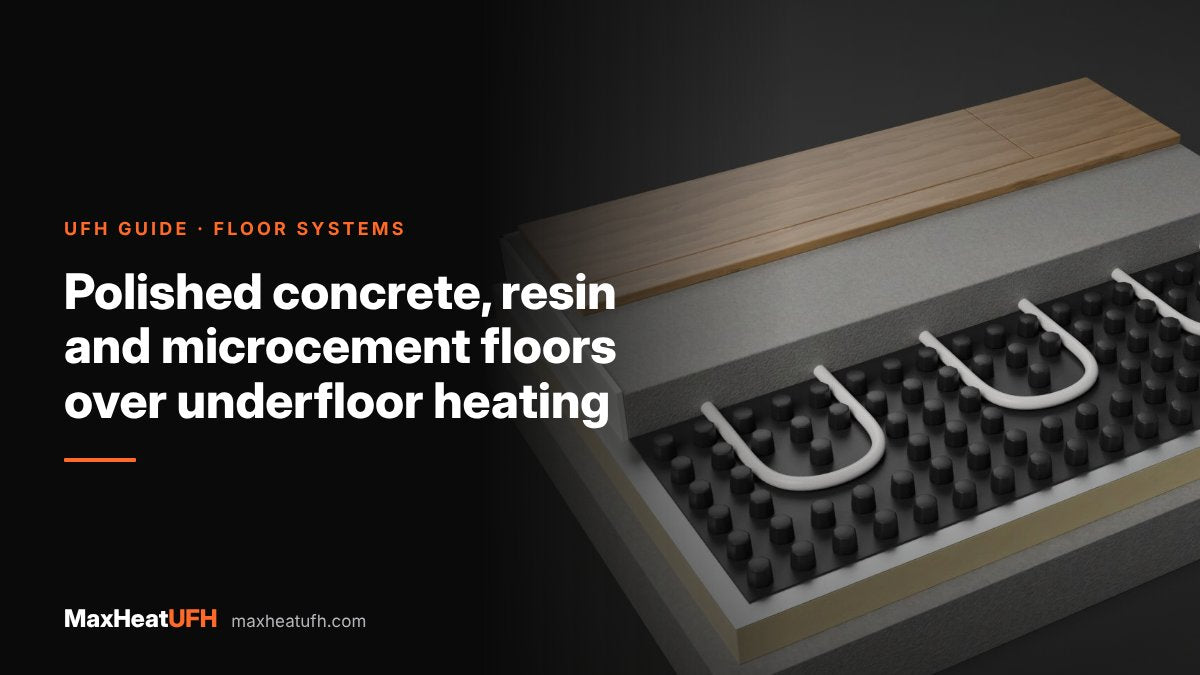
Polished concrete, resin and microcement floors over underfloor heating
Polished concrete, resin and microcement all suit water underfloor heating. How deep to set pipes, how to control cracking with joints and bays, when the finish can go on a heated screed, and the heating shut-down and restart rules finish makers give.
Short answer: Polished concrete, resin and microcement all work well over water underfloor heating, because they are thin, hard and let heat through easily. The risks are cracking and debonding, not poor output. Plan joints before the pipes go down, keep enough cover over the pipes, fully dry and commission the screed before the finish goes on, and switch the heating off around application. One resin flooring maker, for example, limits the temperature under its floorings to 27°C.
Seamless floors suit underfloor heating. There are no radiators to break up a minimal room, and a hard, thin surface passes heat into the room quickly. Many people choose a concrete-look floor and underfloor heating at the same time, often in an open-plan extension with a heat pump.
The trouble is that these finishes show everything. A crack in the screed below, a joint in the wrong place or a floor that was still damp will show through as a line, a blister or a lifted patch. This guide explains how each finish works with underfloor heating, what the screed needs, and the heating start-up and shut-down steps the makers ask for.
Can you have polished concrete, resin or microcement with underfloor heating?
Yes. All three are suitable over a heated screed or slab, as long as the base is stable and dry and the heating is run to the finish maker's rules. They differ in thickness and in how much they depend on the base below.
| Finish | What it is | Main risk over UFH |
|---|---|---|
| Polished concrete | The slab or topping itself, ground and sealed, with pipes cast inside | Shrinkage cracks, saw cuts near pipes, hot spots if cover is thin |
| Resin | A poured or trowelled coating bonded to a screed | Debonding or open joints if the base is damp or heated too fast |
| Microcement | A thin cement-based coating trowelled in layers | Hairline cracks if the screed moves or the heating start-up is skipped |
Because the finish layer is thin, it adds very little resistance to heat flow. EN 1264 design uses a standard floor covering resistance of 0.10m²K/W for living rooms, with up to 0.15m²K/W allowed by agreement, according to one manufacturer's handbook. A thin hard finish sits well inside that, so the floor gives close to its full output. Compare other finishes in our guide to underfloor heating floor coverings.
How deep should the pipes be in a polished concrete floor?
Deep enough that the floor heats evenly and that grinding and saw cuts never reach them. A US specifier article on polished concrete toppings with radiant heating says hydronic tubing usually needs at least 50mm of concrete cover for even heat. On the project it describes, cover dropped to 22mm in places, and the author warns this could cause hot spots.
Polished concrete brings two extra hazards for pipes:
- Grinding. Polishing removes part of the surface to expose the aggregate. Agree the grind depth with the polisher before setting the pipe height.
- Saw cuts. Control joints are often sawn into the slab after casting. Mark the joint lines on the design first and keep pipes well below the cut depth, or route them to cross joints in sleeves.
Use clips or rails that hold the pipe at a fixed height, such as self-adhesive clip rail or castellated panels, so the pipe does not float up when the concrete is placed.
How do you stop a heated concrete floor cracking?
You cannot stop concrete shrinking, so you control where it cracks. The same specifier article explains that cracks form when natural shrinkage is restrained, and closer joints give narrower cracks at each joint.
- Joint spacing. The article cites guidance of under 3m between control joints for a 75mm slab, and 2 to 3m from the Decorative Concrete Council. Your engineer or concrete contractor should set the pattern for your slab.
- Curing. Proper curing builds early strength, and shrinkage-reducing admixtures and reinforcement help limit crack widths.
- Edge isolation. Fit an edge insulation strip round every wall and column so the slab can expand when it heats.
- Joints and loops. Plan loops so each one sits within a single bay where you can, and sleeve any pipe that has to cross a joint.
For a resin or microcement finish on a screed, the screed bays matter in the same way. One liquid screed maker's data sheet limits heated bays to 80m² with an aspect ratio no greater than 4:1, and calls for crack inducers in doorways. A joint or crack in the screed can show through a thin finish, so ask the finish maker how to treat screed joints before you lay it.
When can the finish go on a heated screed?
Only once the screed is dry and the heating has been commissioned. That screed maker says no final finish should go on until the underfloor heating is fully commissioned and run and the flooring contractor has confirmed the surface is suitable. Its heating-up procedure for that screed is:
- Wait. Use the heating to help drying from 7 days after laying, longer in cold weather.
- Start low. Set the water no more than 5°C above the screed temperature.
- Ramp up. Raise it by 5°C a day to the design maximum, never more than 55°C.
- Hold. Keep it at that temperature for 4 days.
- Ramp down. Reduce by 5°C a day, then let the floor cool for 48 hours before testing for moisture.
Other screeds have their own drying times and procedures, so follow the screed maker's sheet. Our guides to screed depth and drying time and commissioning underfloor heating go into more detail.
How do you put resin flooring over underfloor heating?
Turn the heating off before and after the floor goes down, then bring it back up slowly. One maker of resin and other floorings gives these rules in its underfloor heating installation guide:
- Commission first. Run the heating before any flooring goes down to prove it works and that the screed is dry and stable.
- Off before and after. For adhered floors, switch the heating off 48 hours before work starts and keep it off for at least 48 hours after it finishes.
- Room temperature. If the room needs heat while the system is off, use another heat source to keep it between 18°C and 27°C.
- Ramp up slowly. Bring the heating back over several days, a few degrees a day.
- Temperature limit. Never let the temperature at the underside of the flooring go above 27°C.
That maker warns that ignoring these rules can lead to debonding, opening joints and sometimes discolouring. Other resin makers may set different limits, so use the figures for your product.
How do you put microcement over underfloor heating?
The same way in principle: a fully cured, dry base, a heating cycle beforehand, and the heating off while the coating goes on. One microcement maker's guidance for microcement over underfloor heating is:
- Run the heating first. Start it at least four weeks before the microcement goes on.
- Warm-up cycle. Hold the flow at 20 to 25°C for two or three days, then raise it about 5°C a day to 40 to 45°C and hold for 3 to 5 days.
- Check the base. The screed should be practically dry, with no more than 5% moisture.
- Switch off. Turn the heating off 48 to 72 hours before work starts, so the floor is at about 15 to 18°C.
- Restart slowly. Wait at least 48 hours after application, then raise the temperature about 5°C a day.
That maker also advises keeping the room from getting too dry and avoiding heat build-up under rugs or tight to furniture. See rugs and furniture on underfloor heating.
How do you keep the floor below the finish limit?
Cap the water temperature and limit the floor temperature with controls. A thin finish passes heat straight through, so the screed surface and the finish are close to the same temperature.
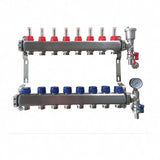
- Fixed flow temperature. A blending valve pump pack holds the water at a set temperature between 20 and 55°C when the heat source runs hotter.
- Floor probe limit. Thermostats with a floor probe can cap the floor temperature as well as control the room.
- Low flow temperature. A heat pump running at low temperatures suits these floors well, because it rarely pushes the surface towards its limit.
Free design tool: enter your rooms and floor type into MaxHeatUFH ProLoop for a quick loop layout, manifold size and fully priced kit, then share it with your screed and finish contractors. Start your design
Frequently asked questions
Is polished concrete good with underfloor heating?
Yes. It is hard and conducts heat well, so it gives good output at low water temperatures. The pipes must have enough cover, and joint lines must be planned so saw cuts and grinding never reach them.
Will microcement crack over underfloor heating?
It can if the screed moves or the heating start-up is skipped. One microcement maker's guidance is to run the heating cycle first, have the screed practically dry, switch off before application and restart slowly at about 5°C a day.
What temperature can resin flooring take over underfloor heating?
It depends on the product. One resin flooring maker limits the temperature at the underside of its floorings to 27°C. Check the data sheet for your resin.
Do I need to turn the underfloor heating off to lay resin or microcement?
Yes. One resin flooring maker asks for the heating to be off 48 hours before and at least 48 hours after laying adhered floors. One microcement maker asks for 48 to 72 hours off before microcement and 48 hours after.
How much cover do pipes need in a polished concrete slab?
One US specifier source gives at least 50mm of concrete cover for even heat. Agree the grind depth and saw cut depth with your concrete contractor and allow for both.
Can I put microcement on overlay underfloor heating boards?
Only if the microcement maker approves that board as a base. Most guidance is written for a cured screed, which is the safer base for a seamless finish.
Does a thin hard floor make underfloor heating more efficient?
It lets heat out with less resistance than carpet or thick timber, so the floor reaches its output at a lower water temperature. That suits heat pumps.
Sources: Construction Specifier: polished concrete topping slabs with radiant heating
Products in this guide
Watch how each part works and how to fit it, and download its data sheet and install manual.


Every data sheet and manual: Product Library · All videos: MaxHeatUFH on YouTube
Design it in MaxHeatUFH ProLoop
Add your rooms, choose screed, overlay, joisted or electric, and get a free quick design and full kit list with prices.