



OpenTherm and modulating boilers with underfloor heating
What OpenTherm does, how much energy modulating boiler control saves, and how it fits a zoned underfloor heating system alongside weather compensation and Boiler Plus requirements.
Short answer: OpenTherm is a communication standard that lets a thermostat ask the boiler for an exact water temperature instead of just switching it on and off, so the boiler modulates down and spends more time condensing. In one manufacturer's comparison, OpenTherm control used 14.3% less energy than a basic mechanical on/off thermostat. It pairs naturally with underfloor heating's low water temperatures, but most multi-zone UFH systems are switched on and off through a wiring centre, so in practice modulation usually comes from the boiler's own weather or load compensation rather than an OpenTherm room stat in every zone.
Underfloor heating and condensing boilers want the same thing: the lowest water temperature that still heats the house. A modulating boiler that trims its flame and flow temperature to match demand runs longer, cycles less and condenses more. The question is how the boiler finds out what the demand is, and that is where OpenTherm, load compensation and weather compensation come in.
This guide explains what OpenTherm actually does, how much energy modulation saves, where it fits with a zoned UFH system, and what Boiler Plus requires when a combi boiler is installed in England. For the wiring side of boiler demand, see our guide to the UFH boiler interlock.
What is OpenTherm and how does it work?
OpenTherm is a shared protocol between heating controls and the boiler. Instead of a relay clicking the boiler on and off, the thermostat and boiler exchange data over a two-wire, low-voltage bus. The wiring is non-polarised and the thermostat is typically powered by the boiler itself over the same pair, at 24V DC on the units one manufacturer documents. Because the standard is shared, an OpenTherm thermostat is designed to work with any OpenTherm boiler.
The useful part is what travels over those two wires. The thermostat requests a specific flow temperature from the boiler: high when the house is cold and demand is high, falling as the rooms approach their set point. The boiler runs for longer at lower temperatures instead of blasting to one fixed temperature and switching off. One controls maker's explanation of the three control types sets out the difference:
| Control type | What the boiler does | Result |
|---|---|---|
| Basic on/off | Heats to one fixed temperature, stops at set point | Overshoots and undershoots |
| On/off with load compensation | Fixed water temperature, cycled in bursts | Lower average temperature, small ripple |
| OpenTherm modulation | Delivers the exact water temperature requested | Long, low-temperature runs, stable rooms |
Lower water temperatures keep a condensing boiler in its higher-efficiency condensing mode for longer, which is the whole point.
How much energy does OpenTherm save?
One manufacturer published a comparison for its OpenTherm room thermostats, testing controls holding a room at 20°C. Against a mechanical on/off thermostat as the baseline, an electronic on/off thermostat used 10.4% less energy, and OpenTherm modulating control used 14.3% less, with a 15% carbon saving.
Treat single figures like these as indicative: the saving depends on the boiler, the house and how the system is run. The direction is consistent, though. Modulation beats cycling, and both beat a boiler held at a fixed high temperature. With underfloor heating the gain compounds, because the floor only ever needed cool water in the first place.
Does OpenTherm work with underfloor heating?
Yes, but the fit is better on simple systems than on heavily zoned ones. OpenTherm is a conversation between the boiler and one controlling thermostat. A typical UFH system has a thermostat per room, each opening its own loops through actuators and a wiring centre, and the wiring centre gives the boiler a simple switched demand. There is no single room whose thermostat can honestly speak for the whole house.
In practice there are three workable patterns:
- Single-zone UFH, OpenTherm stat. One open-plan zone, or a small flat on one thermostat: an OpenTherm thermostat can modulate the boiler directly and works exactly as designed.
- Multi-zone UFH, boiler compensation. Room thermostats switch zones on and off as normal, and modulation comes from the boiler's own weather compensation sensor or load-compensating controls. The boiler trims its flow temperature to the weather while the zones handle which rooms get heat. Our guide to weather compensation with UFH covers this setup.
- Mixed systems. Where radiators and UFH share a boiler, the compensation route again tends to be simpler, with the UFH blending valve smoothing out what reaches the floor.
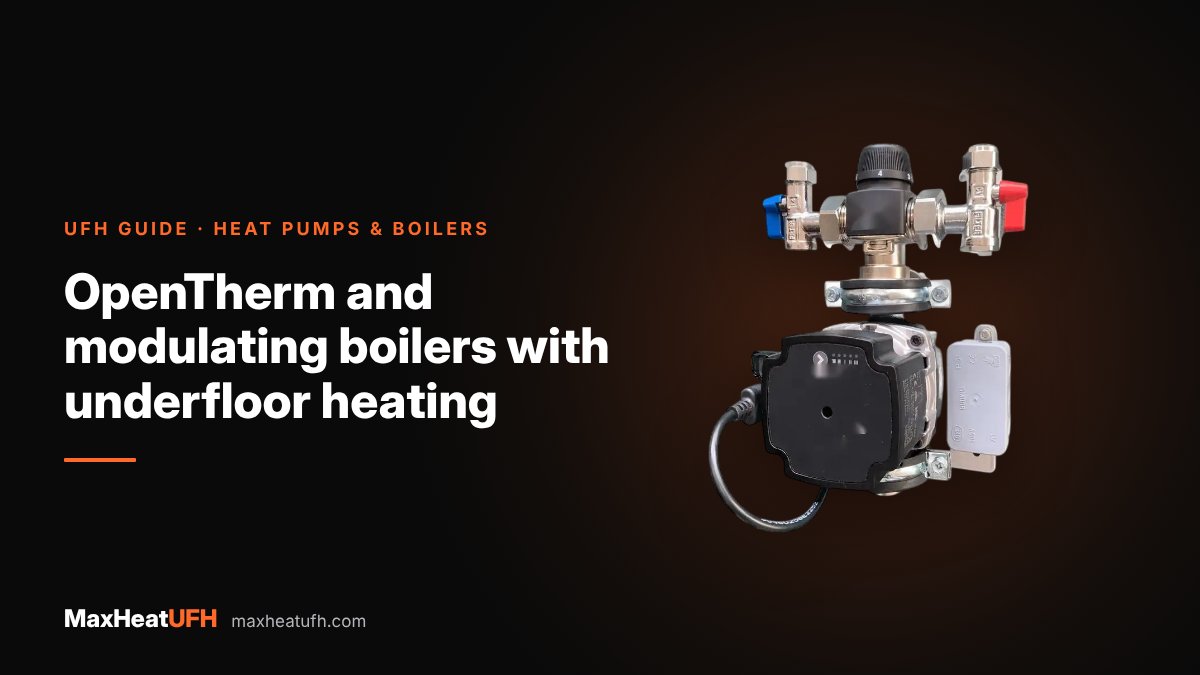
Remember that most boiler-fed UFH runs behind a mixing valve, which caps the floor's water temperature whatever the boiler sends. Modulation still helps, because a boiler flow of 50°C into the blending valve wastes less than 75°C, and the return stays cool enough to condense. Our guide to mixing and blending valves explains that side.
What does Boiler Plus require?
Boiler Plus has applied in England since 6 April 2018. Every gas boiler installed in an existing home must be at least 92% efficient (ErP) and installed with time and temperature control if none is present and working. When the boiler is a gas combi, the installation must also include at least one of four measures:
- Flue gas heat recovery
- Weather compensation
- Load compensation
- Smart controls with automation and optimisation
OpenTherm is not named in the policy, but it is one common way thermostat makers deliver load compensation, and weather compensation is often built into the boiler's own controls. If you are having a combi fitted alongside underfloor heating, it costs little to ask the installer which of the four measures is being used and whether the boiler's modulation is actually enabled. All gas boiler work must be done by a Gas Safe registered engineer. See our guide to connecting underfloor heating to a combi boiler.
Do both the boiler and the thermostat need OpenTherm?
Yes. OpenTherm only works when both ends speak it: the boiler must have OpenTherm terminals and the control must be an OpenTherm device, wired to those terminals and nothing else. One manufacturer's installation notes warn against connecting any other power source to the pair. Check the boiler's manual for OpenTherm support before buying a control, because some boiler ranges use their own proprietary bus instead and only modulate with their own maker's controls.
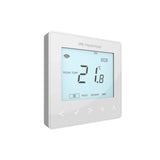
If the boiler does not support OpenTherm, you have lost nothing on a zoned UFH system: standard thermostats such as the Heatmiser neoStat V3 switching through a Heatmiser UH8 wiring centre give you room-by-room control, and the boiler's own compensation handles the modulation. See our guide to smart thermostats for UFH for the control options.
How should a modulating boiler be set up with UFH zones?
The aim is a boiler that only fires when a zone wants heat, and modulates low when it does.
- Keep the interlock. The wiring centre's volt-free switch should call the boiler only when at least one actuator is open, so the boiler never heats a dead-headed circuit.
- Enable compensation. Fit the weather sensor or enable load compensation so the boiler trims its flow temperature instead of running flat out.
- Set the boiler flow sensibly. The boiler only needs to beat the blending valve's set point by a workable margin; a lower boiler flow keeps the return in condensing territory.
- Set the blending valve for the floor. The mixed temperature is set by the floor construction and design, not by the boiler.
- Let the floor run long and low. Underfloor heating responds slowly; long gentle runs suit both the screed and a modulating boiler.
Gas Safe for anything on the gas and boiler side; the UFH wiring centre and thermostats are low-voltage-logic plus 230V switching and belong with a competent electrician.
Design your UFH system yourself in 3 minutes with MaxHeatUFH ProLoop and get an instant quick design and quote. Start your design
Frequently asked questions
What is OpenTherm in simple terms?
A two-wire link that lets the thermostat tell the boiler exactly what water temperature to make, instead of just on or off. The boiler modulates its flame to match, runs longer at lower temperatures and condenses more.
Does OpenTherm save money with underfloor heating?
Modulating control saves energy against on/off control; one manufacturer's test put OpenTherm 14.3% ahead of a mechanical on/off stat. With UFH the bigger win is that the whole system is designed for low water temperatures, which keeps a condensing boiler efficient however the demand signal arrives.
Can I use OpenTherm with multiple UFH zones?
OpenTherm is designed around one master thermostat per boiler, so a multi-zone UFH system normally keeps on/off room stats through a wiring centre and gets its modulation from the boiler's weather or load compensation instead.
Is OpenTherm required by Boiler Plus?
No. Boiler Plus in England requires 92% ErP efficiency and time and temperature control, plus one of four measures with a combi: flue gas heat recovery, weather compensation, load compensation, or smart controls with automation and optimisation. OpenTherm is one way to deliver load compensation, not a requirement.
How do I know if my boiler supports OpenTherm?
Check the installation manual for OpenTherm terminals or an OpenTherm logo. Some boiler brands use their own proprietary modulation bus instead, so a generic OpenTherm stat will not modulate them.
Does a mixing valve make OpenTherm pointless on UFH?
No. The blending valve protects the floor whatever the boiler does, but a modulating boiler feeding it at a lower temperature wastes less heat and keeps the return cool enough to condense.
Who can wire OpenTherm controls?
The OpenTherm pair is low voltage, but boiler wiring and 230V controls belong with a competent electrician, and any work on the gas boiler itself needs a Gas Safe registered engineer.
Sources: GOV.UK Boiler Plus policy
Products in this guide
Watch how each part works and how to fit it, and download its data sheet and install manual.




Every data sheet and manual: Product Library · All videos: MaxHeatUFH on YouTube
Design it in MaxHeatUFH ProLoop
Add your rooms, choose screed, overlay, joisted or electric, and get a free quick design and full kit list with prices.


