

MLCP vs copper for central heating and UFH primaries
A side-by-side comparison of multilayer (MLCP) pipe and copper for heating and UFH primary pipework: sizes and bores, ratings, expansion, bending, joining, earth bonding and where each belongs.
Short answer: Both make a sound central heating or UFH primary. MLCP comes in long coils, bends by hand, needs fewer fittings and is non-conductive, so it suits long runs through floors and voids, manifold tails and retrofits. Copper takes higher temperatures and pressures, is not affected by sunlight and is often expected at the boiler or cylinder. Size by bore, not by the number on the pipe: 25mm MLCP has about the bore of 22mm copper.
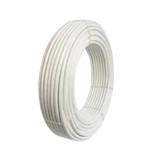
Most UK heating installers grew up with copper, and many still use it for every primary. Multilayer composite pipe (MLCP), with its aluminium core between two plastic layers, has taken over a lot of that work, especially on underfloor heating jobs where the pipe has to travel from a boiler or heat pump to a manifold several rooms away.
This guide compares the two on the points that decide the job: size and flow, temperature and pressure, expansion, bending, joining, bonding and where each one belongs. The figures come from manufacturer data. For the loops in the floor, see UFH pipe types compared instead.
Is MLCP or copper better for heating pipework?
Neither is better everywhere. MLCP is quicker and neater on long, hidden runs. Copper is the safer choice close to hot appliances, outdoors and anywhere the pipe will be on show for decades.
| Point | MLCP | Copper |
|---|---|---|
| Supplied as | Coils and lengths | Straight lengths |
| Bending | By hand, holds shape | Spring or bender |
| Joining | Press (U-profile) or compression | Press (M-profile), solder, compression |
| Heating rating | 80°C at 10 bar continuous | Up to 110°C, fittings 6 to 16 bar |
| Expansion | About 0.025mm/m·K | About 0.017mm/m·K |
| Oxygen | Aluminium barrier | Metal, no barrier needed |
| Earth bonding | Not conductive | Must be bonded |
| Sunlight | Keep out of UV | Not affected |
The MLCP heating rating is one manufacturer's, for its MLC pipe to BS EN ISO 21003. The copper figures are for one maker's copper press fittings, which gives a general limit of 16 bar and 110°C, and 6 bar at 110°C for heating water to EN 12828. A domestic sealed system runs well inside either limit.
What size MLCP replaces 15mm, 22mm and 28mm copper?
Go one size up. MLCP is sized by its outside diameter and has a thicker wall than copper, so the same number gives a smaller bore.
| Copper | Copper bore | MLCP | MLCP bore |
|---|---|---|---|
| 15 × 0.7mm | 13.6mm | 16 × 2mm | 12mm |
| 15 × 0.7mm | 13.6mm | 20 × 2mm | 16mm |
| 22 × 0.9mm | 20.2mm | 25 × 2.5mm | 20mm |
| 28 × 0.9mm | 26.2mm | 32 × 3mm | 26mm |
Copper bores are worked out from wall thicknesses in one fitting maker's EN 1057 tube table. MLCP bores are from manufacturer data. So 16mm MLCP is a little smaller than 15mm copper, 20mm is bigger, 25mm matches 22mm and 32mm matches 28mm.
Do not swap 22mm copper for 20mm MLCP on a primary. The bore drops from about 20mm to 16mm, and the pipe carries far less water at the same speed. Size the primary from the heat load and flow rate. Our guide to UFH manifold primary pipe size shows the method, and the MLCP multilayer pipe guide covers MLCP sizes in more depth.
How much do MLCP and copper expand?
Both move a little, and copper moves slightly less. One manufacturer gives 0.025mm per metre per °C for its MLC pipe, and another 0.024mm. Copper Development Association figures work out at roughly 0.017mm per metre per °C.
Work it out with ΔL = coefficient × length × temperature rise. A 10m primary that warms from 10°C to 70°C rises 60°C:
- MLCP: 0.025 × 10 × 60 = 15mm
- Copper: 0.017 × 10 × 60 = about 10mm
On a domestic run, that movement is taken up by bends and changes of direction. On a long straight run, leave room for it: do not trap the pipe tight between two fixed points, and allow clearance where it passes through walls and joists.
Is MLCP easier to bend than copper?
Yes. MLCP bends by hand and stays where you put it. One manufacturer gives a minimum radius without a spring of 5 times the outside diameter, which is 80mm for 16mm pipe and 160mm for 32mm.
Copper needs a tool. A further education resource on pipe bending gives a minimum of about 100mm radius for 15mm copper, uses internal springs for 12 to 22mm tube and calls a bending machine essential above 22mm. That means copper primaries usually need more elbows, and each elbow is two more joints.
For MLCP, an external bending spring or a lever bender lets you go tighter without kinking. A kinked MLCP pipe should be cut out, not straightened.
How do you join MLCP and copper?
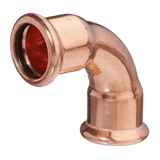
Both are best pressed. MLCP press fittings use a U-profile jaw on a stainless sleeve. Copper press fittings use an M-profile jaw on the fitting bead. The two profiles are not interchangeable.
- One tool for both: the MaxHeatUFH Electric Hydraulic Press Tool Set takes U-profile jaws for 16 to 32mm MLCP and M-profile jaws for 15 to 28mm copper.
- Copper only: solder is the cheapest per joint but needs a flame. See copper press vs solder vs compression.
- MLCP to copper: an MLCP press fit to copper brass tail has a press end for multilayer and a copper-sized tail for a 15, 22 or 28mm copper fitting.
MLCP fittings cost a little more per joint than copper fittings, but MLCP needs far fewer of them. A bag of 16mm MLCP straight connectors and a bag of 15mm copper M-press couplings both hold 10. The bigger saving on MLCP is the elbows you no longer need.
Does MLCP need earth bonding?
No, not on its own. One manufacturer says multilayer pipework is non-conductive and does not need bonding in a new installation with no metal pipe sections. Metal parts on the system, such as the boiler, pump and any copper, still need bonding, and the pipe itself cannot be used as a bonding conductor.
Copper is different. One copper press system maker says its copper press installations are electrically conductive and must be included in the main equipotential bonding. If you replace a copper run with MLCP, the bonding arrangement may change, so ask an electrician to check it under BS 7671.
Where should I use MLCP and where copper?
Use MLCP where its coils and bendability save time, and copper where heat, light or appearance favours metal.
| Location | Better choice | Why |
|---|---|---|
| Long run to a UFH manifold | MLCP | Coils, few joints |
| Through joists and floor voids | MLCP | Threads through by hand |
| Manifold tails, radiator drops | MLCP | Bends neatly |
| Boiler or cylinder connections | Check appliance manual | Appliance rules apply |
| Outdoors or in sunlight | Copper, or protected MLCP | Manufacturer guidance: keep MLCP out of sunlight |
| Exposed runs on show | Either | Copper looks traditional, MLCP stays straight |
For a heat pump or boiler to manifold run, pre-insulated PEX-AL-PEX comes with red or blue insulation already fitted, in 16 to 32mm. One manufacturer rates its MLC pipe to Class 5 for high temperature radiators, and its multilayer pipe carries fire classification E to EN 13501-1, so check fire-stopping where any plastic pipe passes through compartment walls and floors.
Design your UFH system yourself in 3 minutes with MaxHeatUFH ProLoop and get an instant quick design and quote. Start your design
Frequently asked questions
Is MLCP as good as copper for central heating?
Yes, within its rating. One manufacturer rates its MLC pipe to 80°C continuous at 10 bar for heating, with a 100°C short-term limit, which covers domestic boilers and heat pumps.
Does MLCP last as long as copper?
Multilayer pipe is rated under BS EN ISO 21003 using temperature classes. One manufacturer's underfloor heating class, for example, is built from set periods at 20°C, 40°C, 60°C and 70°C that add up to 50 years. Keep MLCP out of sunlight and within its limits.
Can I connect MLCP straight to a boiler?
Follow the boiler maker's manual for the pipe allowed at the appliance connections. Where copper is used at the boiler, join MLCP to it with a press or compression adaptor.
Do I need 22mm or 25mm MLCP to replace 22mm copper?
25mm. Its bore is about 20mm, close to 22mm copper. 20mm MLCP has a bore of only about 16mm.
Does MLCP need a different press tool from copper?
It needs different jaws. MLCP fittings take U-profile jaws and copper takes M-profile. One battery tool can take both, if the maker lists both jaw types.
Is MLCP pipe oxygen-tight?
Yes. One manufacturer describes the aluminium layer in its MLC pipe as a 100% oxygen-proof diffusion barrier, beyond the DIN 4726 requirement.
Products in this guide
Watch how each part works and how to fit it, and download its data sheet and install manual.



Every data sheet and manual: Product Library · All videos: MaxHeatUFH on YouTube

Design it in MaxHeatUFH ProLoop
Add your rooms, choose screed, overlay, joisted or electric, and get a free quick design and full kit list with prices.