








Electric underfloor heating with insulation boards: do you need them?
Why insulation boards matter under electric underfloor heating, how much thermal resistance 6, 10 and 20mm XPS boards add, which thickness to choose, when you can skip them and how to fit them.
Short answer: On a concrete or screed floor, yes: lay an insulation board under the electric mat or cable. Without one, part of the heat goes down into the cold slab, so the floor takes longer to warm and costs more to run. One manufacturer recommends insulation under its systems to cut downward heat loss and warm-up time, and says even a thin layer is better than none. Use 6mm where floor height is tight, 10mm as a good default, and 20mm over a cold, uninsulated slab.
An electric heating mat gives out heat in both directions. Heat flows toward whatever is colder and easier to reach. On a bare concrete floor that can be the slab and the ground, not the room. An insulation board puts a layer of resistance under the cable, so more of the heat goes up through the tiles.
This guide explains how much difference a board makes, which thickness to choose, when you can skip it, and how to fix it. It covers electric systems under tile and stone. For insulation under water systems, see insulation under underfloor heating.
Do you need insulation boards under electric underfloor heating?
On concrete and screed, you should use them. On timber, you will usually need a board anyway as a stable tiling base, so choose an insulated one.
- One mat manufacturer recommends suitable insulation under its heating to reduce downward heat loss and warm-up time, and advises laying mats on insulation boards for the best results.
- One manufacturer's design manual says it is strongly advised to install insulation in the floor if possible, and that even a small amount is better than none.
- Another manufacturer says the subfloor must be well insulated, with thermal bridges and vents closed.
- Which? calls insulation below the system really important to stop heat escaping into the floor.
The board is not a legal requirement. It is the single biggest thing you can do to make a thin electric floor respond quickly and cost less to run.
How much difference does an insulation board make?
A lot, relative to the thin layers above the cable. Even a 6mm board adds almost as much thermal resistance under the cable as the maximum floor finish one manufacturer allows on top.
Thermal resistance (R, in m²K/W) measures how hard it is for heat to pass through a layer. Heat leaving the cable splits between up and down roughly in proportion to how easy each path is. Here are published figures for one maker's XPS backer board, compared with one mat manufacturer's limit for the layers above a thin mat:
| Layer | Thermal resistance (m²K/W) |
|---|---|
| Maximum floor covering above a thin mat (manufacturer figure) | 0.18 |
| 6mm XPS backer board | 0.16 |
| 10mm XPS backer board | 0.28 |
| 20mm XPS backer board | 0.59 |
So a 10mm board puts more resistance below the cable than the tiles and adhesive put above it, and a 20mm board more than three times as much. That tilts the heat strongly toward the room. The board also stops the heat warming the mass of the slab before the floor surface gets warm, which is why it shortens warm-up so much.
We have not quoted a percentage saving, because it depends on the slab, the ground insulation, the room and how you use it. One manufacturer's own manual gives no measured figure either.
What thickness of insulation board should I use?
Choose the thickest board your floor height allows, with 10mm as a sensible default on concrete and the minimum on floorboards.
| Board | Use it when |
|---|---|
| 6mm | Floor height is tight, such as next to an existing floor or door threshold |
| 10mm | Most concrete and screed floors; the minimum one board maker allows on traditional floorboards |
| 20mm | Older, uninsulated ground floor slabs where you can take the extra height |
Add up the full build-up before you choose: board, adhesive bed, mat (about 3 to 4mm thick on MaxHeatUFH mats), any decoupling membrane, tile adhesive and tile. Check door heights, threshold strips and where the floor meets other rooms.
MaxHeatUFH's cement-coated XPS tile backer board comes in 6, 10 and 20mm, in 1200 × 600mm boards (0.72m²). It has a fibreglass-reinforced cement coating on both faces, so you can lay the mat and tile straight onto it.
When can you skip insulation boards?
Rarely on concrete. The board may add little where there is already insulation directly below the heating layer, or where you have no height to spare at all.
- Over an existing insulated overlay or heated floor build-up. If there is already insulation within a few millimetres under the cable, a second board adds less.
- Where height rules it out. If even 6mm will not fit, the mat still works, but it will warm more slowly and use more energy.
- Thick storage screeds. In-screed cable is meant to heat the screed, so the insulation goes under the screed, not directly under the cable.
A new-build slab with insulation below it still benefits. That insulation sits under the concrete or screed, which the mat has to warm first. One manufacturer's manual also says cables must not sit directly in or on insulation, so a cement-faced board, which gives a solid surface between the two, is the right type.
How do you fit insulation boards for electric underfloor heating?
Bed them in flexible tile adhesive, stagger and tape the joints, and add screws and washers on timber. Then lay the mat straight on top.
- Prepare the floor. Clean, dry, sound and level. Prime if the adhesive maker requires it, for example with Ultra Prime IT.
- Bed the boards. One board maker combs a full bed of flexible cement-based adhesive with a 6 to 8mm notched trowel, or a 20mm trowel on uneven floors, and presses each board firmly down.
- Stagger the joints. Lay boards in a brick pattern so the joints do not line up.
- Fix on timber. On sheet timber floors, one board maker uses a screw and washer every 300mm. MaxHeatUFH's board is fixed with insulation board washers.
- Tape the joints. Use the board maker's reinforcing tape, or waterproof tape in wet areas.
- Groove for the sensor. One manufacturer's UK guide cuts a groove 10mm deep and 10mm wide for the floor sensor tube.
- Lay the mat and tile. Lay the heating on the board, test it, and tile in flexible adhesive.
Check the tile size with the board maker. One maker, for example, says its floor board needs tiles of at least 50 × 50mm and is not suitable for small mosaics. For the full mat process, see how to install an electric underfloor heating mat.
Insulation board, cement board or decoupling membrane: which do I need?
They do different jobs, and some floors need two of them.
| Product | Main job | Best for |
|---|---|---|
| Cement-coated XPS board | Insulates and gives a tile-ready surface | Concrete, screed and stiff timber floors |
| 6mm cementitious board | Solid tiling base, no insulation | Where you need a firm base but have insulation already |
| Uncoupling membrane | Separates tiles from subfloor movement | Timber, new screed and mixed substrates |
On a timber floor you may use an insulated board as the overlay and a membrane over the heating. On floorboards, that board should be at least 10mm thick.
Frequently asked questions
Do I need insulation boards for electric underfloor heating?
On concrete or screed, yes, if at all possible. One manufacturer recommends insulation to cut downward heat loss and warm-up time. Without it, much of the heat goes into the slab.
What thickness insulation board is best under an electric mat?
10mm is a good default on concrete and the minimum one board maker allows on floorboards. Use 20mm on cold, uninsulated slabs where height allows, and 6mm only where height is tight.
Can I lay an electric mat straight onto concrete?
You can, and it will work, but it will warm slowly and cost more to run. An insulation board underneath sends far more heat up into the room.
Can you tile directly onto XPS insulation boards?
Yes, if the board is cement coated. MaxHeatUFH's XPS board has a cement coating on both faces and is ready to tile, with the mat laid on top.
Do insulation boards make electric underfloor heating warm up faster?
Yes. The board stops heat soaking into the slab first, so the floor surface reaches temperature sooner. One manufacturer cites shorter warm-up as one of the main reasons to insulate.
Can I use insulation boards on a timber floor?
Yes, on a floor that is already stiff. One board maker says its board must be at least 10mm thick on traditional floorboards, and fixes it with a screw and washer every 300mm on sheet timber floors.
Do I need insulation boards upstairs?
They help. Heat lost downward warms the ceiling below rather than being wasted, but a board still makes the floor respond faster and gives a stable tiling base on timber.
Sources: Which?: underfloor heating costs
Products in this guide
Watch how each part works and how to fit it, and download its data sheet and install manual.


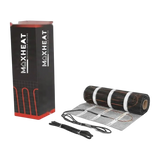
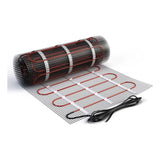
Every data sheet and manual: Product Library · All videos: MaxHeatUFH on YouTube

Design it in MaxHeatUFH ProLoop
Add your rooms, choose screed, overlay, joisted or electric, and get a free quick design and full kit list with prices.


