








Upgrading old underfloor heating thermostats to smart controls
How to swap old dial UFH thermostats for programmable or smart controls: checking system voltage and wiring, the Heatmiser neoStat wired route, the battery neoAir wireless route with receivers, electric floor stats, and when the wiring centre stays.
Short answer: Most old dial thermostats are simple 230V switches, so they can usually be swapped for a modern programmable or smart thermostat using the same wires. A Heatmiser neoStat V3 needs 230V at the wall and fits a standard 35mm back box; where the wiring is missing or unsuitable, a battery-powered neoAir talks wirelessly to a receiver by the wiring centre instead. Identify your system voltage first, and have any mains wiring done by a qualified electrician.
Plenty of underfloor heating systems from the 2000s and 2010s still run perfectly, but their controls show their age: a plain dial per room, no schedules, no app, and often no record of which stat drives which loop. Upgrading the thermostats is the cheapest meaningful upgrade an older UFH system can get, because better control trims run times without touching the floor.
This guide covers what can be reused, what wiring a new thermostat needs, the wireless route when the wiring is wrong, and how to choose between the Heatmiser models we stock. For background on how the stats, wiring centre and actuators fit together, see UFH zoning and wiring.
Can I replace an old dial thermostat with a smart one?
Usually yes, because most wired room thermostats do the same simple job: they switch a circuit that tells the wiring centre to open that zone's actuators. If the old stat switches 230V, a modern 230V thermostat can normally take its place on the same conductors, subject to an electrician confirming what is actually in the back box.
There are two checks before you order:
- System voltage. Most UK UFH control circuits are 230V, but some systems run low-voltage networked stats from a 12V wiring centre. A 230V stat on a 12V system, or the reverse, will not work, so confirm which wiring centre you have first.
- What is in the back box. A thermostat such as the Heatmiser neoStat V3 has live, neutral and switching terminals, so the back box needs a neutral as well as the switched connection. Old two-wire stats sometimes have no neutral at the wall, which is exactly the case the wireless route solves.
What wiring does a modern wired thermostat need?
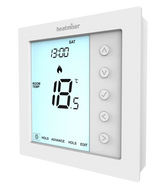
Taking the Heatmiser neoStat V3 as the example: it runs on 230V, switches up to 3A, fits a standard 35mm deep back box, and its terminals include live, neutral, the switching connections and optional sensor terminals for a remote air or floor probe. At 85 x 85mm and 13mm deep it sits almost flush on the wall, which is a visible upgrade from a domed dial stat.
That 3A rating is ample for signalling a wiring centre, which is all a water UFH stat does. It is not a rating for switching heating loads directly, which matters for electric floors (below).
The swap itself is quick for an electrician: isolate, photograph the old terminals, transfer the conductors, and label the zone. If several rooms are being upgraded at once, it is worth tracing and labelling every stat-to-wiring-centre pair while the covers are off. Our Heatmiser UH4 and UH8 wiring guide shows the wiring-centre end.
What if there are no wires, or the wrong wires, at the thermostat?
Go wireless. The Heatmiser neoAir runs on four AAA batteries and needs no wiring at the thermostat at all: it mounts on a back plate with two wall plugs, so it can sit where the room actually needs sensing rather than where a cable happens to be. Heatmiser's manual notes it should not be used with rechargeable batteries.
The switching happens at the other end, where mains already exists. The neoAir pairs with a neoHub, an RF-Switch receiver, or a UH8-RF wireless wiring centre that replaces an old wired one. The receivers have a designed failsafe: if an RF-Switch or UH8-RF loses the thermostat's signal for 40 minutes, it runs the heating 12 minutes in every hour until the signal returns, so a flat battery does not leave a floor stone cold. For the trade-offs between the two approaches, see wired vs wireless UFH thermostats.
Which Heatmiser thermostat should I choose?
Match the model to how much control you want and what wiring exists:
| Model | Best for |
|---|---|
| Heatmiser DS1 | Straight like-for-like dial replacement, no schedules |
| Heatmiser Edge | Neat programmable stat, no app |
| neoStat V3 | Programmable, app control when paired with a neoHub |
| neoStat WiFi | App control with no hub, one room or few zones |
| neoAir | No usable wiring at the stat, battery powered |
If you want whole-house app control on the neo system, add one neoHub G3; every neoStat and neoAir in the house then appears in one app. Upgrading stats room by room is fine: neo stats and old dial stats can coexist on the same wiring centre while you phase the work.
Do I need to replace the wiring centre too?
Not usually. If the existing wiring centre switches the actuators and pump correctly, new 230V thermostats can drive it exactly as the old ones did. Replace it when it is failing, when you are moving from wired to wireless (the UH8-RF takes the receivers' job into the wiring centre), or when you want tidy zone-by-zone wiring with proper labelling after years of additions. How the stat, wiring centre and actuators interact is covered in how UFH actuators and zone valves work.
What about old electric underfloor heating thermostats?
Electric floor stats are a different case, because the thermostat switches the heating load itself rather than signalling a wiring centre, and it must use a floor probe to protect the floor covering. Upgrade like for like: an electric-specific model such as the Heatmiser neoStat-e, with a 10K floor probe if the old sensor is incompatible or damaged. Check the mat or cable's load against the thermostat's rated switching current, and where the load exceeds it, the stat must switch via a contactor.
Any work on the mains side, for water or electric systems, is a job for a qualified electrician working to BS 7671, and electric floor heating circuits in dwellings fall under Part P. The thermostat programming afterwards is safely a homeowner job.
Free design tool: planning a wider upgrade than just the stats? Design your UFH system yourself in 3 minutes with MaxHeatUFH ProLoop and get an instant quick design and quote. Start your design
Frequently asked questions
Can any old UFH thermostat be replaced with a smart one?
Almost always, either wired (same position, same conductors, if voltage and terminals suit) or wireless (battery stat plus a receiver at the wiring centre). The rare exceptions are proprietary low-voltage network systems, which need matching parts.
How do I know if my system is 230V or 12V?
Look at the wiring centre label by the manifold: it states the control voltage. Heatmiser, for example, makes both 230V and 12V network wiring centres, and the thermostats are not interchangeable between them.
Do smart thermostats need a neutral wire?
Mains-powered models such as the neoStat V3 have a neutral terminal in the wiring detail, so plan for live and neutral at the wall. If the back box has no neutral, a battery-powered neoAir with a receiver avoids rewiring.
Will a new thermostat save money on an old system?
Accurate scheduling and setback stop zones running when nobody benefits, which is where older always-on dial systems waste heat. The saving depends on how crude the old control was, so we will not put a number on it, but schedules and app control remove the main waste.
Can I mix wired and wireless thermostats in one house?
Yes. On the Heatmiser neo system, wired neoStats and wireless neoAirs sit on the same neoHub and app, which is useful when most rooms have wiring and one or two do not.
Do I need an electrician to change a thermostat?
For anything involving the 230V wiring, yes: a qualified electrician working to BS 7671. Battery thermostats avoid wiring at the stat, but their receivers still connect to the mains at the wiring centre.
Will new thermostats work with my old manifold and actuators?
Yes, if voltages match. The thermostat only tells the wiring centre to open a zone; the actuators neither know nor care which thermostat asked. Replace a failed actuator separately, as covered in our actuators guide.
Sources: Heatmiser neoStat V3 datasheet, Heatmiser neoAir manual
Products in this guide
Watch how each part works and how to fit it, and download its data sheet and install manual.




Every data sheet and manual: Product Library · All videos: MaxHeatUFH on YouTube

Design it in MaxHeatUFH ProLoop
Add your rooms, choose screed, overlay, joisted or electric, and get a free quick design and full kit list with prices.


