Underfloor heating noises: ticking, creaking, gurgling and humming explained
What causes ticking, creaking, gurgling, whooshing and humming noises in underfloor heating, and how to stop each one, from bleeding air to turning down the pump.
Short answer: Ticking or creaking from the floor as it warms up or cools down is usually pipe expanding against spreader plates, clips or joist notches, and is most common in timber floors. Gurgling or trickling at the manifold means air in the system, so bleed it. Whooshing, whistling or a loud hum usually means the water is moving too fast, often because the pump speed is set too high. Clicks from the wiring centre or thermostat are normal relay switching.
Underfloor heating should be close to silent. When it is not, the type of noise and when it happens tell you most of what you need to know. A tick that starts ten minutes after the heating comes on points to expansion. A gurgle that never stops points to air. A whoosh that gets louder when other zones close points to flow.
This guide works through the common noises, what causes each one and how to stop it. Some fixes are simple, such as bleeding the manifold or turning down the pump. Others, such as noise built into a timber floor, are best avoided at install stage, so we also cover what installers can do to prevent them.
What causes underfloor heating noises?
Almost every UFH noise comes from one of three things: movement as the pipe expands and contracts, air in the water, or water moving too fast. Use this table to match the noise to the cause.
| Noise | When you hear it | Likely cause |
|---|---|---|
| Ticking or clicking in the floor | As the floor warms up or cools down | Pipe expanding against plates, clips or notches |
| Creaking | Warm-up, or when walked on once warm | Timber floor moving, pipe rubbing on joists |
| Gurgling or trickling | All the time, often at the manifold | Air in the system |
| Whooshing or whistling | While the pump runs, worse when zones close | Flow rate too high |
| Humming or rattling at the pump | While the pump runs | Pump speed too high, or air in the pump |
| Click at wiring centre or thermostat | When a zone switches on or off | Normal relay switching |
Why does my underfloor heating tick or click?
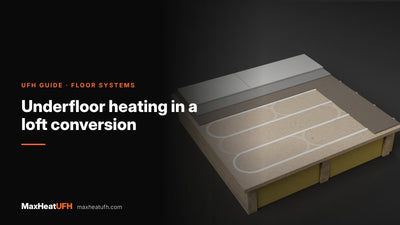
Because the pipe is moving as it heats and cools, and something is holding it tight enough to make a noise as it slips. This is most common in joisted floors with aluminium spreader plates, where the pipe and the plate expand at different rates.
A pipe maker's instructions for heat transfer plates say this directly: switching the heating on and off makes ticking more likely, because the pipe and the aluminium expand at different rates. Its advice for avoiding it is to design for steady circulation with outdoor reset control, which is weather compensation, rather than hard on and off cycling. It also says it cannot guarantee plates will be silent.
The same instructions list install steps that reduce the risk:
- Fix plates on one side only. Screw one edge of each plate and let the other hang, so the plate can move as it expands.
- Leave gaps between plates along the pipe run, rather than butting them tight.
- Feed pipe in straight. Work out twists so the pipe enters each plate in a straight line and does not rub the sides of the groove.
- Leave pipe ends free to move and pass the pipe between joist bays through holes big enough for it to slide.
- Bed the pipe in the channel. The maker suggests a bead of silicone in the plate channel, which improves heat transfer and helps stop expansion noise.
Our guide to fitting spreader plates from below covers plate fixing in more detail. Ticking in a screed floor is much rarer, because the pipe is fully held in the screed.
How do I stop ticking that is already there?
Make the temperature changes gentler. You usually cannot get at the pipe without lifting the floor, so the practical fix is to reduce how fast and how far the pipe temperature swings.
- Lower the flow temperature. A smaller temperature change means less expansion. Turn the mixing valve down to the lowest setting that still heats the rooms.
- Avoid big setbacks. A drop of several degrees overnight means a large, fast warm-up in the morning. A smaller setback keeps the pipe at a steadier temperature. Our guide to setback schedules explains the settings.
- Run longer at lower temperature. Steady, longer heating periods give fewer warm-up and cool-down cycles than short bursts.
- Check where you can reach. If the ceiling below is open or there is a void, look for pipe tight against joists, notches or holes and ease it free.
Why does my floor creak when the heating is on?
A timber floor moves as it warms and dries, and pipes pressed against the structure can rub as they expand. Both create creaks, usually during warm-up or when you walk on the floor once it is warm.
- Pipe against joists: pipe touching joists, notches or holes as it passes through can creak as it moves. Heating engineers widely agree the cure is stopping the pipe touching the structure, by enlarging tight holes or sleeving the pipe.
- Floor deck movement: loose boards or panels creak whether the heating is on or off, but the heat can make it worse. Screw down loose boards into the joists, clear of the pipe routes.
- Board systems: on routed or joisted floor panels, make sure the pipe sits fully down in the groove so the floor finish does not rub on it.
Our guide to UFH on joisted timber floors covers how to build the floor so it stays quiet.
Why is my underfloor heating gurgling?
There is air in the system. Gurgling or trickling, usually loudest at the manifold or the pump, is the sound of water moving past air pockets. It is common after a new install, a refill or a repair.
Bleed the manifold loop by loop until the noise stops, then top the system back up to its normal pressure. Our guide to bleeding air from underfloor heating shows the method. If the air comes back, check the auto air vent at the end of the manifold is working, and look for a leak, because a leak lets air in as the pressure drops.
Grundfos, the pump maker, notes that noise from air in a heating system is a fault for a heating engineer when bleeding does not clear it. A persistent air problem can come from a poorly placed pump, a missing air vent or a system that keeps losing pressure.
Why does my underfloor heating whoosh or whistle?
The water is moving too fast. That happens when the pump speed is too high for the loops, or when most loops have closed and all the flow is pushed through the one or two still open.
Grundfos lists a flow rate that is too high as one of the main causes of noise in heating systems, and suggests changing the pump setting. On its pumps with an AutoAdapt mode, it suggests trying that mode first, and returning to the previous setting if the rooms no longer get enough heat. One manufacturer's UFH handbook also explains that a smaller flow and return temperature difference means a higher volume flow, higher flow speed and more pressure loss, which is where noise comes from.
- Turn the pump down one step at a time until the noise stops and every loop still gets its design flow.
- Balance the loops. One loop with its flow meter wide open takes far more flow than the others. Our guide to balancing underfloor heating loops shows how.
- Check for a bypass. When most zones close, the pump needs somewhere for the water to go, or the flow through the open loops rises sharply.
Why is the UFH pump humming or rattling?
A loud hum usually means the pump is set too fast, and a rattle or grinding usually means air is trapped in the pump. Both are fixable without replacing the pump in most cases.
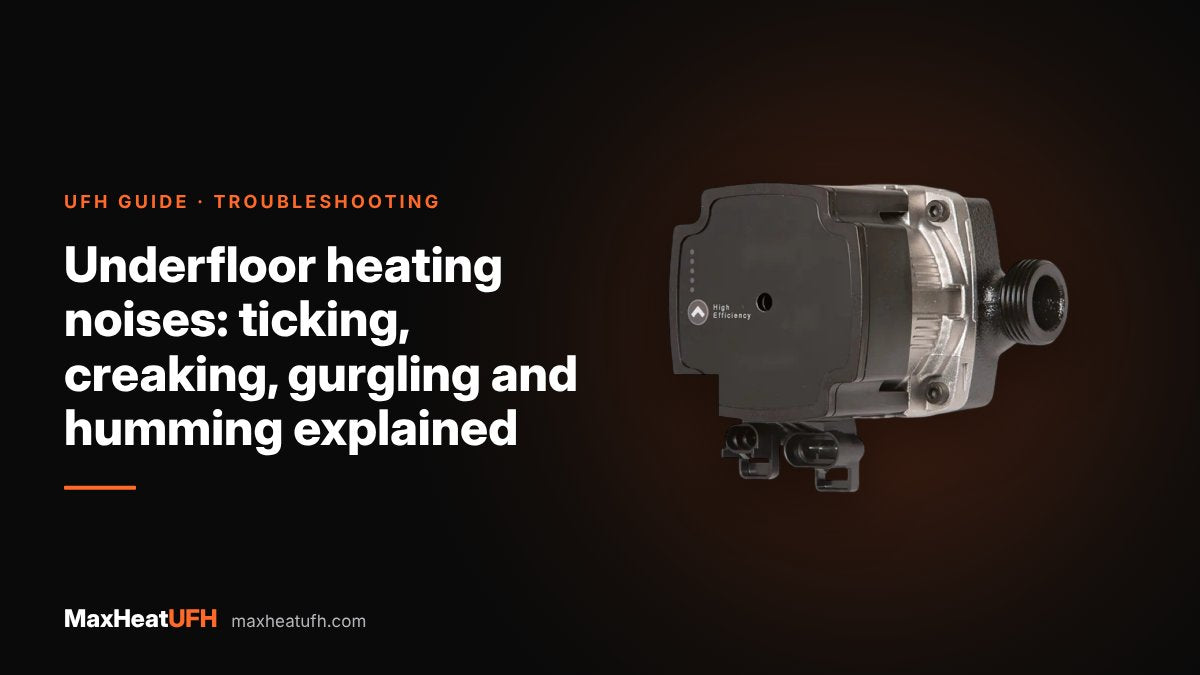
Turn the pump down first. If it rattles, bleed it according to the maker's instructions and bleed the manifold. A pump that still rattles, will not start or runs hot needs checking. Our guide to UFH pump not working, noisy or airlocked covers the checks in order. If the pump does need replacing, the Grundfos UPM3 Flex 25-70 is a standard 130mm pump with 1½in unions.
A soft click from the wiring centre or thermostat when a zone switches is just the relay. Thermal actuators on the manifold open and close slowly with no motor, so they make little noise. A hum or buzz from the wiring centre itself is not normal and should be checked by an electrician.
Frequently asked questions
Is it normal for underfloor heating to make noise?
A quiet click from the thermostat or wiring centre is normal. Ticking, gurgling, whooshing or humming are not, and each has a cause you can track down.
Why does my floor tick when the heating comes on?
The pipe is expanding and slipping against spreader plates, clips or joist notches. It is most common in timber floors with aluminium plates, because the pipe and plate expand at different rates.
Can I stop ticking without lifting the floor?
Often you can reduce it. Lower the flow temperature, use smaller setbacks and run the heating for longer at a steadier temperature, so the pipe moves less.
Why is my manifold making a gurgling noise?
Air is trapped in the system. Bleed each loop at the manifold and top the pressure back up. If the air keeps coming back, look for a leak or a faulty air vent.
Why does my underfloor heating whistle?
The flow is too fast. Turn down the pump speed and balance the loops so no single loop takes most of the water.
Does screed underfloor heating make noise?
Rarely. The pipe is fully held in the screed, so it cannot slip and tick. Noise in a screed system usually comes from the manifold or pump instead.
Sources: Grundfos: why is the heating system making noise, HeatingHelp forum: ticking from pipe expansion
Products in this guide
Watch how each part works and how to fit it, and download its data sheet and install manual.



Every data sheet and manual: Product Library · All videos: MaxHeatUFH on YouTube
Design it in MaxHeatUFH ProLoop
Add your rooms, choose screed, overlay, joisted or electric, and get a free quick design and full kit list with prices.