



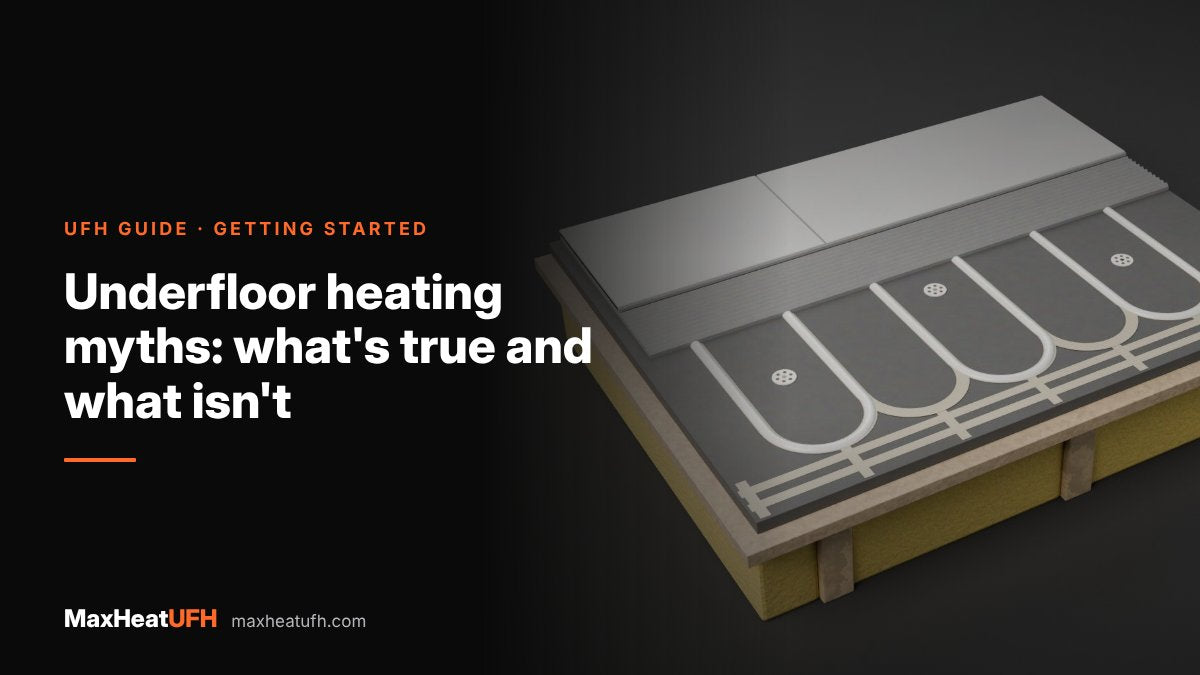
Underfloor heating myths: what's true and what isn't
The most common underfloor heating myths checked against the standards and current energy prices: running costs, warm-up times, carpet, retrofits, leaks, comfort and electric vs water systems.
Short answer: Most of the familiar underfloor heating myths date from systems fitted decades ago. Water UFH is not expensive to run: it uses the same boiler or heat pump as radiators at lower water temperatures, and gas costs 7.97p/kWh against 26.32p for electricity under the October 2026 price cap. You can lay carpet over it within the tog limit, retrofit it with low-profile boards, and run it upstairs. The pipe is laid in continuous loops with no joints buried in the floor, and floor surfaces are limited to 29°C in occupied areas under BS EN 1264, so it heats rooms gently and evenly rather than "cooking your feet".
Underfloor heating attracts strong opinions, and a surprising number of them are out of date or were never true. Some myths put people off a system that would suit their home well; others lead to real mistakes, like switching a screeded floor on and off as if it were a fan heater.
This guide takes the claims we hear most often, from customers, forums and the trade, and checks each against the standards, the published guidance and the price cap. Where a myth contains a grain of truth, we say so, because a few of them do.
Is underfloor heating expensive to run?
Not water UFH on a boiler or heat pump: this myth mostly comes from confusing it with direct electric heating. A water system is just another emitter on your heat source, like radiators, and it runs at lower water temperatures, which is exactly what condensing boilers and heat pumps want: Part L guidance now expects new heating systems in England to be sized for a maximum 55°C flow, and well-designed UFH runs below that.
The fuel figures frame it. Under the October 2026 price cap, gas averages 7.97p/kWh and electricity 26.32p/kWh for a typical direct debit customer in Great Britain. So a gas- or heat-pump-fed water system heats a whole house economically, while direct electric UFH, at full electricity rates, is usually kept to bathrooms and small areas where its low install cost wins. What you actually pay depends on your heat loss, insulation, set temperatures, hours of use and tariff: underfloor heating running costs works through labelled estimates.
The grain of truth: a badly set up system can waste money: flow temperature too high, no setbacks, one thermostat for the whole house. The fix is settings, not ripping the floor up.
Does underfloor heating take all day to warm up?
Only a thick screed starting from cold takes that long, and a running system never starts from cold. A heavy screed stores hours of heat, so the right way to run it is steady, with setbacks of a few degrees rather than off: then it only ever tops up, and recovery is quick. Low-profile overlay and timber systems carry little mass and respond in a fraction of the time. Typical figures by floor build-up are in UFH warm-up times.
The grain of truth: if you treat a screeded floor like a radiator, off all day, full blast at 6pm, it will disappoint. It is a different instrument, and it rewards programming, not poking.
Can you not put carpet on underfloor heating?
You can. Carpet and underlay simply add thermal resistance, so the combined tog rating has to stay within the system design: the floor beneath runs a little warmer to push the same heat through. Plenty of UFH homes have carpeted bedrooms and lounges. What you cannot do is pile a thick carpet on a thick underlay and expect full output; our guide to carpet and tog ratings over UFH gives the limits and the right underlay types.
The same logic covers the related myths about rugs and furniture: flat-bottomed furniture and thick rugs insulate patches of floor, so flag them at design time rather than banning them from the room.
Is underfloor heating only for new builds?
No, this one was true enough in the days when UFH meant 75mm of fresh screed, but retrofit systems changed it. Low-profile overlay boards sit on an existing floor and add only a little height; routed and castellated panels, biscuit-mix floors and fit-from-below spreader plate systems between joists cover most other cases. A product like the MaxHeatFix Plus low-profile panel is designed exactly for going over an existing slab or deck.
Doors, thresholds and the odd step need thought, and a retrofit survey should always start with insulation and heat loss. Our guides to retrofitting underfloor heating and low-profile overlay systems cover the options floor by floor.
Do underfloor heating pipes leak or burst under the floor?
A properly installed system has no joints buried in the floor to leak: each loop is a single continuous run of pipe from the manifold and back, and every connection lives at the manifold where you can see it. Modern multilayer and barrier pipe is tested to pressures and temperatures far beyond anything the system produces, and the install is proven with a pressure test before the screed goes down: see pressure testing UFH.
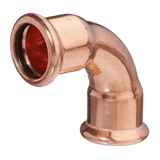
The grain of truth: pipes do get damaged by other trades: a screwed-down door bar, a drilled floor. That is why installers photograph the pipe layout before covering it, test during screeding, and why a damaged pipe is repairable with a pressed coupling rather than a disaster.
Does underfloor heating just cook your feet and make rooms stuffy?
The opposite, by design. BS EN 1264 limits the floor surface to 29°C in occupied areas (35°C at the edges, and about room temperature plus 9°C in bathrooms), which is only a few degrees above the room: warm to bare feet, not hot. Because the whole floor is the emitter, output is capped at roughly 100W/m² and arrives largely as radiant heat spread across the room, instead of a convection plume off a hot radiator. That is why UFH rooms feel even, with no scorching surfaces and no cold corner by the window.
Radiant, low-temperature heat also moves less air around than strong convection. And if you like radiators in some rooms, you do not have to choose: mixed systems are common: see UFH and radiators together.
Is electric underfloor heating always the wrong choice?
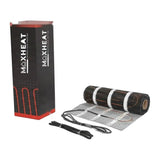
No, the myth here runs the other way. Electricity costs more per kWh than gas, so electric UFH is a poor whole-house heating choice at standard rates, but it is often the right answer for a single bathroom or small refit: the kit is cheap, the build-up is millimetres, there is no pipework back to a manifold, and installation is quick. The crossover point between water and electric is mostly about area and how the room will be used: water vs electric UFH compares them honestly.
One rule is not a myth: the final electrical connection of any electric floor must be made by a qualified electrician (Part P / BS 7671).
Free design tool: still weighing it up? Design your UFH system yourself in 3 minutes with MaxHeatUFH ProLoop and get an instant quick design and quote. Start your design
Frequently asked questions
Is underfloor heating cheaper to run than radiators?
On the same heat source it is broadly comparable, with an edge from lower water temperatures, which help condensing boilers and heat pumps run efficiently. The big differences come from settings, zoning and insulation, not the emitter alone.
Does underfloor heating have to stay on 24/7?
No. Heavy screeds suit setbacks, a few degrees down overnight and when out, rather than fully off, and light overlay systems can be timed much like radiators. Constant full temperature is not required and wastes money.
Can underfloor heating go upstairs?
Yes. Joisted floors take spreader plate, routed board or overlay systems, and upstairs rooms often need less output than downstairs. Weight and build-up are handled by choosing the right floor system.
Does underfloor heating cause damp or mould?
No, a gently warm floor dries surfaces and keeps the room fabric warmer, and UFH has no hot surfaces to scorch dust. Damp problems have building causes, not UFH ones.
Can you put furniture on underfloor heating?
Yes, with sense. Furniture on legs is no problem; large flat-bottomed pieces and very thick rugs insulate the floor beneath them, so plan the layout around them at design time.
Is a heat pump required for underfloor heating?
No. UFH runs happily from a gas, oil or LPG boiler at a mixed-down flow temperature. It is simply the emitter best matched to a heat pump if you fit one later, because of its low flow temperatures.
Do old underfloor heating systems fail after 25 years?
The buried pipe itself is the long-life part of the system; it is the serviceable kit at the manifold, pumps, actuators, valves and controls, that gets replaced over the years, and all of it is accessible without touching the floor.
Sources: Ofgem: energy price cap 1 October to 31 December 2026, BEAMA Part L heating controls guidance (55°C flow), Energy Saving Trust: take control of your heating
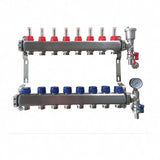
Products in this guide
Watch how each part works and how to fit it, and download its data sheet and install manual.




Every data sheet and manual: Product Library · All videos: MaxHeatUFH on YouTube
Design it in MaxHeatUFH ProLoop
Add your rooms, choose screed, overlay, joisted or electric, and get a free quick design and full kit list with prices.


