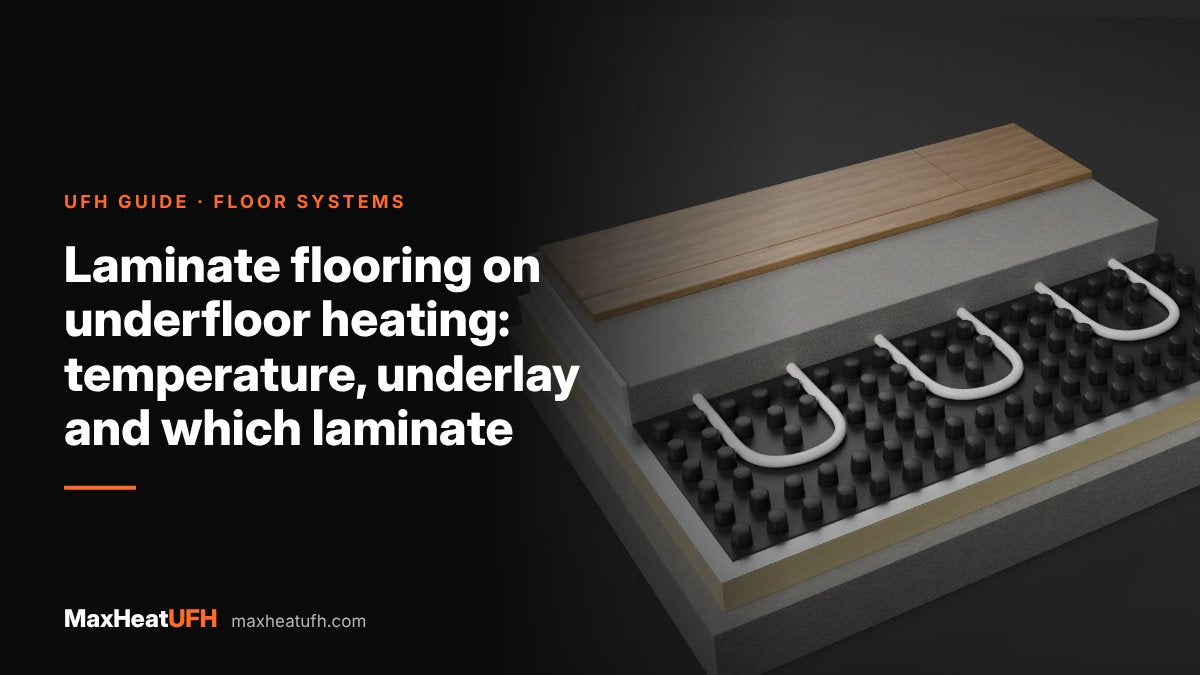
Laminate flooring on underfloor heating: temperature, underlay and which laminate
The laminate makers' limits for underfloor heating: 27°C surface, 0.15m²K/W total resistance, which underlay to use, screed moisture, and how to warm up and cool down the heating around fitting.
Short answer: Yes, most laminate works over underfloor heating if you stay inside two limits. Laminate makers cap the floor surface at 27°C (one allows 28°C), and the laminate plus underlay should add up to no more than 0.15m²K/W, which is 1.5 tog. Lay the laminate floating on a thin, dense underlay made for underfloor heating, with a damp-proof layer over a screed, and change the heating by no more than 5°C a day.
Laminate is a high-density fibreboard core with a printed, sealed top layer. It handles warmth well, but it does not like heat that is too high or changes too fast, and the underlay under it can quietly block a large part of the heat. Most problems with laminate on underfloor heating (UFH) come from the wrong underlay, a screed that was still wet, or heating that was switched straight on at full output after fitting.
This guide gives the numbers the laminate makers publish: surface temperatures, thermal resistance, underlay values, screed moisture and the warm-up routine. For a side-by-side view of every floor finish, see underfloor heating under tiles, LVT, laminate, wood and carpet.
Can you put laminate on underfloor heating?
Yes. Laminate makers approve their floors for low-temperature water UFH, and for electric heating embedded in the screed. Two laminate makers (Maker A and Maker B in this guide) both say the floor must be laid floating, with an insulating layer below the heating that insulates better than the laminate does, so the heat goes up rather than down.
The conditions are the same across the makers we checked:
- Low temperature: a maximum surface (contact) temperature of 27°C, or 28°C for one maker.
- Low resistance: laminate and underlay together no more than 0.15m²K/W.
- Floating fit: click joints over an underlay, never glued or nailed down.
- Slow changes: no more than 5°C a day when warming up or cooling down.
- A dry base: screed tested and below the maker's moisture limit before you lay.
Always read the instructions for the exact product. The warranty usually depends on following them.
What is the maximum temperature for laminate on underfloor heating?
27°C at the floor surface for most laminate. This is lower than the 29°C comfort limit that BS EN 1264 sets for heated floors in general, so laminate is one of the finishes that limits how hard the system can work.
| Laminate maker | Surface limit | Other limit |
|---|---|---|
| Maker A | 27°C contact temperature | Total R no more than 0.15m²K/W |
| Maker B | 27°C contact temperature | Total R no more than 0.15m²K/W |
| Maker C | 28°C contact temperature | Water no hotter than 50°C |
The thermostat cannot hold the surface temperature on its own unless it can see the floor. Fit a floor probe between the pipe runs and set the floor limit to the laminate maker's figure, or a degree below it. Our guide to floor probes and floor limits shows where to fit it and how to wire it.
Holding 27°C at the surface is not a big restriction in a well-insulated room. EN 1264 puts the maximum output of any heated floor at about 100W/m² with a surface 9°C above the room. At 27°C in a 20°C room, the surface is 7°C warmer, so the floor gives a little less than that maximum.
Which underlay should I use under laminate on underfloor heating?
Use a thin, dense underlay sold for underfloor heating, with a stated thermal resistance (R value) low enough that laminate and underlay together stay under 0.15m²K/W. The underlay usually matters more than the laminate.
Maker A publishes the combined figures for its own laminate and underlays. Here are three of them for an 8mm board:
| 8mm laminate on | Underlay R | Total R (m²K/W) | Within 0.15? |
|---|---|---|---|
| No underlay | none | 0.055 | Yes |
| Thin dense underlay | 0.01 | 0.065 | Yes |
| 1.2mm underlay | 0.045 | 0.100 | Yes |
| Basic foam underlay | 0.075 | 0.130 | Yes, just |
| Insulating underlay | 0.143 | 0.198 | No |
The last row is the trap. An underlay sold for warmth or levelling can take you over the limit on its own, and Maker A excludes that one from use over UFH. Before you buy, check the underlay data sheet for these figures:
- Thermal resistance (R): in m²K/W. Lower is better. Add it to the laminate's own R value.
- Test standard: laminate underlays are tested to EN 16354. Maker A's 1.2mm underlay sheet, for example, quotes its results to that standard.
- Compressive strength (CS): a firm underlay stops the click joints flexing. That sheet gives more than 400kPa.
- Vapour barrier: some underlays have one built in, many do not. The same sheet says it has none and that some UFH systems or subfloors need an extra vapour barrier.
On a screed, lay a damp-proof layer first unless the underlay includes one. Maker C specifies its 150 micron damp screen under the underlay. Maker A says to always provide a vapour barrier where there is any risk of rising moisture.
Which laminate is best over underfloor heating?
A laminate that its maker approves for UFH and that has a published R value. Thinner boards pass heat slightly better, but the differences between laminates are small next to the differences between underlays.
| Board thickness | Maker A laminate R | Maker C laminate R |
|---|---|---|
| 7mm | 0.051 | 0.056 |
| 8mm | 0.055 | 0.054 |
| 9mm | 0.059 | 0.057 |
| 12mm | 0.072 | not listed |
So going from 8mm to 12mm laminate adds about 0.017m²K/W, while swapping a thin underlay for a basic foam one adds 0.065m²K/W. Pick the board you like, then spend your care on the underlay.
Look for the words "suitable for underfloor heating" in the laminate's fitting instructions, not just on the box. If the instructions give a lower temperature limit than 27°C, design to that figure.
How do I prepare the screed and the heating before laying laminate?
Get the screed dry, run the heating through a full warm-up first, then turn it off before you lay. Laying on a damp or never-heated screed is the commonest cause of gaps, cupping and swelling.
- Wait for the screed. Maker A says to leave at least 21 days between laying a new screed and starting the heating. Our guide to screed depths and drying times covers how long each screed type takes.
- Run the heating first. Start it at least two weeks before laying, raising the water temperature by no more than 5°C a day. This drives out moisture and proves the system. See commissioning underfloor heating for the full routine.
- Test the moisture. With heating in the screed, Maker A sets 1.5% CM (60% RH) for a cement screed and 0.3% CM (40% RH) for an anhydrite screed. Maker C sets 1.5% CM for concrete.
- Check the pipe cover. Maker C requires the pipes to sit at least 30mm below the surface of the base floor.
- Turn the heating off. Maker A says at least 24 hours before laying. Maker C says the floor should be no warmer than 18°C before, during and for 24 hours after fitting.
- Lay floating with gaps. Maker C asks for an 8 to 10mm expansion gap at every wall and obstacle, and a connecting profile every 10m and between rooms.
How do I turn the heating back on after laying laminate?
Wait 24 to 48 hours, then raise the temperature by no more than 5°C a day. Maker A says wait at least 48 hours. Maker C says at least 24 hours.
The same slow change applies at the start and end of every heating season. Both makers say to avoid sudden swings. Day-to-day changes from your heating schedule are fine as long as the floor stays under its maximum temperature.
Avoid trapping heat on top of the laminate. Maker A warns against heat building up under rugs, or under furniture with too little gap to the floor. Choose thin rugs, and leave air space under large furniture so heat can escape.
Can laminate go over overlay boards or a joisted UFH floor?
Usually yes, with a rigid layer between the grooved panels and the laminate. A floating floor needs a flat, stiff base, and the pipe grooves must not show through or let the boards flex.
One floating-floor maker requires a stiff board between a grooved subfloor (chipboard, XPS or EPS panels with heat plates) and the floor. On a joisted floor, MaxHeatChip routed chipboard with our 6mm foil-backed top board over it gives that stiff layer, and the foil spreads heat between the runs. See UFH in joisted timber floors for the board rules.
On a solid floor, our overlay boards are made to tile directly. For laminate, ask the laminate maker whether its product can float directly on the board you choose, and add a rigid layer if it cannot. Note that Maker C's guidance assumes the heating is embedded in the base floor, so check with the maker before you lay over any dry system.
Can laminate go over electric underfloor heating or underfloor cooling?
Over electric heating, only within strict output limits. Maker C says electric heating laid on the slab, directly under the underlay and laminate, should not exceed 60W/m², because more can heat the planks too fast and split the core. Electric heating embedded in the screed follows the same rules as water.
Our electric mats and loose cable are made for tile and stone floors, laid in the tile adhesive. They are not for use under laminate. For a laminate floor, water UFH is the better match.
Underfloor cooling is possible on some laminates, with tighter limits. Maker A's 1.2mm underlay sheet lowers the total R to 0.10m²K/W for cooling, and Maker B advises 0.09m²K/W or less. Both need controls that stop condensation forming under the floor. Maker C advises against combined heating and cooling under its laminate, because condensation can swell the boards.
Design your UFH system yourself in 3 minutes with MaxHeatUFH ProLoop and get an instant quick design and quote. Start your design
Frequently asked questions
What tog is laminate?
Thin laminate is well under 1 tog. Maker A lists its 7 to 12mm boards at 0.051 to 0.072m²K/W, about 0.5 to 0.7 tog. One heating maker's CIBSE table puts 22mm timber laminate at 1.5 tog.
Do I need a special underlay for laminate on underfloor heating?
Yes. Use one sold for UFH with a published R value, so laminate and underlay together stay under 0.15m²K/W. Avoid thick insulating or levelling underlays, which can go over the limit on their own.
Can I glue laminate down over underfloor heating?
No. Makers A, B and C all say laminate must be laid floating, with or without underfloor heating.
How long after screeding can I lay laminate on underfloor heating?
Wait at least 21 days before starting the heating, run it for at least two weeks, then test the moisture. Many screeds take longer than that to reach 1.5% CM, so test rather than count days.
Will underfloor heating damage laminate?
Not if you keep the surface under 27°C and change temperature slowly. Damage comes from wet screed, fast warm-ups, a floor that runs too hot, or heat trapped under rugs.
What temperature should I set the water to under laminate?
Low enough that the floor surface stays under 27°C. Maker C caps the water at 50°C, but most systems need much less. Use a floor probe to cap the surface and set the flow temperature to the room's design.
Sources: laminate and underlay manufacturers' published underfloor heating guidance and data sheets, and floating floor installation guidance
Products in this guide
Watch how each part works and how to fit it, and download its data sheet and install manual.


Every data sheet and manual: Product Library · All videos: MaxHeatUFH on YouTube
Design it in MaxHeatUFH ProLoop
Add your rooms, choose screed, overlay, joisted or electric, and get a free quick design and full kit list with prices.