Hybrid heat pump and boiler systems with underfloor heating
How hybrid (bivalent) heat pump and boiler systems work with underfloor heating: changeover vs parallel operation, sizing rules, tariff-based switching, and why hybrids miss the £7500 grant.
Short answer: A hybrid (bivalent) system pairs a heat pump with a boiler: the heat pump does the everyday heating and the boiler steps in for peak demand or high temperatures. CIBSE's analysis puts the sweet spot at a heat pump sized around 50 to 75% of peak load for changeover systems, or 25 to 50% where the two run in parallel. Underfloor heating suits hybrids well because its low water temperatures keep the heat pump in its efficient range. Be aware that the £7500 Boiler Upgrade Scheme requires the new system to fully replace the fossil fuel system, which rules out a hybrid that keeps the gas boiler.
Not every house can jump straight to a heat pump. Sometimes the electrical supply is tight, the budget will not stretch to the full system, or the building's peak heat loss on a design cold day is more than a sensibly sized heat pump can cover. A hybrid keeps a boiler in the system for the hardest hours of the year and lets a smaller heat pump carry the bulk of the heating season.
This guide explains how hybrids work, how the system decides which heat source runs, why underfloor heating is a strong match, what the MCS standard says about hybrid sizing, and where grants and VAT stand. For the two heat sources individually, see UFH with a heat pump and UFH with a boiler.
What is a hybrid or bivalent heating system?
A system with two heat sources sharing one set of emitters: a heat pump plus a boiler, usually gas or oil. The industry term is bivalent. CIBSE's analysis of bivalent systems describes two ways of running them:
| Mode | How it works | Typical heat pump size |
|---|---|---|
| Changeover | Heat pump runs alone up to a set point, then switches off and the boiler takes over | About 50 to 75% of peak load, max flow around 55°C |
| Parallel | Heat pump runs whenever it can; boiler joins in when demand exceeds its output | About 25 to 50% of peak load |
The logic rests on one fact about UK heating: peak capacity is needed for only a few hours a year. A heat pump sized well below the design-day load still covers most of the heating season, because most of the season is nowhere near the design day. Parallel operation gets more annual heat out of the heat pump; changeover keeps it working at lower temperatures, where it is more efficient and cheaper to run.
How does a hybrid decide when to use the boiler?
On packaged hybrid units, the controller decides, and on at least one major system the deciding factor is cost rather than outside temperature alone. That system's user guidance describes three operating modes, heat pump only, hybrid (boiler assisting the heat pump) and boiler only, chosen to give the most energy-efficient and cost-effective operation for your tariff. You enter your gas and electricity unit prices into the controller, including time-of-day bands if your electricity tariff has them, and the system works out when the heat pump is cheaper than gas.
That matters for running costs. Under the October 2026 price cap, electricity averages 26.32p/kWh and gas 7.97p/kWh, roughly a 3.3:1 ratio, so a heat pump needs to make about three units of heat per unit of electricity before it beats gas on cost. At low flow temperatures into underfloor heating it often can; at high flow temperatures on a freezing day it may not, and that is exactly when the controller hands over to the boiler. Weather compensation usually runs alongside, raising the flow temperature as it gets colder outside.
Why is underfloor heating a good match for a hybrid?
Because it moves the changeover point in the heat pump's favour. One major heat pump maker puts efficient underfloor heating operation at 30 to 40°C water, inside the 35 to 45°C band where heat pumps perform best, and notes that above roughly 50°C the compressor works harder and efficiency falls. A floor that heats the house on 35 to 40°C water lets the heat pump cover more hours of the year before the economics or the physics call for the boiler.
- More heat pump hours. The lower the flow temperature the emitters need, the longer the heat pump stays the cheaper source.
- No emitter upgrade. A house with UFH already has low-temperature emitters, which is the expensive part of making a home heat-pump-ready.
- Graceful mixed systems. Where UFH covers the ground floor and radiators the bedrooms, the boiler can serve the high-temperature radiators while the heat pump feeds the floor; see UFH and radiators together.
Design flow temperature is a decision, not an accident: pipe centres, floor construction and coverings set what the floor can do at 35 or 40°C. Our guide to UFH flow temperatures covers the numbers.
What size heat pump goes in a hybrid?
The MCS standard sets a floor under it. Where a heat pump alone cannot meet 100% of the calculated heat loss, MIS 3005-D's hybrid provisions require the combined output of all heat sources to cover at least 100% of the heat loss, with the heat pump providing at least 55% of the heat loss at a 55°C flow temperature at the design external temperature, and the controls set to prioritise the heat pump.
Within that, the CIBSE ranges give the design territory: a changeover hybrid around 50 to 75% of peak load, a parallel hybrid as low as 25 to 50%. The right answer comes from a proper room-by-room heat loss calculation, the same BS EN 12831 exercise as for any heat pump, then an honest look at what the boiler is for: a few peak days a year, or daily top-up duty. See our guide to what size heat pump underfloor heating needs.
Two cautions from the CIBSE analysis: parallel running at high flow temperatures in cold weather drags the heat pump's efficiency down, sometimes below the cost of just burning gas; and the outcome depends more on the control strategy than on the hardware. A hybrid with lazy controls becomes a gas boiler with an expensive ornament outside.
Can you get a grant for a hybrid system?
Not under the Boiler Upgrade Scheme as it stands. The scheme's published rules require the funded system to fully replace an existing fossil fuel system, and it offers up to £7500 for an air source or ground source heat pump in England and Wales, installed by an MCS certified installer, with the scheme currently open to 30 December 2029. A hybrid that keeps the gas or oil boiler does not fully replace it, so it falls outside those rules. If grant money matters to your project, price the full heat pump route before settling on a hybrid; check gov.uk for the current position.
On VAT: 0% VAT on energy-saving materials applies only where a qualifying installer supplies and installs qualifying measures, under rules that currently run to 31 March 2027. Buying kit supply-only from any merchant, including MaxHeatUFH, carries 20% VAT. Our guide to grants and VAT has the detail.
How does a hybrid connect to underfloor heating?
The UFH side looks much like any mixed-source system, and the detail depends on the hybrid unit's own schematics.
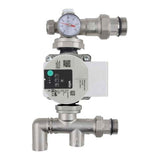
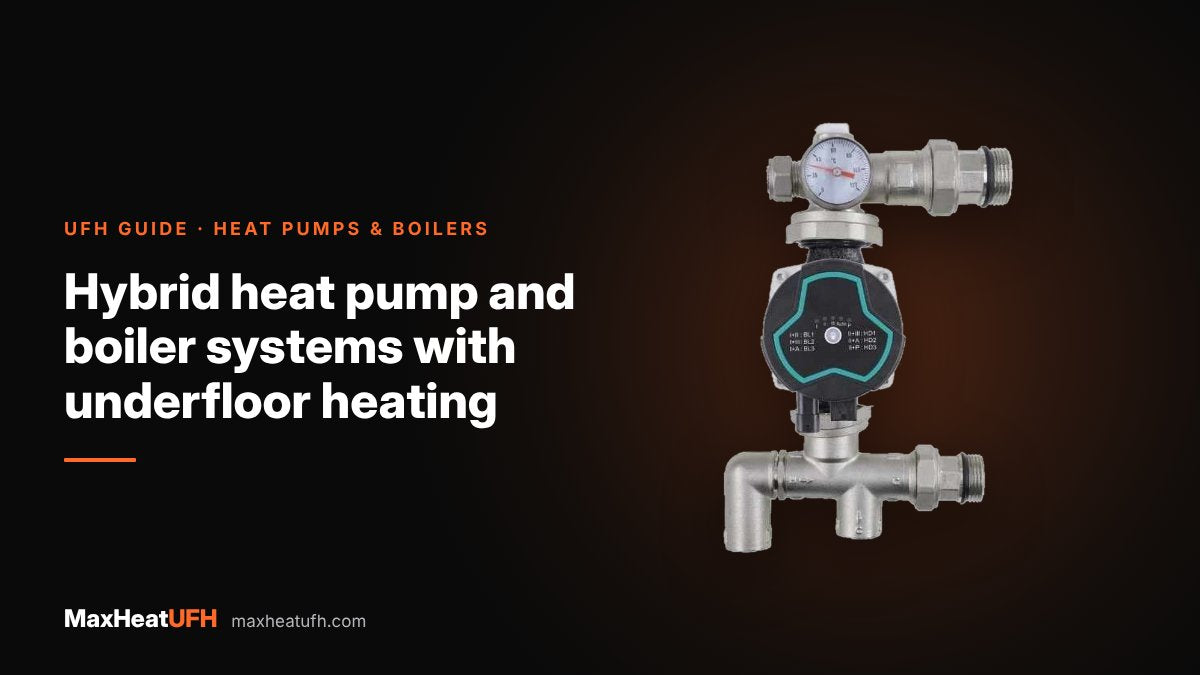
- Protect the floor from boiler temperatures. If boiler-temperature water can reach the manifold, a blending valve and pump such as our UFH blending valve pump pack (20 to 55°C) caps what enters the loops.
- Direct connection where the design allows. Packaged hybrids that always deliver floor-safe temperatures to the UFH circuit can feed the manifold through a non-mixing pump set instead, exactly as a heat pump would.
- System volume and buffers. Follow the heat pump maker's requirements; our guide to buffer tanks explains when one is needed.
- The right trades. Gas and boiler work needs a Gas Safe registered engineer, the heat pump belongs with an MCS installer, and the final electrical connections with a qualified electrician. MaxHeatUFH supplies the UFH kit and works with vetted approved installers rather than installing itself.
Design your UFH system yourself in 3 minutes with MaxHeatUFH ProLoop and get an instant quick design and quote. Design the floor for low flow temperatures and give your hybrid its best chance. Start your design
Frequently asked questions
What is the bivalent point?
The condition at which the heat pump stops covering the load alone: in a changeover system it hands over to the boiler entirely, in a parallel system the boiler starts helping. Designers set it through the heat pump's size, flow temperature limit and the control settings.
Does a hybrid heat pump work with underfloor heating?
Very well. UFH runs on low water temperatures, around 30 to 40°C, which is where heat pumps are most efficient, so the heat pump covers more of the year before the boiler is needed.
Is a hybrid cheaper to run than a boiler?
It can be, when the heat pump runs at low flow temperatures and the controller knows your tariff prices. At the October 2026 price cap, electricity costs about 3.3 times gas per kWh, so the heat pump beats gas on cost when its efficiency is above roughly that ratio.
Can I get the £7500 grant for a hybrid?
No. The Boiler Upgrade Scheme requires the heat pump to fully replace the fossil fuel system, so keeping the boiler in a hybrid puts the installation outside the scheme's published rules.
What size heat pump does a hybrid need?
MCS hybrid provisions require the heat pump to cover at least 55% of the calculated heat loss at 55°C flow at the design outdoor temperature, with the combined sources covering 100%. CIBSE's ranges are 50 to 75% of peak load for changeover systems and 25 to 50% for parallel.
Can I add a heat pump to my existing boiler and UFH?
Often, yes: the UFH is already a low-temperature emitter. The design questions are the heat pump's size, how the two sources are controlled, and keeping boiler-temperature water off the floor circuit, which is the blending valve's job.
Who installs a hybrid system?
An MCS installer for the heat pump, a Gas Safe registered engineer for the boiler and gas work, and a qualified electrician for the final connections. MaxHeatUFH supplies the underfloor heating side and can pass the install to a vetted approved installer.
Sources: CIBSE Journal: the bivalent approach to heat pumps, MCS MIS 3005-D clause 5.5, GOV.UK Boiler Upgrade Scheme, Ofgem price cap
Products in this guide
Watch how each part works and how to fit it, and download its data sheet and install manual.




Every data sheet and manual: Product Library · All videos: MaxHeatUFH on YouTube
Design it in MaxHeatUFH ProLoop
Add your rooms, choose screed, overlay, joisted or electric, and get a free quick design and full kit list with prices.