








Underfloor heating paperwork: commissioning records, certificates and building control
The records an underfloor heating installation should produce: pressure test protocol, BS EN 1264-4 screed heat-up record, balancing settings, the Benchmark checklist, commissioning notices to building control, Gas Safe and Part P certificates, and what goes in the handover pack.
Short answer: A finished underfloor heating job should leave you with a pressure test record, a screed heat-up record to BS EN 1264-4, the loop layout and flow settings, and the commissioning paperwork for the heat source: a signed Benchmark checklist for a boiler, with the Gas Safe engineer notifying the work within 30 days so you receive a Building Regulations Compliance Certificate. Electrical work on the system that is notifiable under Part P needs its own certificate. Keep everything: solicitors ask for these documents when you sell or remortgage.
Underfloor heating is buried work. Once the screed is down and the floor is finished, the paperwork is the only proof of what was installed, how it was tested and that the right people signed it off. It also protects you practically: the flooring layer wants the heat-up record before laying wood, the warranty claim wants the commissioning record, and the house sale wants the compliance certificates.
This guide lists the records a wet or electric UFH installation should produce, who provides each one, and the deadlines that apply in England. It is written for homeowners checking what to ask for and installers building a tidy handover pack; the companion handover checklist covers how to present it all.
What paperwork should an underfloor heating job produce?
Here is the full set for a typical boiler-fed wet system in a new floor:
| Record | Who provides it | When |
|---|---|---|
| Loop layout and design | Designer or installer | Before the pipe goes down |
| Pressure test record | Installer | Before and during screed laying |
| Screed heat-up record (EN 1264-4) | Installer | Before floor finishes are laid |
| Flow settings and balancing record | Commissioning engineer | At commissioning |
| Benchmark checklist | Boiler installer | At commissioning, signed at handover |
| Building Regulations Compliance Certificate | Via Gas Safe notification | Within 30 days of a gas appliance install |
| Electrical certification | Electrician | For notifiable electrical work |
Not every job needs every line: replacing a manifold needs far less than a new build. But a whole-house system with a new boiler should tick them all.
What should the pressure test record show?
That the loops were tested before the screed went over them, and held pressure while it was laid. One manufacturer's commissioning instruction to BS EN 1264-4 requires a pressure test before and during screed laying, at 1.3 times the permissible operating pressure, with a test protocol prepared.
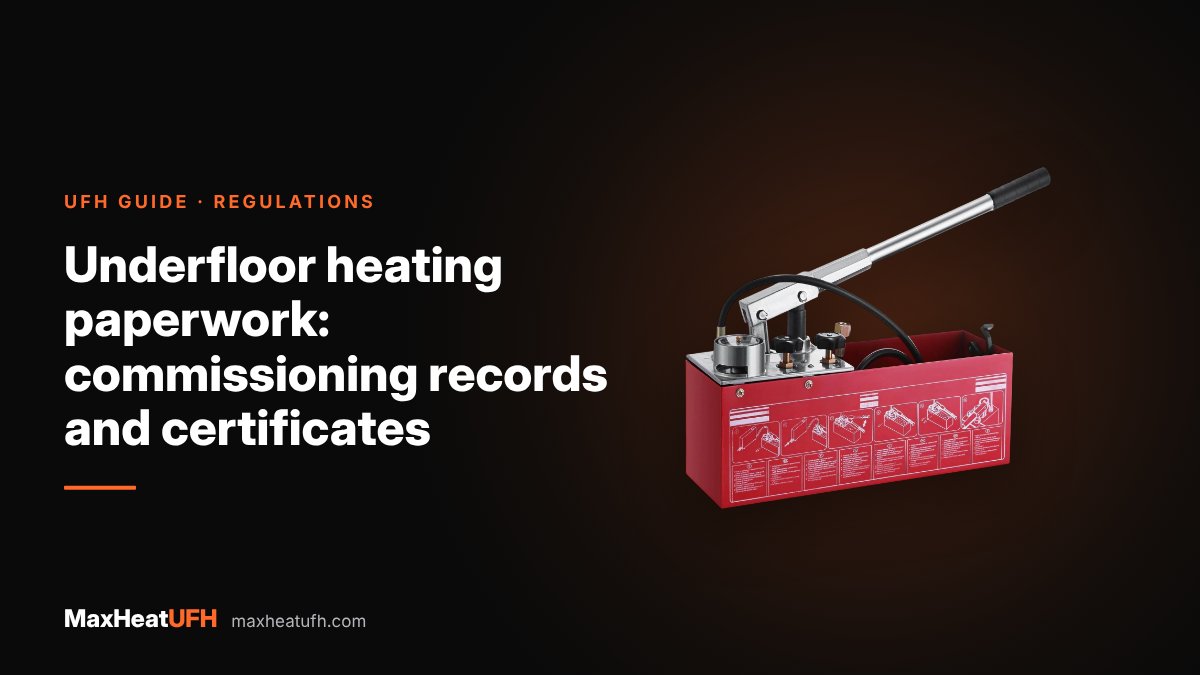
A good record states the test pressure, the start and end readings, the date, and who witnessed it, alongside photos of the laid pipe before pouring. Our guide to pressure testing underfloor heating covers the method, and a hydraulic test pump is the tool for it. If you are buying a house with UFH, this is the single most valuable sheet to ask for: it proves the buried pipe was sound when it was buried.
What is the screed heat-up record?
A dated log of the first controlled heating of the screed, called functional or initial heating in BS EN 1264-4. That manufacturer's instruction sets out the sequence:
- Wait at least 21 days after laying a cement screed, or 7 days for anhydrite, before starting.
- Run a flow temperature of 20 to 25°C and hold it for 3 days.
- Raise to the maximum design flow temperature and hold it for 4 days.
- Keep the screed near the pipes at or below 55°C throughout, and follow the screed maker's instructions where they are stricter.
The record matters because wood, laminate and vinyl suppliers ask for evidence the floor was heated before their product went down, and because skipping the sequence is a common cause of cracked screeds. The wider sign-off process around it is in our guide to commissioning underfloor heating, which also covers recording each loop's flow meter setting so the balance can be restored after any future work.
What is the Benchmark checklist?
The heating industry's standard commissioning record, run by the Heating and Hotwater Industry Council (HHIC) since 1999 for domestic heating and hot water products. The installer completes the relevant sections of the Benchmark Checklist and Service Record at commissioning, hands over the manufacturer's instructions with it, and obtains the customer's signature confirming the system was demonstrated.
Under the scheme the installer must be competent for the work, follow the manufacturer's instructions and meet the Building Regulations, and for notifiable work must either belong to a competent person scheme or confirm building control was notified before work started. At each annual service the engineer completes the service record section. An unfilled Benchmark section in the boiler manual is worth chasing: manufacturers and warranty handlers expect to see it completed.
Do I need to tell building control about underfloor heating?
The heating system has to be commissioned and notified, and who does it depends on the installer.
- Notice of commissioning. Fixed building services, including heating and hot water systems, must be tested and adjusted under the Building Regulations, and a notice of commissioning goes to the building control body: within 5 days of completing commissioning on a local authority building notice or full plans job, or within 30 days where the installer is registered with a competent person scheme.
- Gas appliances. A Gas Safe registered engineer self-certifies the installation and must report it within 30 days through Gas Safe Register, which sends the customer a Building Regulations Compliance Certificate and advises the local authority. Keep that certificate: it is the document solicitors request on sale or remortgage.
Where the UFH is part of a larger project already running under building control, such as an extension, the commissioning records feed into that approval rather than needing their own application. The standards behind the sign-off are summarised in our guide to BS EN 1264 and BS 7671 for UFH.
What electrical paperwork applies?
Any electric underfloor heating, and the wiring of thermostats, actuators and wiring centres on a wet system, ends with an electrician, and the final connection of electric UFH must be made by a qualified electrician working to BS 7671.
Under Part P, as set out by the Planning Portal, installing a new circuit is notifiable, as is work in the zones around baths and showers, which catches most bathroom UFH. An electrician registered with a competent person scheme self-certifies the work; an unregistered installer means the job must be notified before work starts and inspected and certificated through building control or, in England, a registered third-party certifier. The practical split between what you may do yourself and what the electrician signs is covered in can I install underfloor heating myself.
What should be in the final handover pack?
One folder, paper or digital, holding: the loop layout drawing with pipe centres and loop lengths, photos of the laid pipe, the pressure test protocol, the heat-up record, the balancing record with every flow meter's setting, the Benchmark checklist, the compliance and electrical certificates, thermostat instructions, and the installer's contact details. MaxHeatUFH supplies systems and supports vetted approved installers across the UK rather than installing itself; if you need an installer who will produce this paperwork properly, send an enquiry via our installation page.
Design your UFH system yourself in 3 minutes with MaxHeatUFH ProLoop and get an instant quick design and quote. Start your design
Frequently asked questions
Is there a certificate for underfloor heating itself?
Not a single one. The system's proof is the set of records: pressure test, heat-up log and commissioning settings, plus the Benchmark checklist for the boiler and certificates for any gas and electrical work.
Who fills in the Benchmark checklist?
The installing engineer, at commissioning. The customer signs to confirm the system was demonstrated and the instructions handed over, and service engineers add to the service record afterwards.
How long does the installer have to notify a new boiler?
A Gas Safe registered engineer must report the installation within 30 days, after which the customer receives a Building Regulations Compliance Certificate from Gas Safe Register.
I never received a compliance certificate. What now?
Ask the installer first, since the work may simply not have been notified yet: a Gas Safe engineer has 30 days to report it, and the certificate follows the notification. If that goes nowhere, contact your local authority building control for advice.
Does DIY-laid pipe need any paperwork?
Yes, the same wet-side records: pressure test before and during the screed, and the EN 1264-4 heat-up log. Gas and notifiable electrical connections still need registered professionals and their certificates.
What does the flooring company want to see?
The heat-up record showing the screed was taken to its maximum design temperature and the dates, and usually a screed moisture reading, before they will lay wood, laminate or vinyl over the heating.
Do I need the paperwork to sell the house?
Expect to be asked for compliance certificates for gas and electrical work; buyers' solicitors routinely request them, and keeping the full UFH pack also answers the survey questions about what is under the floor.
Sources: Designing Buildings: notice of commissioning, Planning Portal: electrics and Part P
Products in this guide
Watch how each part works and how to fit it, and download its data sheet and install manual.




Every data sheet and manual: Product Library · All videos: MaxHeatUFH on YouTube
Design it in MaxHeatUFH ProLoop
Add your rooms, choose screed, overlay, joisted or electric, and get a free quick design and full kit list with prices.
Related guides
 Underfloor heating trade accounts: how installers buy UFH supplies at trade pricesGetting started · 5 min read
 Buying underfloor heating supplies online: what to check before you orderGetting started · 6 min read
 Underfloor heating glossary: every term explained (A to Z)Getting started · 14 min read