



Underfloor heating one room or loop cold: step-by-step fault finding
A step-by-step fault finder for one cold underfloor heating room or loop: thermostat, wiring centre zone, actuator, flow meter, air, balancing, connections and heat loss.
Short answer: If one room or one loop is cold while the rest of the floor heats, the boiler or heat pump and the pump are working, so the fault lies between that room's thermostat and its loop. Check in this order: the thermostat is calling, the wiring centre is switching that zone, the actuator has opened, the flow meter shows flow, the loop is free of air and the loop is getting its share of flow. Most of these checks take minutes and need no tools.
A single cold room is the most common underfloor heating complaint, and also one of the easiest to track down. Because the rest of the house is warm, you already know there is hot water at the manifold and a pump pushing it round. You only have to follow one path: thermostat, wiring centre, actuator, loop.
This guide is a step-by-step fault finder for one cold room or loop. If every room is cold or only lukewarm, start with our guide to underfloor heating not getting warm instead. Checks inside the wiring centre or thermostat backbox should be done by a qualified electrician with the power off.
First, is it one room or one loop? Find out which manifold ports serve the cold room before you start. A large room may have two or three loops, all switched by one thermostat. The answer points you to the right step.
| What you find | Likely area | Start at |
|---|---|---|
| Whole room cold, all its loops cold | Thermostat or wiring centre zone | Step 1 |
| One of the room's loops cold, the others warm | That loop's actuator, flow or air | Step 3 |
| Loop warm near the manifold, cold further out | Low flow or air | Step 5 |
| Loop flowing and warm, room still cold | Heat loss or floor covering | Step 8 |
Most installers label each port with the room it serves. If yours are not labelled, turn one thermostat up with the others down and watch which actuators open.
Step 1: Is the room thermostat calling for heat?
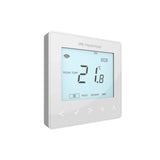
Turn the cold room's thermostat a few degrees above the room temperature and check that it shows it is calling for heat. Most programmable thermostats show a flame or heating symbol when they call.
- No symbol: check the program, the hold or holiday mode, and that the thermostat is not in frost protection.
- Floor sensing or floor limit: a thermostat with a floor probe will stop calling once the floor reaches its limit, even if the air is cool. Check which sensor mode it is set to.
- Wireless thermostat: check the batteries and that it is still paired with its receiver or wiring centre.
Step 2: Is the wiring centre switching that zone?
With the thermostat calling, the matching zone on the wiring centre should show it is on. If the zone stays off, the signal is not getting from the thermostat to the wiring centre.
On a Heatmiser UH8, each zone has its own output for an actuator, and each output follows the thermostat wired to that zone. A common fault on a new install is a thermostat wired to the wrong zone, so a different room's actuator opens. Turn each thermostat up in turn and check the right actuators respond. For wiring centre faults, see UFH actuator, zone valve and wiring centre faults.
Step 3: Has the actuator opened?
Look at the actuator on top of the cold loop's return valve. Most have an indicator that changes when the valve opens. Thermal actuators are slow, so give it several minutes after the zone switches on.
- Normally closed actuators keep the loop shut until they have power and have warmed up.
- First-open setting: on one maker's normally closed actuators, a new actuator is held open from the factory. The first-open function releases automatically once it has had power for more than 6 minutes. A loop that flowed when it was filled and then stopped may simply have had its actuator released.
- Swap test: swap the cold loop's actuator with one from a working loop. If the fault moves with the actuator, replace the actuator.
- Stuck valve pin: if a known good actuator still does not open the loop, the valve pin under it may be stuck. Unscrew the actuator and check the pin moves freely.
A replacement 2-wire 230V thermal actuator is a quick fix. Check it matches your wiring centre voltage before you order.
Step 4: Does the flow meter show flow?
With the actuator open and the pump running, the flow meter on the cold loop should show flow. Compare it with the meters on the warm loops.
| Flow meter reading | Meaning | Next step |
|---|---|---|
| Zero, actuator open | Meter shut, air lock or blockage | Reopen the meter, then Step 5 |
| Flickering or jumping | Air in the loop | Step 5 |
| Much lower than its design figure | Other loops taking the flow | Step 6 |
| At its design figure | Flow is fine | Step 7, then Step 8 |
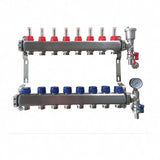
Check nobody has turned the meter shut. On one maker's meters, turning clockwise closes the circuit. If the pipe after the meter is warm but the marker reads zero, the meter is stuck, not the loop. A replacement manifold flow meter is sold on its own.
Step 5: Is there air in the loop?
Air is the most likely cause when a loop gurgles, the flow meter flickers, or the loop is warm only near the manifold. The manifold air vent cannot reach air trapped out in the floor.
Purge the loop on its own. One manifold maker's instructions say to fill and bleed one circuit at a time with every other circuit closed. Push water in through the flow bar and out of a hose on the return bar until no bubbles come out and the flow meter sits steady. Our guide to bleeding air from underfloor heating covers the full method, then top the system back up to its working pressure.
Step 6: Is the loop getting its share of flow?
A cold loop on an unbalanced manifold often belongs to the longest loop. Water takes the easiest path, so short loops take more than they need and long ones are starved. One manifold maker puts it plainly: without balancing, the short circuits get over-supplied and those rooms overheat.
- Open the cold loop's flow meter fully.
- Turn the shorter loops down towards their own design flow.
- Check the cold loop again after an hour or two.
- If the pump is on its lowest setting, try the next one up.
If a loop is far less favoured than the others, one maker suggests splitting it across two or more circuits rather than closing the others hard down. For setting each loop, see how to balance underfloor heating loops.
Step 7: Is the loop connected the right way round?
If a loop has flow but stays cool, check that its flow and return are on the correct bars and on the ports its actuator controls. A loop with its ends crossed between two ports, or a room wired to the wrong actuator, can look like a cold room.
Feel the two pipes at the port. With the loop running, the pipe from the flow bar should be warmer than the pipe going back to the return bar. Our guide to flow and return reversed at the manifold explains how to spot and fix a swap. A damaged or kinked pipe, or a loss of pressure, points to a leak in the loop: see repairing damaged underfloor heating pipe.
Step 8: Is the room losing more heat than the floor can give?
If the loop is flowing, the pipes at the manifold are warm and the room is still cool, the system may be working as designed but not giving enough heat for that room. This shows up most in cold weather.
- Floor covering: a thick carpet and underlay, or a rug over most of the floor, holds the heat back. See UFH under tiles, LVT, wood and carpet.
- Big glazing: rooms with bifolds or roof lights can need more heat than the floor gives at the design temperature.
- Furniture and fixed units: if much of the floor is covered, the loop has less area to release heat.
- Flow temperature: if every other room is slightly cool too, the flow temperature may be set too low.
The BS EN 1264 floor surface limit of 29°C in occupied areas caps how much heat any floor can give, whatever the water temperature. If a room needs more than that, it needs less heat loss or another heat source.
Free design tool: Planning new loops or a rebuild? Design your UFH system yourself in 3 minutes with MaxHeatUFH ProLoop and get an instant quick design and quote. Start your design
Products for this job
- 2-Wire Thermal Actuator 230V
- Manifold Flow Meter
- Hydraulic Pressure Test Pump, to check a loop for leaks
Frequently asked questions
Why is one room with underfloor heating cold?
Usually its thermostat is not calling, its actuator has not opened, the loop has air in it, or other loops are taking its flow. Work from the thermostat to the manifold in that order.
Why is one underfloor heating loop not getting hot?
Check that loop's actuator, flow meter and air first. If those are fine, the loop may need more flow at the expense of shorter loops, or its connections may be on the wrong ports.
How do I test a UFH actuator?
Swap it with one from a loop that works. If the fault follows the actuator, it has failed. If not, check the valve pin under it and the wiring centre zone.
Why is my underfloor heating warm by the manifold but cold in the room?
The flow is too low to carry heat to the end of the loop, or air is blocking it. Purge the loop, then check its flow meter against its design setting.
Can a thermostat cause one cold room?
Yes. A thermostat on the wrong program, in frost mode, with flat batteries or wired to the wrong zone will leave its room cold while the rest of the house heats.
How long should I wait for a cold loop to warm up?
Give the actuator several minutes to open, then hours for the floor. A screed floor can take many hours to warm, so judge it the next day after any change.
Sources: Heatmiser UH8 wiring centre manual
Products in this guide
Watch how each part works and how to fit it, and download its data sheet and install manual.


Every data sheet and manual: Product Library · All videos: MaxHeatUFH on YouTube

Design it in MaxHeatUFH ProLoop
Add your rooms, choose screed, overlay, joisted or electric, and get a free quick design and full kit list with prices.


