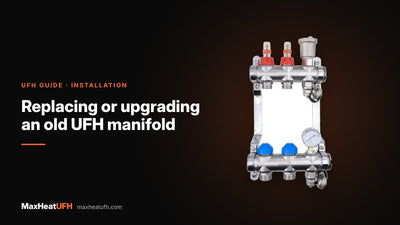
Underfloor heating flow direction: what if the manifold flow and return are reversed?
Which way water should flow through a UFH manifold, how to tell the flow bar from the return bar, the symptoms of reversed flow and return, how to test for it and how to fix it.
Short answer: Water should come in from the heat source through the flow bar, which on most manifolds carries the flow meters, go round each loop, and leave through the return bar, where the valves and actuators sit. If the primaries are swapped, the floor often still heats, but the flow meters usually read zero or wrongly, valves can knock or hammer as they close, and you cannot balance the loops properly. Confirm it with a cold-start temperature test, then re-pipe the primary connections so the flow goes into the flow side.
Reversed flow is one of the most common faults found on inherited or DIY underfloor heating systems. It usually comes to light when someone tries to balance the loops and finds the flow meters stuck at zero, or hears a knock in the pipes when a zone shuts off. Because the house still gets warm, it can go unnoticed for years.
This guide explains which way water should flow through a UFH manifold, how to tell the bars apart, what reversed flow does, how to check for it and how to put it right. If your problem is a loop that will not heat at all, start with underfloor heating not getting warm.
Which way should water flow through a UFH manifold?
From the heat source into the flow bar, out through each loop, back into the return bar and back to the heat source. Manufacturer manifold fact sheets describe it the same way: warm water is distributed from the flow bar to each loop through the flow gauges, then returns through the return valves into the return bar.
- Heat source flow arrives at the red ball valve.
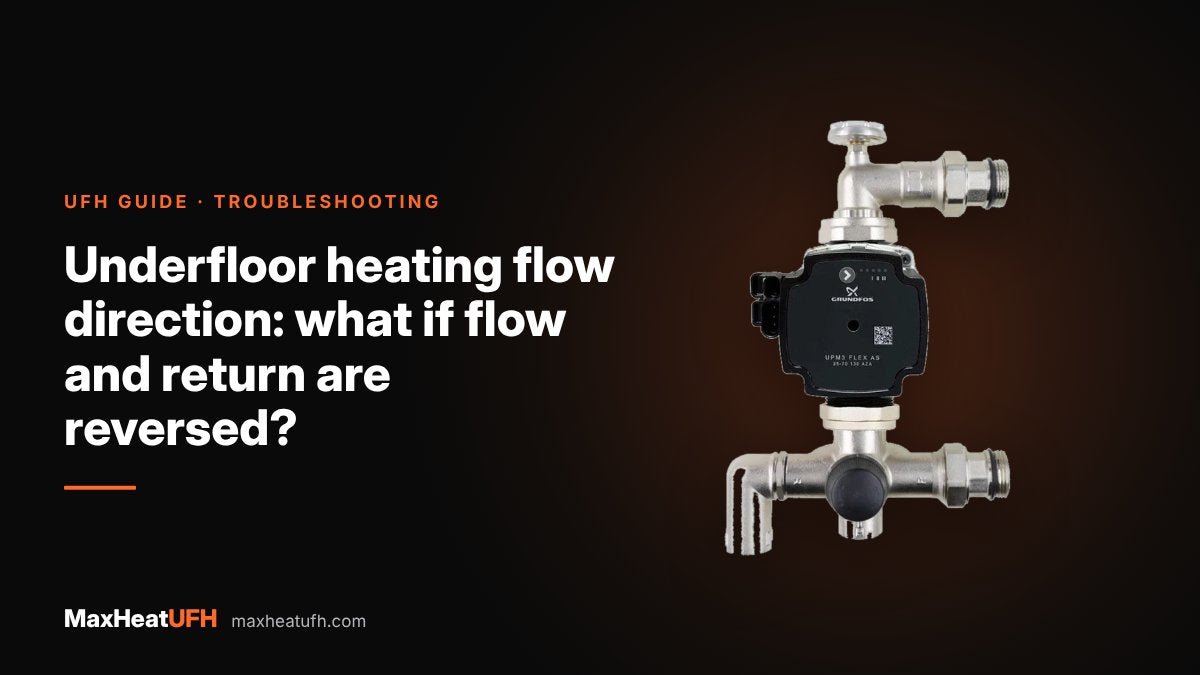
- The pump pack, if fitted, blends and pumps the water into the flow bar.
- The flow bar feeds each loop through its flow meter.
- Each loop runs through the floor and comes back to the manifold.
- The return bar collects the water through each loop's valve.
- Return leaves through the blue ball valve, back to the heat source.
Valves and meters on the manifold are made for flow in one direction. One manufacturer's manifold instructions say to fill and flush only in the direction of flow.
How do I tell the flow bar from the return bar?
Look at what is fitted to each bar, not just which is on top. Makers mount the bars both ways round.
| Clue | Flow bar | Return bar |
|---|---|---|
| Flow meters | Usually here | Not usually |
| Valve inserts and actuators | Not usually | Usually here |
| Ball valve handle | Red | Blue |
| Temperature with heating running | Warmer | Cooler |
Position varies. One manufacturer's instructions put the flow bar at the top with a red valve, and the return at the bottom with a blue one. Another manufacturer describes a lower return manifold. Other instructions tell you to rotate the flow bar so the flow gauges are on top. Layouts differ between makers, so always check the diagram for your manifold.
On our 1" ball valve set, the red handle marks the flow and the blue the return. The version with temperature gauges lets you read both at a glance.
What happens if flow and return are reversed?
The heating may still work, but the manifold cannot do its job properly. These are the usual signs:
- Flow meters read zero, bounce or cannot be adjusted. On a Buildhub forum thread about a reversed heat pump manifold, the meters always showed no flow, and an experienced member said reversed flow means the flow meters will not read correctly.
- Knocking or hammering when a loop closes. In the same thread, pressing a zone pin made the meter bounce and sent a knock along the pipe. One valve maker sells special radiator valve bodies for reversed flow, because swapped flow and return causes hammering noises.
- Balancing is guesswork. Without readable flow meters, you cannot set each loop to its design flow, so some rooms heat slowly. See how to balance UFH loops.
- Possible extra wear. Forum members suggest it may shorten actuator life, but this is opinion rather than tested data.
In the Buildhub case, the house still reached 22 to 23°C. Members did not think reversal was hurting efficiency much. The problem is control and diagnosis, not usually comfort.
Is it always a fault if the pipework looks backwards?
No. Some pump packs are meant to look odd. Check the pack's own diagram before you start cutting pipe.
On a DIYnot thread, a homeowner found the boiler feed entering what looked like the return rail, passing through the pump and only then reaching the supply rail. An experienced member explained that this is how some packs give hydraulic separation. The pump circulates water round the floor loops, and hot boiler water is let in through the thermostatic valve when needed. The real fault in that thread pointed to the pump not running, not to the layout.
So before re-piping, confirm two things: the pump pack's inlet and outlet are labelled the way you think, and the water through the loops goes from the flow meters to the valves. Our guide to mixing and blending valves shows how the common packs connect.
How do I check which way the water is flowing?
Do a cold-start test. Let the system cool fully, then turn the heating on and see which primary pipe warms first. The pipe that warms first is the flow.
- Let it go cold. Turn the heating off for several hours so all pipes are at room temperature.
- Call for heat. Turn up one thermostat so its zone opens and the heat source fires.
- Feel or measure. Use your hand, a clip-on thermometer or an infrared thermometer on both primary pipes near the ball valves.
- Follow the heat. The warm pipe should feed the flow bar, the one with the flow meters on most manifolds.
- Check the loops. With heat on, the loop tail on the flow bar should be warmer than its other end on the return bar.
A Buildhub member suggested exactly this test, and it confirmed the reversal in that case. Also look for the arrow cast on the pump body and any arrows on the blending valve, and check they point the way the water should go.
How do I fix reversed flow at the manifold?
Swap the primary connections so the heat source flow goes into the flow side. Do not try to fix it by moving actuators or flow meters between bars.
- Turn off the heat source and the UFH wiring centre.
- Isolate the manifold at its ball valves. If there are none, drain the primaries and fit a set while you are there.
- Re-pipe the primaries at the manifold or pump pack so the heat source flow goes to the flow inlet. Often the neatest fix is to cross the two pipes just before the ball valves.
- Refill and vent. Fill and flush in the direction of flow, then bleed the air. See bleeding air from UFH loops.
- Pressure test the new joints. See pressure testing UFH.
- Rebalance. With the meters now reading, set each loop to its design flow.
Any work on gas boiler pipework must be done by a Gas Safe registered engineer. On a heat pump system, ask the installer, since the heat pump's own flow and return connections and any buffer or volumiser need to stay correct too.
Does it matter which end of a loop goes on the flow bar?
For the manifold, no. Each loop works either way round, as long as water goes from the flow bar into the loop and back to the return bar. For the room, it can.
The end connected to the flow bar gets the warmest water. If a loop was laid so one end starts at a cold outside wall or glazing, connect that end to the flow bar so the hottest water reaches the coldest part of the room first. Label every loop tail as you lay it so you know which end is which. This is far easier than tracing it later.
Design your UFH system yourself in 3 minutes with MaxHeatUFH ProLoop and get an instant quick design and quote. Start your design
Products for this job
- Manifold Ball Valve Set 1", red flow and blue return, with gauge options
- Manifold Flow Meter, to replace a broken meter
- Pressure / Temperature Gauge for UFH Mixing Unit
- UFH Manifold 90° Elbow Connector Set 1"
- 2-Wire Thermal Actuator 230V
- Hydraulic Pressure Test Pump
- All manifolds and components
Frequently asked questions
Will underfloor heating work if the flow and return are the wrong way round?
Often, yes. The floor may still get warm. But the flow meters will not read properly, valves may knock and you cannot balance the loops, so it is worth correcting.
Why do my UFH flow meters always read zero?
Reversed flow is one cause. Others are a stuck or dirty sight glass, a meter wound shut, a stuck valve pin or a pump that is not running. Do a cold-start test to rule reversal in or out.
Which bar has the flow meters?
On most manifolds, the flow bar. The return bar usually carries the valves that actuators fit onto. Check your maker's diagram, because layouts differ.
Is the top bar always the flow?
No. Some makers fit the flow bar on top and others below. Go by the fittings on each bar and the red and blue valves, not by position.
Can reversed flow damage the boiler or heat pump?
The forum cases suggest it does not affect the heat source much. The main problems are noise, inaccurate meters and poor balancing at the manifold.
Can I swap the actuators to the other bar instead?
No. The valve inserts are part of the bar, and the manifold is designed for water to pass the flow meters first and the valves second. Fix the primary pipework instead.
What causes knocking when a UFH zone shuts off?
Reversed flow through the valves is one known cause of hammering. Air in the loops can also make noise, so check the flow direction and bleed the system.
Sources: Buildhub: UFH flow direction incorrect, DIYnot: UFH system wrong flow direction, and valve manufacturer data on reversed flow direction
Products in this guide
Watch how each part works and how to fit it, and download its data sheet and install manual.




Every data sheet and manual: Product Library · All videos: MaxHeatUFH on YouTube
Design it in MaxHeatUFH ProLoop
Add your rooms, choose screed, overlay, joisted or electric, and get a free quick design and full kit list with prices.